
James Wilson writes about making an open source high frequency oscilloscope probe:
Students, hobbyists, and professionals today enjoy unprecedented access to powerful and affordable test equipment for understanding and building electronic projects. But as enthusiast projects have become more advanced and ambitious, it is still possible to hit the limits of entry-level equipment. I have been excited about open source hardware as an avenue to advance the performance and accessibility of test equipment, in much the same way the early open source software focused on development tools as a foundation for greater access to computing. This article is about my experiences building an open hardware single-ended active probe.
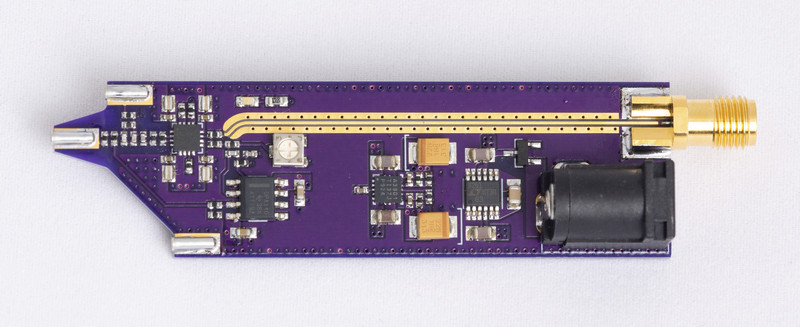
Active probes shine with high-frequency circuits or ones that require low loading, because their input capacitance is smaller by an order of magnitude. The operating principle behind an active probe is to use a buffer amplifier that has high input impedance and reproduces the signal at lower output impedance.
A project is now underway to build an open source oscilloscope using this chip in the front end, and I’ve been experimenting with a complementary effort to build a single-ended active probe, with the following design goals:
- DC–2 GHz analog bandwidth, 10:1 attenuation
- Input impedance of 1 MΩ // 1 pF, 50 Ω output impedance
- Rated performance achievable on OSH Park FR-408HR four-layer stackup
- Minimum component size of 0402 and no BGA parts
- Open source design and repairable
 OSH Park