There’s a gritty feel to the Hackerboat project. It doesn’t have slick and polished marketing, people lined up with bags of money to get in on the ground floor, or a flashy name (which I’ll get to in a bit). What it does have is a dedicated team of hackers who are building prototypes to solve…
Uncategorized
se7eduino: ARM Cortex M7 dev board
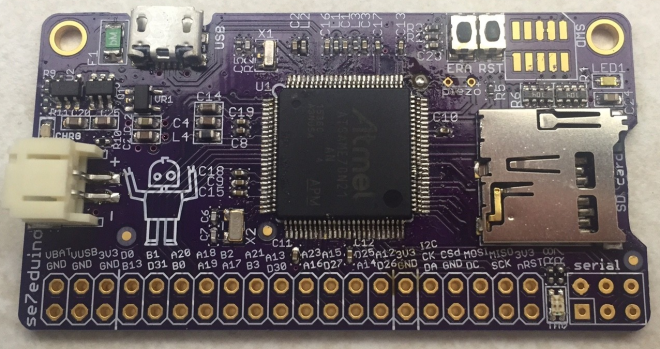
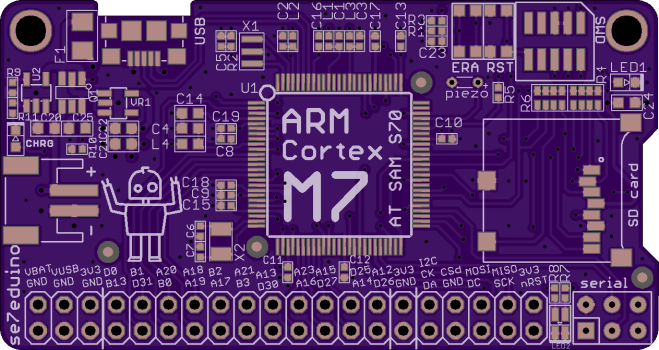
jeff on hackaday.io has designed a board for an Atmel microcontroller with the ARM Cortext M7 core:
se7eduino
Small Atmel SAM S70 based dev board. Similar to the Arduino Due, except super-mega-turbocharge
The board features:
- 300 MHz ARM Cortex-M7
- 2MB flash
- 384k RAM
- 480 Mbps high-speed USB
- MicroSD card
- Battery Charger
jaw has shared the project on GitHub:
se7eduino/2015-05
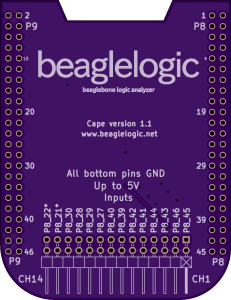
BeagleLogic turns BeagleBone into Logic Anaylzer
mobilewill was looking for a logic analyzer and found this BeagleBone-based solutions:
Quest for a Logic Analzyer
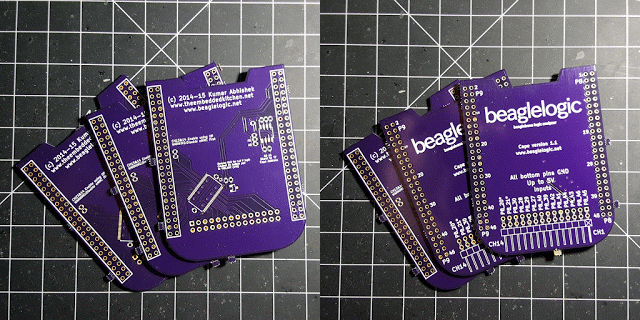
The BeagleLogic is a logic analyzer based on the Beaglebone created by Kumar Abhishek, a semi-finalist of the Hackaday Prize Best Product 2015.
The BeagleLogic features:
- 100MSPS
- 14 Channels
- Web Interface
What makes the BeagleLogic special is it uses the BeagleBone PRUs which are basically 200Mhz microcontrollers attached to the ARM CPU with shared memory. This is one thing that sets the BeagleBone apart from other SBCs.
The cape is shared on OSH Park:
Tiny Tiny RGB LED Displays — Hackaday
Hackaday.io contributor extraordinaire [al1] has been playing around with small LEDs a lot lately, which inevitably leads to playing around with large groups of small LEDs. Matrixes of tiny RGB LEDs, to be precise. Where’s the LED?First, he took 128 0404 SMD RGB LEDs (yes, 40 thousandths of an inch on each side) and crammed them…
Quickie USB Keyboard Device — Hackaday
There are a ton of applications that we use that can benefit from keyboard shortcuts, and we use ’em religiously. Indeed, there are some tasks that we do so often that they warrant their own physical button. And the only thing cooler than custom keyboards are custom keyboards that you’ve made yourself. Which brings us…
LED Strip Raspberry Pi Adapter
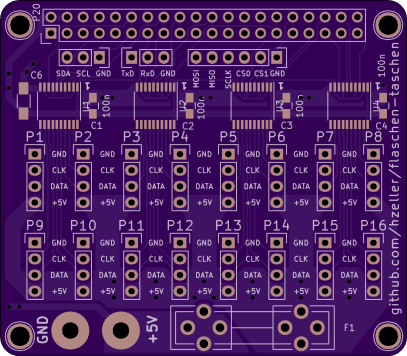
Henner Zeller created the Spixels project to control 16 LED strips at once from a Raspberry Pi:
Spixels
The Spixels library and PCB to control SPI-type LED strips was originally developed for the Noisebridge Flaschen-Taschen project, but broken out as separate project because it is independently useful for many other LED strip applications.
hzeller shared the board on OSH Park:
Spixels – 16 SPI LED Strip Raspberry Pi Adapter
1575 Bottle of Beer on the (LED) Wall — Hackaday
Say hello to my little friend, lovingly named Flaschen Taschen by the members of Noisebridge in San Francisco. It is a testament to their determination to drink Corona beer get more members involved in building big displays each year for the Bay Area Maker Faire. I pulled aside a couple of the builders for an interview…
FR4 Machine Shield Is A CNC Milling Machine From FR4 PCB — Hackaday
The people behind the PocketNC heard you like CNC PCB mills, so they milled you a PCB mill out of PCB. They announced their surprising new open source hardware product, a pocket sized 3-axis CNC machine entirely made out of FR4 PCB material, aptly named “FR4 Machine Shield”, at this year’s Bay Area Maker Faire. We know the concept…
via FR4 Machine Shield Is A CNC Milling Machine From FR4 PCB — Hackaday
It’s Time to Finally Figure Out How to Use KiCAD — Hackaday
https://youtube.com/watch?v=videoseries%3Flist%3DPLy2022BX6Eso532xqrUxDT1u2p4VVsg-q%26hl%3Den_US
KiCAD has been making leaps and bounds recently, especially since CERN is using it almost exclusively. However, while many things are the same, just enough of them are different from our regular CAD packages that it’s hard to get started in the new suite. [Chris Gammell] runs Contextual Electronics, an online apprenticeship program which goes from…
via It’s Time to Finally Figure Out How to Use KiCAD — Hackaday
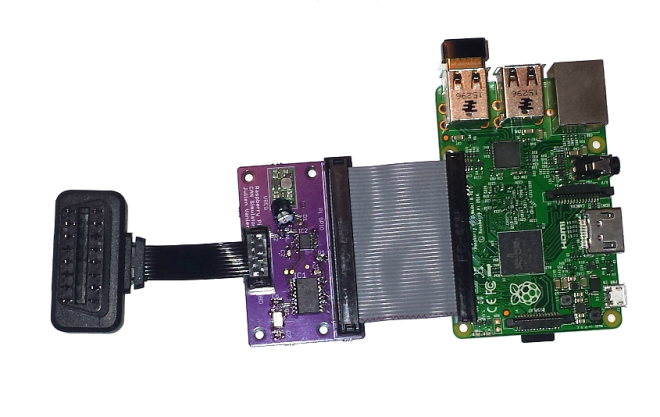
CAN bus simulator on the Rasperry Pi
CAN Simulator
used to transmit and receive messages simulating OBD-II communications and regular vehicle messages
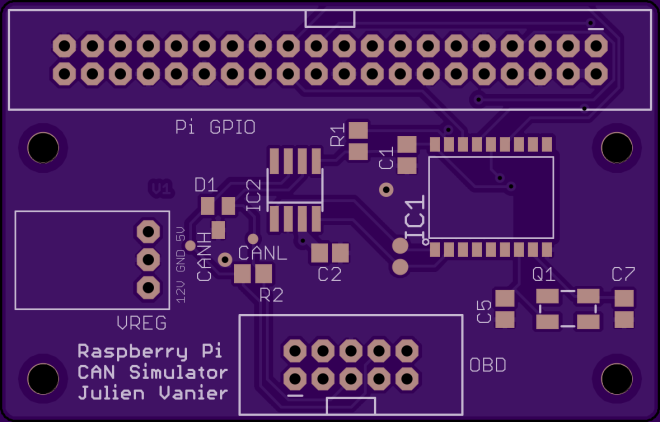
The simulator consists of:
- MCP2515 standalone CAN controller connects to Raspberry Pi over the SPI bus
- TJA1049 CAN transceiver translate logic levels for high speed CAN
- 5V to 12V step up regulator to provide 12V on ODB connector
- Off-the-shelf OBD cable and connector
- Simulator program on the Raspberry Pi
jvanier shared the board on OSH Park:
CAN-Simulator v1