Hackaday Podcast: Igloos, Lidar, And The Blinking LED Of RF Hacking

It’s cold outside! So grab a copy of the Hackaday Podcast, and catch up on what you missed this week.

Highlights include a dip into audio processing with sox and FFMPEG, scripting for Gmail, weaving your own carbon fiber tubes, staring into the sharpest color CRT ever, and unlocking the secrets of cheap 433 MHz devices. Plus Elliot talks about his follies in building an igloo while Mike marvels at what’s coming out of passive RFID sensor research.

And what’s that strange noise at the end of the podcast?

via Hackaday Podcast Ep3 – Igloos, Lidar, And The Blinking LED Of RF Hacking — Hackaday


Quote

The SNES Box Go: Perhaps A First for Console Modding

The SNES Box Go is a relatively simple portable Super Nintendo mod, much like the N64 portables I’ve done in the past. The one key difference here is that this is my first time I’ve used a Flashcart in the build to load the games from ROMs instead of the actual cartridge. I’ve had a little experience with Flashcartswhere I updated an old system of mine with an Everdrive 64 at the end of last year.

via The SNES Box Go: Perhaps A First for Console Modding — Downing’s Basement

Quote

Hackaday Podcast: Curious Gadgets And The FPGA Brain Trust

In this week’s podcast, editors Elliot Williams and Mike Szczys look back on favorite hacks and articles from the week. Highlights include a deep dive in barn-door telescope trackers, listening in on mains power, the backstory of a supercomputer inventor, and crazy test practices with new jet engine designs. We discuss some of our favorite circuit sculptures, and look at a new textile-based computer and an old server-based one.

This week, a round table of who’s-who in the Open Source FPGA movement discusses what’s next in 2019. David Shah, Clifford Wolf, Piotr Esden-Tempski, and Tim Ansell spoke with Elliot at 35C3.

via Hackaday Podcast Ep2 – Curious Gadgets And The FPGA Brain Trust — Hackaday

Quote

Essential Equipment For Your Soldering Workbench

From  on the Tindie blog:

04-wordspace.jpeg

Essential Equipment For Your Soldering Workbench

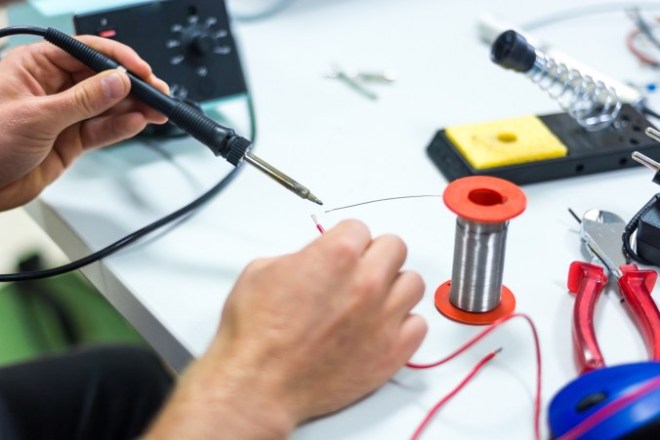
Soldering is the perfect hobby for anyone who wants to make their own electrical equipment – you’ll learn how it operates, teach yourself to diagnose faults and even save money on buying completed products!

This is the core skill in assembling your own electronics. It requires a slowly-paced, methodical approach which becomes equally relaxing as it is engrossing. You’ll love the feeling of plugging in a device you’ve just put together from intriguing and seemingly magical components – one of the great little pleasures of soldering, especially when it works first time!

Even the most long-standing electrician was once in a position of not knowing what was required or involved in soldering, so don’t fret if it’s new to you. We’re going to look at what’s needed to get started in soldering and what each item does, so you’ll know exactly what to put on your soldering workbench and get started in making exciting electrical gadgets!

Essential Equipment For Your Soldering Workbench

Open Source Hardware User Group (OSHUG) in London on January 17th

The Open Source Hardware User Group (OSHUG) is meeting tomorrow, Thursday, January 17th, in London, UK:

oshug

OSHUG Event #71 — Machines and systems of past, present, future

To start off the year, we have a series of talks around the theme of
Acorn computers, RISC OS, RISC-V toolchain.

  • Brief history of Unix-like operating systems on Acorn hardware
  • RISC OS : What’s Next
  • Embedded FreeBSD on a five-core RISC-V processor using LLVM
  • Using Buildroot to create embedded Linux systems for 64-bit RISC-V
Open Source Hardware User Group (OSHUG) in London on January 17th

Hardware Happy Hour (3H) Chicago on January 15th

Screenshot from 2019-01-14 19-26-21.png

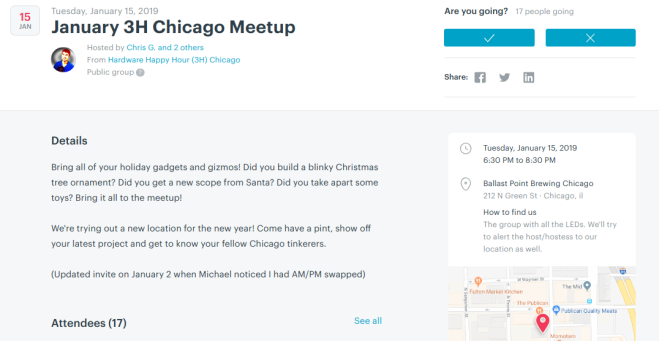
The next Hardware Happy Hour (3H) Chicago is tomorrow, Tuesday, January 15th:

https://www.meetup.com/Hardware-Happy-Hour-3H-Chicago/events/257467548/

Bring all of your holiday gadgets and gizmos! Did you build a blinky Christmas tree ornament? Did you get a new scope from Santa? Did you take apart some toys? Bring it all to the meetup!

We’re trying out a new location for the new year! Come have a pint, show off your latest project and get to know your fellow Chicago tinkerers.

Hardware Happy Hour (3H) Chicago on January 15th

Giant Board packs Linux into the size of an Adafruit Feather

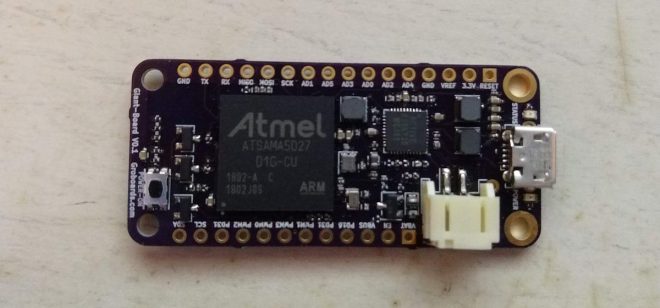
@groguard designed the Giant Board which runs Linux in the form factor of the Adafruit Feather:

board-e1543421093991

The Giant Board is a super tiny single-board computer based on the Adafruit Feather form factor. We always want more power in a smaller package and the Giant Board delivers!

There are always those couple of projects that just need a little more power, or a different software stack. With the release of the ATSAMA5D27C-D1G, its made linux possible in such a small form factor. Listed below are the specs and current pinout of the board.

Follow @groguard on Twitter to learn more about the project:


https://twitter.com/groguard/status/1066788245659279360


https://twitter.com/groguard/status/1067494549168287747


https://twitter.com/groguard/status/1069231574191751168

Giant Board packs Linux into the size of an Adafruit Feather