The US is primed and ready for open source hardware to accelerate scientific breakthroughs, but open source hardware needs a cemented place on the intellectual property landscape within the sciences enabling a faster, more efficient acceleration. If we can cement science using open source hardware, we’ve got a path to expanding American manufacturing. Many businesses profit from open source hardware, demonstrating that it is a lucrative business model. The field of science needs equipment for all sorts of experiments and lab work. Let’s apply the groundwork already laid in the United States for open source hardware to be the default for science.
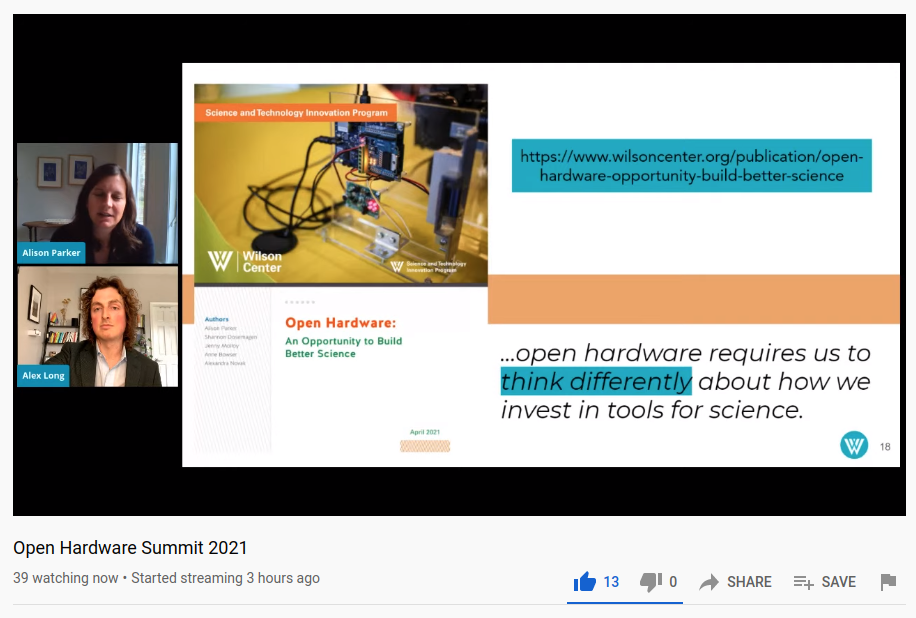
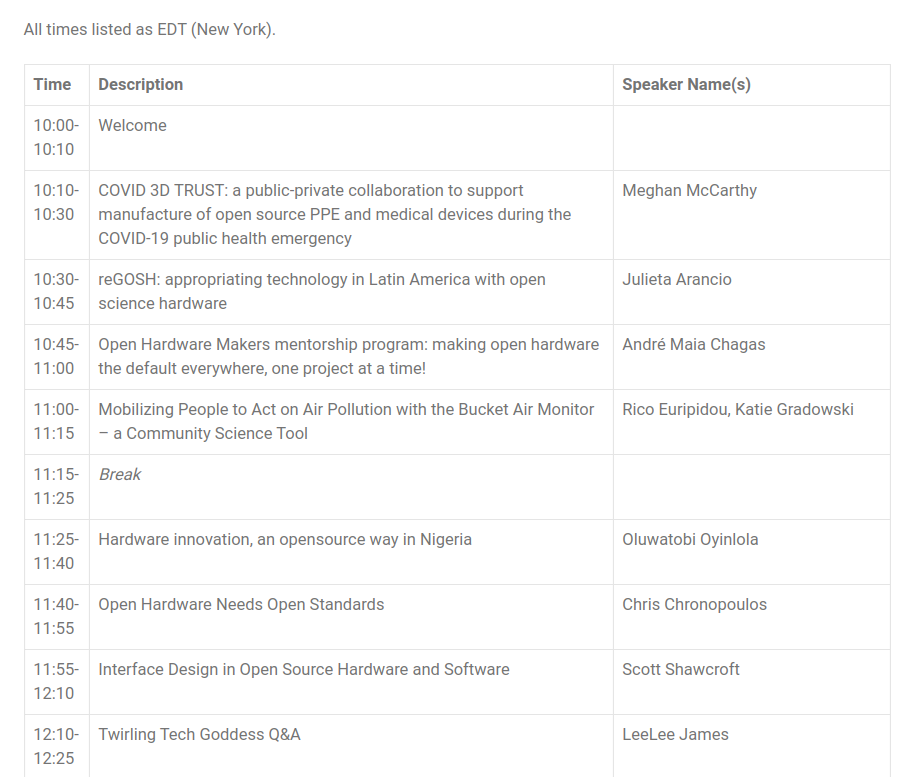
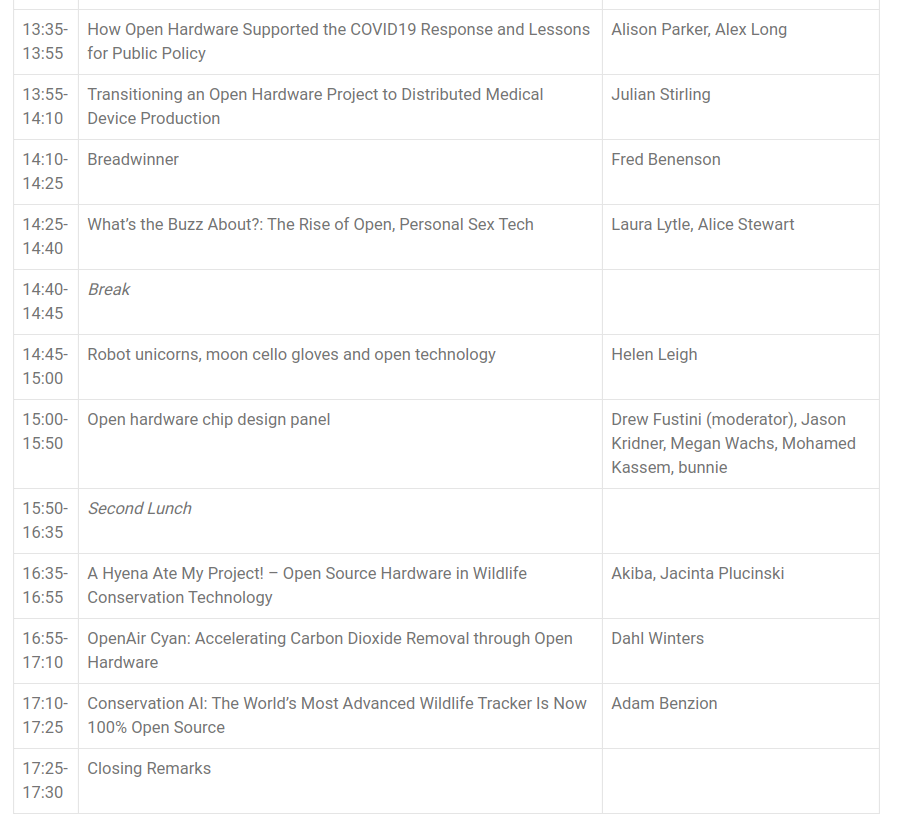
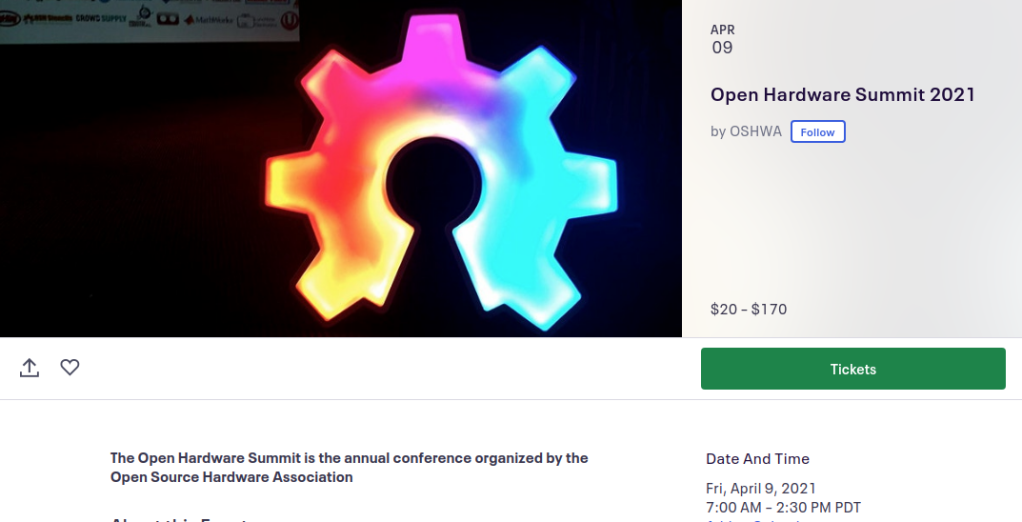
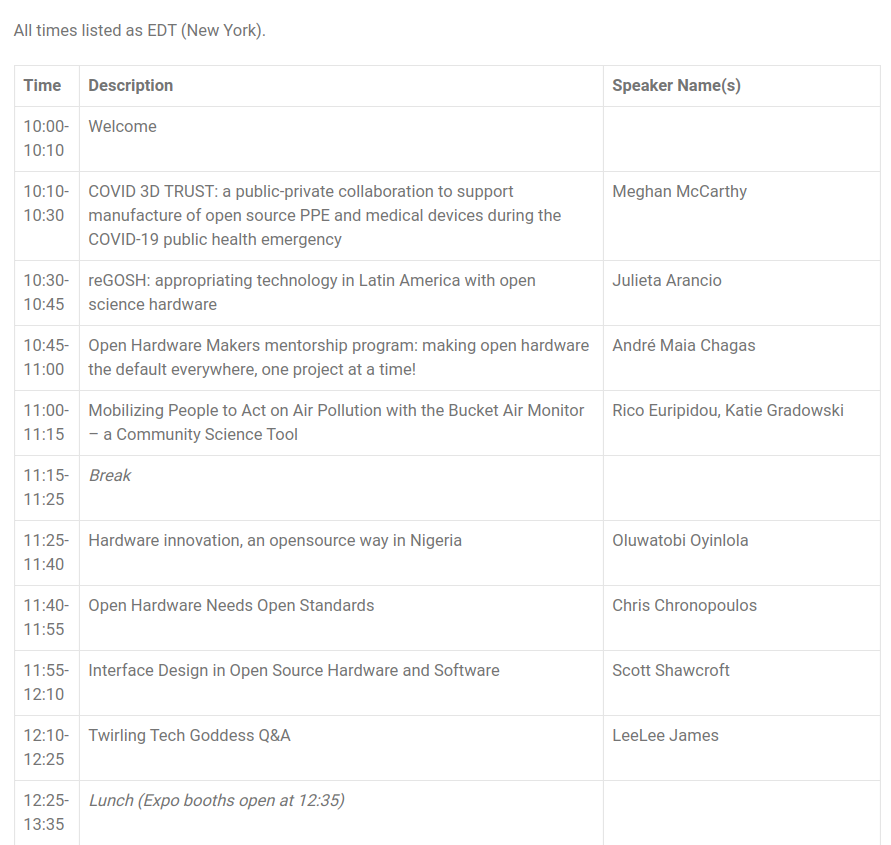
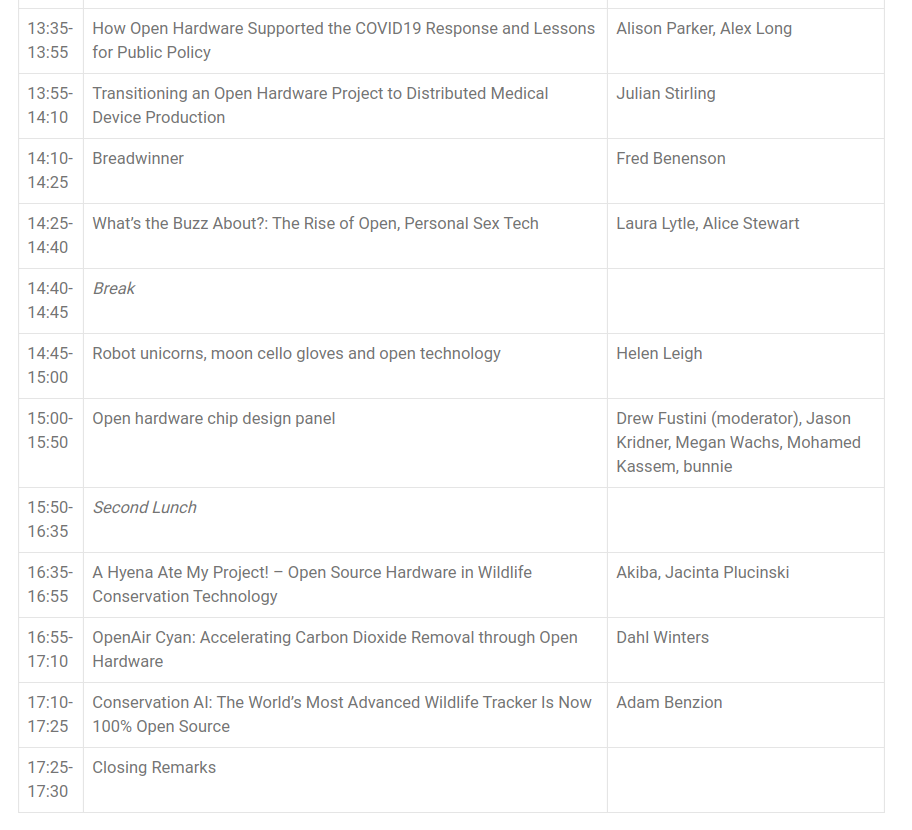
The Open Hardware Summit (OHS) invites talk proposals for the eleventh annual summit! This year’s summit is virtual and will be held online on Friday 2021-04-09, 9:00 AM – 5:30 PM EDT.
The Open Hardware Summit is for presenting, discussing, and learning about open hardware of all kinds. The summit examines open hardware applications, practices, and theory, ranging from environmental sensors to 3D printable medical devices to open hardware processors and beyond. We are interested in open hardware on its own as well as in relation to topics such as software, design, business, law, and education. Past talks have featured topics such as advances in space propulsion, humanitarian projects, right to repair legislation, open hardware in education, and open hardware marketing.
For our eleventh edition we are especially looking for speakers who can offer insights around the role of open hardware in the COVID-19 pandemic, open hardware medical devices, and related topics.
We invite talk proposals from individuals and groups. Submissions are due by Thursday 2021-02-11 at 11 PM EDT.
Today we are excited to announce the launch of a read/write API for our Open Source Hardware Certification program. This API will make it easier to apply for certification directly from where you already document your hardware, as well as empower research, visualizations, and explorations of currently certified hardware.
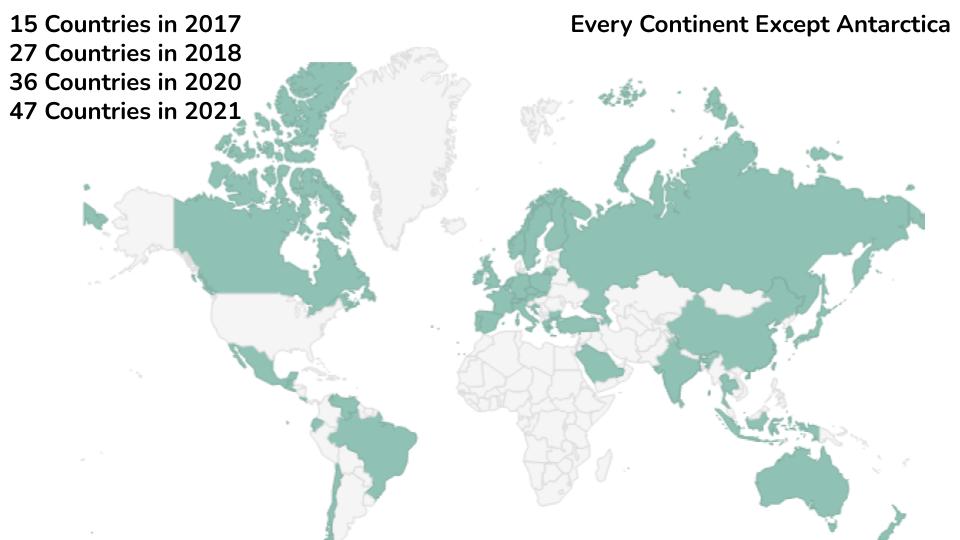
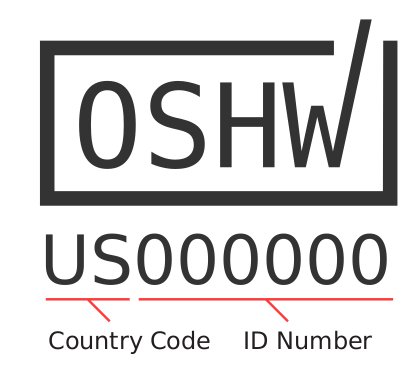
OSHWA’s Open Source Hardware Certification program has long been an easy way for creators and users alike to identify hardware that complies with the community definition of open source hardware. Since its creation in 2016, this free program has certified hardware from over 45 countries on every continent except Antarctica. Whenever you see the certification logo on hardware:
You know that it complies with the definition and that the documentation can be found using its unique identifier (UID).
What’s New?
The new API supports both read and write access to the certification process.
Write access means that you can submit certification applications directly instead of using the application form. If you already have all of the application information in a system, there is no need to retype them into a webform.
We hope that this will make it easier for entities that certify large amounts of hardware to build the certification process directly into their standard workflow. We are also working with popular platforms to integrate a ‘certify’ button directly into their systems.
Read access gives you access to information about hardware that has already been certified. This will make it easier to explore the data for research, create compelling visualizations of certified hardware, and build customized lenses to understand what is happening in open source hardware.
In the longer term, we hope that the community will build better ways to both submit applications for certification and present information about certified hardware. OSHWA expects to maintain our application form and certification list for the foreseeable future. That being said, we are also happy to share (and possibly cede) the stage to better ways to get information into and out of the system as they come along.
For now, let us know what you do with the API! You can tweet to us @OHSummit or send us an email at [email protected].
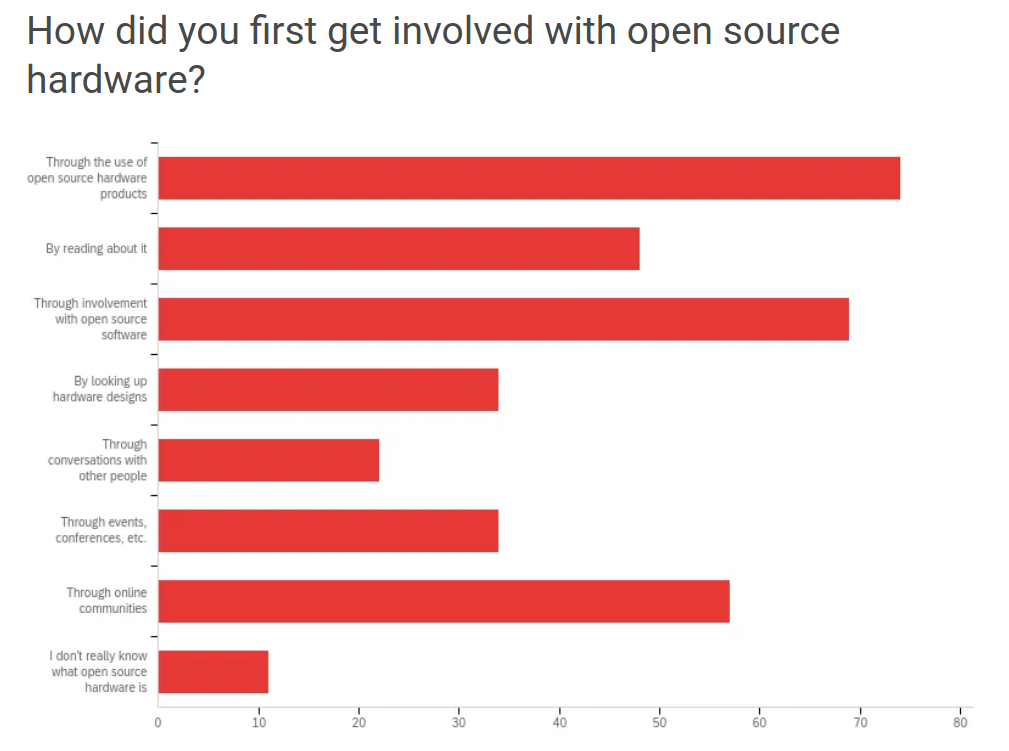
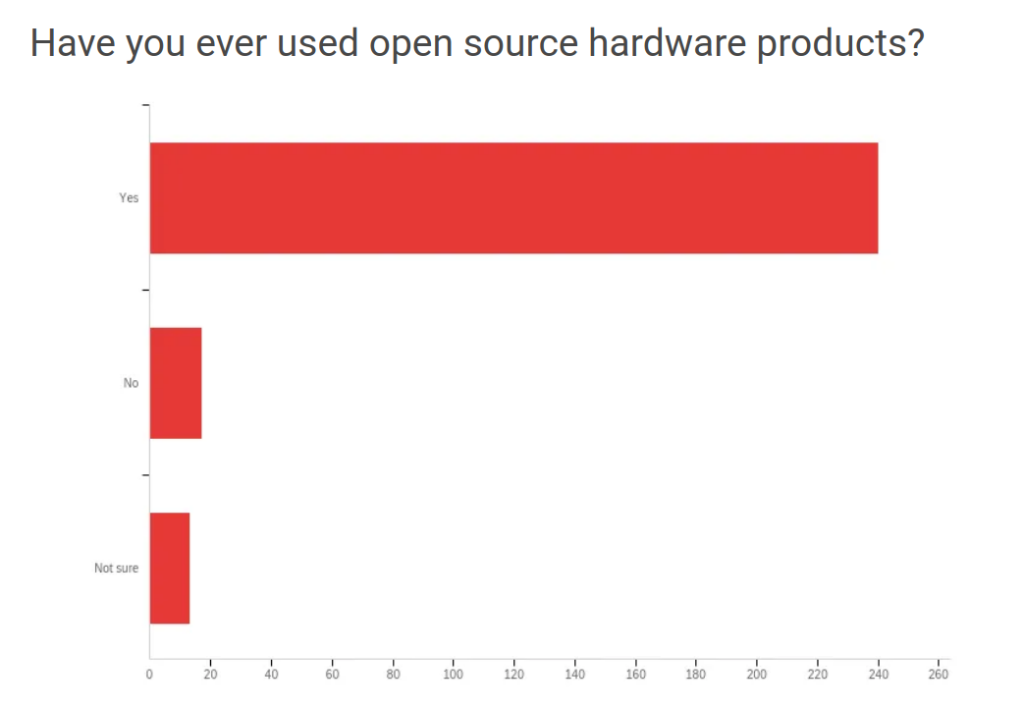
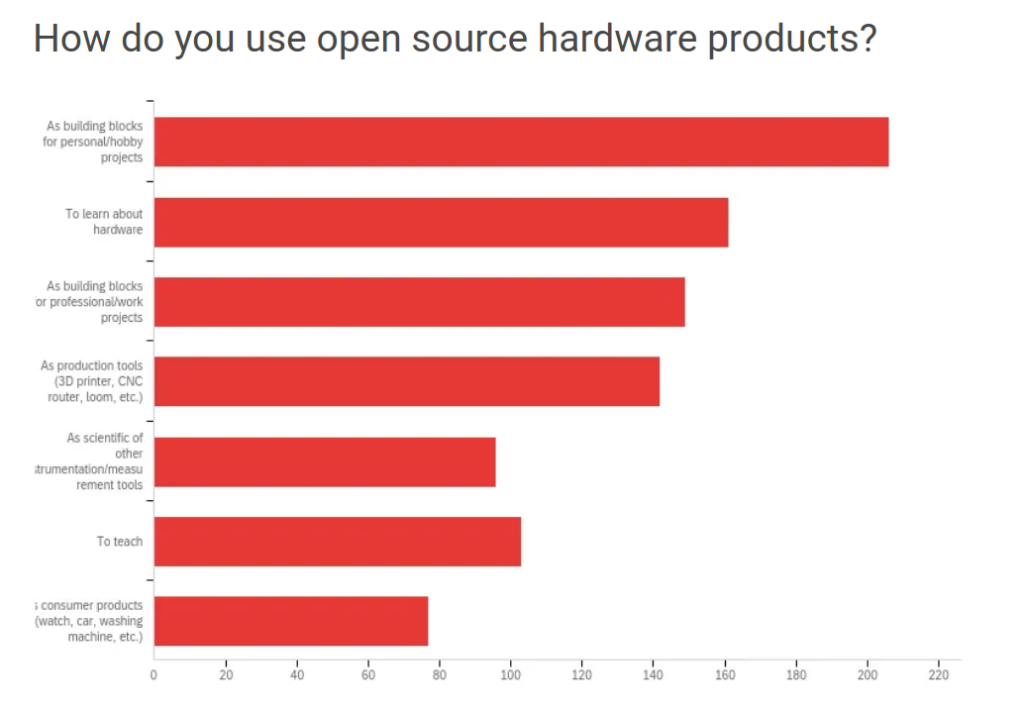
In 2020 we conducted the third OSHW Community Survey (see 2012 and 2013), which collected 441 responses. All questions were optional, so you may notice response counts do not always add up to 441. In particular, a number of individuals didn’t feel comfortable with the demographic questions. We ask these questions as part of our efforts to promote diversity in the community, but these too were optional and anonymous.
A few highlights from this year’s survey compared to the 2013 survey:
The portion of people coming to open source hardware from open source software increased from 14.6% to 23.9%
In 2013, 42.8% of respondents indicated they have worked on or contributed to an open hardware project. This jumped to 85.6% in 2020.
While 2013 showed a plurality of people using blogs to publish design files, this year’s survey shows public repositories as the most popular option. The increase in people with open source software experience and improvement in repository collaboration offerings may be contributing factors.
This year’s survey shows a large increase in attendees for the 2020 Open Hardware Summit. This is likely due to 2020 being the first virtual summit. Although it was moved online due to unfortunate circumstances, the virtual platform offered the upside of greatly expanding the audience.
A small gain in the community’s gender diversity was seen, with those identifying as either female or other making up 18% of respondents, compared to 7% in 2013.
Interested in more granular results for any of these questions? Reach out to us at [email protected].
As part of my role on the @ohsummit board, I’ve been compiling works by Black creators in maker/DIY/open hardware/art whom I admire. If you’ve helped contribute to this list, thank you! Pls add or retweet! And I plan to post more soon. Happy Open Hardware Month! ❤️🔥 pic.twitter.com/83GJzmESfp
I spent a relatively small fraction of my life making @CircuitClassics (a focused few-month burst) and it’s unbelievably gratifying that the project has its own legs, and continues to bring people joy. https://t.co/Fw8NGA6QbG
Got RTSP Working with the OpenMV Cam H7 Plus, our WiFi shield, and the OV5640. Can stream 1920×1080 images over WiFi at 10 FPS to VLC. pic.twitter.com/XOqUejFii1
OSHWA is looking for 5 new faces to join the board of directors for the Open Source Hardware Association.
The nominee form is, as always, for self-nominations only. Please fill out the nominee form (deactivated 11:59PM ET on Oct. 10th) to become a nominee or forward the link to someone you want to nominate. Do not fill out the form for someone else. The purpose of this form is to tell voting members why you want to serve on the OSHWA board. We will be publish the nominees and their answers on Oct 12th. Board members hold a 2-year position. Once board members have been chosen by the community, the board will appoint a President, VP, and Secretary. Board responsibilities include fundraising, advising on goals and direction, and carry out compliance with the organizations purposes and bylaws. See the board member agreement to get a sense of the responsibilities. Board members are expected to adhere to the board attendance policy and come prepared having read the board packet. Board members are expected to spend 5-10 hours of time per month on OSHWA. Nominees can submit questions to [email protected]. Nominations will be open until Oct. 10th.






 OSH Park