Turning The Beaglebone On A Chip Into A 3D Printer Controller

UPDATE: Thomas Sanladerer interviews Elias Bakken about the Revolve board

writes on the Hackaday blog:

Turning The Beaglebone On A Chip Into A 3D Printer Controller

It’s understood that 3D printers and CNC machines need to control motors, but there are a few other niceties that are always good to have. It would be great if the controller board ran Linux, had support for a nice display, and had some sort of networking. The usual way of going about this is either driving a CNC machine from a desktop, or by adding a Raspberry Pi to a 3D printer.
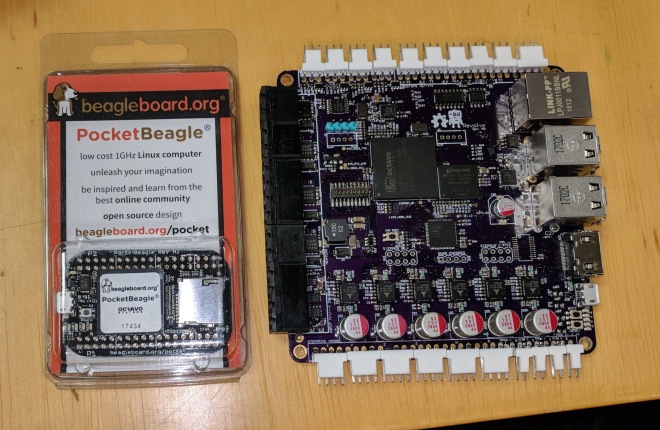
IMG_20180323_172921

The best solution to this problem is to just drive everything from a BeagleBone. This will give you Linux, and with a few motor drivers you can have access to the fancy PRUs in the BeagleBone giving you fast precise control. For the last few years, the Replicape has been the board you need to plug a BeagleBone into a few motors. Now, there’s a better, cheaper solution. At the Midwest RepRap Festival this weekend, [Elias Bakken] has unveiled the Revolve, a single board that combines Octavo Systems’ OSD3358 ‘BeagleBone On A Chip’ with silent TMC2130 motor drivers from Trinamic. It’s an all-in-one 3D printer controller board that runs Linux.


The specs for the Revolve are more or less exactly what you would expect for a BeagleBone with a 3D printer controller. The main chip is the Octavo Systems OSB3358, there are six TMC2130 stepper drivers from Trinamic connected directly to the PRUs, 4 GB of eMMC, 4 USB host ports, 10/100 Ethernet, 1080p HDMI out, and enough headers for all the weird and wonderful 3D printers out there. The software is based on Redeem, a daemon that simply turns G-code into spinning motors and switching MOSFETs.


The price hasn’t been set, but [Elias] expects it to be somewhere north of $100, and a bit south of $150. That’s not bad for a board that effectively does everything from online printer monitoring to real-time motion control. There’s no date for the release of this board, but as with most things involving 3D printer, the best place to check for updates is Google+.

You can also checkout the official product page for more info:
Revolve: Replicape has evolved

Turning The Beaglebone On A Chip Into A 3D Printer Controller

Hardware Happy Hour (3H) Chicago on Wednesday, March 28th

DP7FTAwXcAEkH49.jpg

Hardware Happy Hour (3H) Chicago is Wednesday, March 28th!  Come hang out with our Drew Fustini and many more:

https://www.meetup.com/Hardware-Happy-Hour-3H-Chicago/events/248935521/

Hardware Happy Hour (3H) Chicago on Wednesday, March 28th

Introduce Yourself To a PocketBeagle With BaconBits

From  on the Hackaday blog:

Introduce Yourself To a PocketBeagle With BaconBits

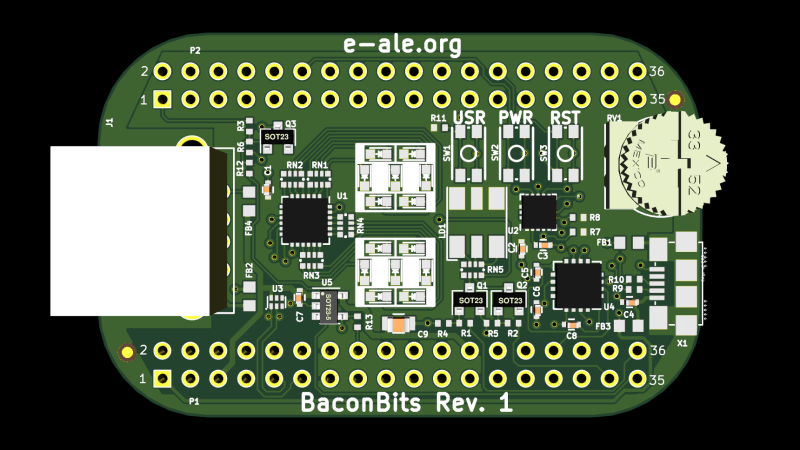
The PocketBeagle single-board computer is now a few months old, and growing fast like its biological namesake. An affordable and available offering in the field of embedded Linux computing, many of us picked one up as an impulse buy. For some, the sheer breadth of possibilities can be paralyzing. (“What do I do first?”) Perhaps a development board can serve as a starting point for training this young puppy? Enter the BaconBits cape.

When paired with a PocketBeagle, everything necessary to start learning embedded computing is on hand. It covers the simple basics of buttons for digital input, potentiometer for analog input, LEDs for visible output. Then grow beyond the basics with an accelerometer for I²C communication and 7-segment displays accessible via SPI. Those digging into system internals will appreciate the USB-to-serial bridge that connects to PocketBeagle’s serial console. This low-level communication will be required if any experimentation manages to (accidentally or deliberately) stop PocketBeagle’s standard USB network communication channels.

BaconBits were introduced in conjunction with the E-ALE (embedded apprentice Linux engineer) training program for use in hands-on modules. The inaugural E-ALE session at SCaLE 16X this past weekend had to deal with some last-minute hiccups, but the course material is informative and we’re confident it’ll be refined into a smooth operation in the near future. While paying for the class will receive built hardware and in-person tutorials to use it, all information – from instructor slides to the BaconBits design – is available on Github. Some of us will choose to learn by reading the slides, others will want their own BaconBits for independent experimentation. And of course E-ALE is not the only way to learn more about PocketBeagle. Whichever way people choose to go, the embedded Linux ecosystem will grow, and we like the sound of that!

Introduce Yourself To a PocketBeagle With BaconBits

Hackaday’s Irish Excursion is on 7 April

Try something a bit out of the ordinary with us on 7 April. Spend a Saturday with Hackaday in Dublin without really knowing what to expect. This is the Unconference format, and we’ve fallen in love with the spontaneity and consistently fascinating talks that come out of it.

We’ve booked a fantastic hall in the Temple Bar district of Dublin, lined up snacks throughout the day and dinner for all who attend, plus there’s an after bar and we’ll buy the first round. All of this is yours if you grab one of the rapidly disappearing free tickets.

via Hackaday’s Irish Excursion is on 7 April

Hackaday’s Irish Excursion is on 7 April

Ada Lovelace Fellowship

30576304890_f4bcf49df9_z

Apply to the Ada Lovelace Fellowship for 2018 Open Hardware Summit:

Ada Lovelace Fellowship

The Ada Lovelace Fellowship was founded in 2013 prior to the annual Open Hardware Summit at MIT by Summit Chair Addie Wagenknecht and OSHWA Director Alicia Gibb as a way to encourage women, LGBTA+ and/or other minorities in open technology and culture to actively participate and foster a more diverse community within open source.

For the sixth year, we are excited to offer up to ten Open Hardware Fellowships to members of the community which includes a $500 travel stipend and entrance to the Open Hardware Summit.

By offering the annual travel and summit conference assistance to community members, the Open Source Hardware Association hopes we as a community can encourage more women, LGBTA+ and/or people of color to participate in open source. We have many strong leaders and speakers in our field and we personally want to continue the trend upward.

This is a crucial time in open source where we have the opportunity to shape the future of the whole field together. We invite you to contact us about sponsoring. We are just on the edge of what is possible, Let’s be the change!


Ada Lovelace Fellowship

DIY 5V-3V Switching Converter in the Space of a TO-220 Package

From  on the Hackaday blog:

DIY 5V-3V Switching Converter in the Space of a TO-220 Package

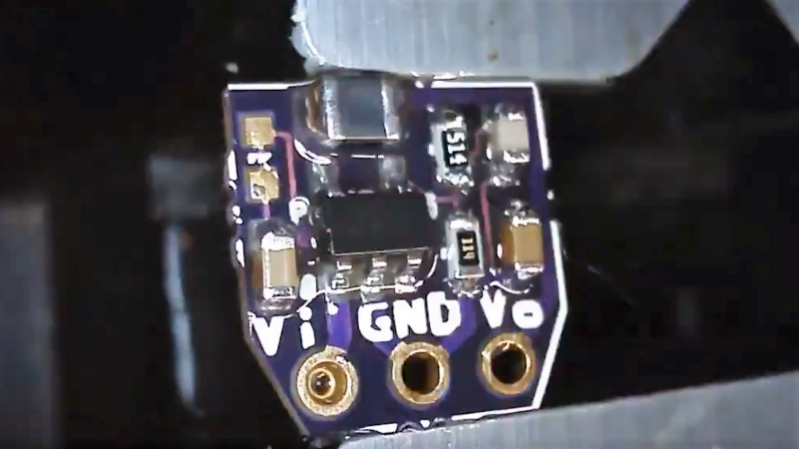
We’re suckers for miniaturization projects. Stuff anything into a small enough package and you’ve probably got our attention. Make that something both tiny and useful, like this 5-volt to 3.3-volt converter in a TO-220 sized package, and that’s something to get excited about. It’s a switch mode power supply that takes the same space as a traditional linear regulator.

Granted, the heavy lifting in [Kevin Hubbard]’s diminutive buck converter is done by a PAM2305 DC-DC step-down converter chip which needs only a few supporting components. But the engineering [Kevin] put into this to squeeze everything onto a scrap of PCB 9-mm on a side is impressive. The largest passive on the board is the inductor in 0805. Everything else is in 0603, so you’ll be putting your SMD soldering skills to the test if you decide to make this. Check the video after the break for a speedrun through the hand soldering process

The total BOM including the open-source PCB only runs a buck or two, and the end result is a supply with steady 750-mA output that can handle a 1-A surge for five seconds. We wonder if a small heatsink tab might not help that; along with some black epoxy potting, it would at least complete the TO-220 look.

[Kevin]’s Black Mesa Labs has a history of turning out interesting projects, from a legit video card for Arduino to a 100-watt hotplate for reflow work that’s the size of a silver dollar. We’re looking forward to whatever’s next — assuming we can see it.

DIY 5V-3V Switching Converter in the Space of a TO-220 Package

Midwest RepRap Fest this weekend

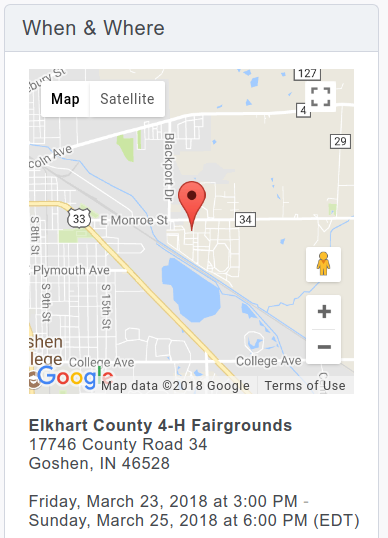
11The world’s biggest open source hardware 3-D printer festival is this weekend in Goshen, Indiana (USA):

2c4ebd1e-fb4a-4343-80f4-f38f9464c57c

2018 Midwest RepRap Festival (MRRF)

Friday, March 23, 2018 at 3:00 PM  Sunday, March 25, 2018 at 6:00 PM (EDT)

What is MRRF?   It’s the worlds largest celebration of open source 3D printing with over 1,000 people from around the globe attending in 2017.   If you are a hobbyists, enthusiast or any level of user of 3D printing then come on out and enjoy the weekend with others.  Not sure what 3D printing is or want to learn more about it?  Perfect!  Come out and see what it’s all about.

Screenshot from 2018-03-22 13-42-07

Hackaday has a great recap of MRRF last year:

The Midwest RepRap Festival Spectacular

31.jpg

Check out the MRRF newsletter for the latest details and follow MRRF on Twitter.  And look for our Drew Fustini this weekend who will, of coruse, be wearing purple and carrying lots of OSH Park coupons to share!

Midwest RepRap Fest this weekend

Expanding the NeoPixel Project — Rebooting Electronics

Playing with some animations of the single LEDs strip of my NeoPixel board was nice but the thoughts soon come to mind: “It would look better if there were more strips”, “…if there were more strips, how could they be coordinated”, to “Could I still use the ATiny1614?”.

via Expanding the NeoPixel Project — Rebooting Electronics

Expanding the NeoPixel Project — Rebooting Electronics

Water Level Sensors, Alexa in a Fish, and Modular Synths During World Create Day

On Saturday we saw a flood of interesting hacks come to life as more than 100 community organized meetups were held for World Create Day. Thank you to all of the organizers who made these events possible, and for everyone who decided to get together and hack. Students Learning Hardware Design in Islamabad, Pakistan The…

via Water Level Sensors, Alexa in a Fish, and Modular Synths During World Create Day — Hackaday

Water Level Sensors, Alexa in a Fish, and Modular Synths During World Create Day