


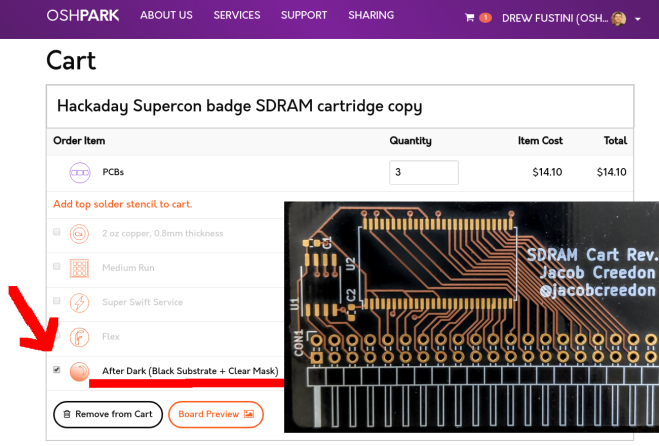
Jacob Creedon designed an a cartridge board that adds 32MB of SDRAM to the Hackaday Supercon badge. Michael Welling just assembled a version of the PCB made with the OSH Park “After Dark” black FR-4 service:
The addition of SDRAM provides enough memory to boot Linux on a RISC-V soft-core in the ECP5 FPGA on the badge. Here’s a screenshot of Linux running:
@pdp7 @jacobcreedon And we are back in business…. https://t.co/uLEhUHvEuw—
Michael Welling (@QwertyEmbedded) December 20, 2019
Read more about “Team Linux on Badge” in this Hackaday post:
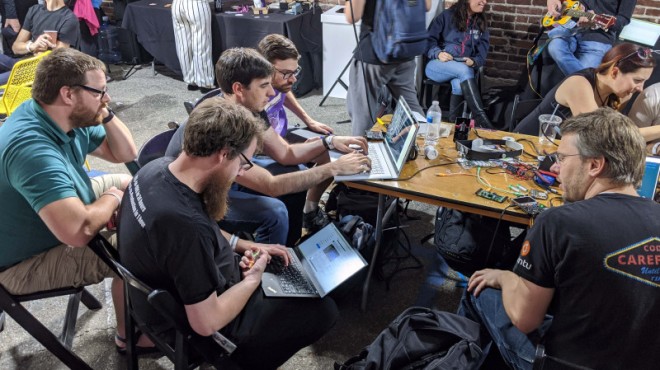
And finally, receiving the biggest applause was Linux-on-Badge: this team used all the badge hacking tricks in the book. The hardware component was a 32 MiB SDRAM cartridge by [Jacob Creedon]. The default badge SOC FPGA bitstream was entirely replaced in order to support a minimalist Linux. Much of the development was done on [Michael Welling]’s computer, guided by the precedence of a LiteX project putting Linux on the Radiona ULX3S. This is a true success story of Supercon collaboration as the team (including [Drew Fustini], [Tim Ansell], [Sean Cross], and many others) came together and worked late into nights, drawing from the massive body of collective expertise of the community.
Watch the demo during the Badge Hacking ceremony (jump to 17m 35s):
Resources:
- support for the Hackaday badge has now been merged into Linux-on-LiteX
- KiCad design files are available on GitHub: jcreedon/dram-cart
- Shared DigiKey cart of the parts
- Shared project on OSH Park: Hackaday Supercon badge SDRAM cartridge
UPDATE:
Demo of Linux-on-LiteX booting on the badge:

Wondering what LiteX is?
LiteX is a FPGA design/SoC builder that can be used to build cores, create SoCs and full FPGA designs


