Many artists are inseparably associated with their medium: Vincent Van Gogh had oil paint, Auguste Rodin had bronze, and Banksy has the spraycan and stencil. You have ICs, passives, wire, and solder. So often electronics are hidden away, but not today! We want to see you build electronic circuits that are beautiful in and of…
Author: fustini
Keep Both Hands on the Probes With This Oscilloscope Footswitch
We’ve got two hands, so it’s natural to want to use both of them while diagnosing a circuit with an oscilloscope. Trouble is, keeping both hands on the probes makes it a touch difficult to manipulate the scope. If only there were some way to put your idle lower appendages to work.
This multipurpose oscilloscope footswitch interface makes so much sense that we wonder why such a thing isn’t standard equipment on more scopes. [Paul Roukema]’s interface relies on the USB Test and Measurement Class (USBTMC) protocol that allows most modern scopes to be remotely controlled, somewhat like the General Purpose Interface Bus (GPIB) protocol of old. [Paul]’s interface uses an STM32 microcontroller to talk USBTMC to either Keysight’s Infinium scopes or the Tektronix DPO line, since those were what he had to test against. Tapping the footswitch cycles the acquisition mode on and off or triggers a single acquisition. He’s thoughtfully included the USBTMC specs in his GitHub project, so adapting it to other scopes should be straightforward. We’d even wager that older scopes with GPIB could enjoy the same handsfree control.
via Keep Both Hands on the Probes With This Oscilloscope Footswitch
BadgeLove contest on Hackster.io
We are excited to announce this new contest with Hackster.io and Autodesk:

BadgeLove!
BadgeLove by Hackster: The Blinkiest Badge Challenge on Earth!
Win up to $5,000+ in prizes!
#BadgeLife is the new electronic graffiti. This form of art is in a league of its own, first popularized by DEFCON hackers, now boasts serious technical sophistication, a wicked artistic flair, peppered with political, cryptography, social, cultural and comical narratives, flashing LEDs and screens with add-ons galore.
You are invited to join our first, and certainly not last, BadgeLove challenge, sponsored by OSH Park, Autodesk EAGLE & Fusion 360, and Hackster.
Share your unique design with 700,000+ Hacksters and we will reward badge fanatics for their beautiful, weird, cool contributions.
Building Portable Linux Devices: Never Been Easier, But Still Hard — Hackaday
We live in a Golden Age of single-board computers. There was a time when a portable computer that was any good was a relatively rare and expensive device, certainly not something you could expect to replicate for yourself. A Psion, or later a Palm or perhaps a WinCE device would have been a lot more…
via Building Portable Linux Devices: Never Been Easier, But Still Hard — Hackaday
2 layer Flex PCBs now at OSH Park!
New! 2 layer Flex PCBs for $15 per square inch including 3 copies of your design. Orders will be sent to fabrication weekly and ship within 21 calendar days of ordering.
Find out more on our Flex documentation page.
(please note the first few panels will be slower than usual due to Winter holidays)
Digital video for FGPAs over PM
From Kevin Hubbard of Black Mesa Labs:
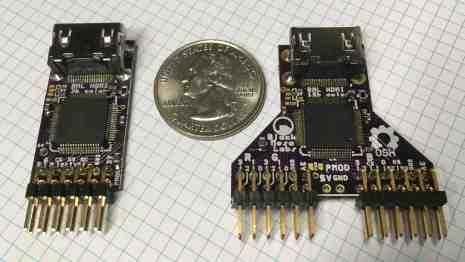
BML DVI DIGITAL VIDEO FOR FPGAS OVER PMOD
2018.11.18 : Update – new board added. Does full 24bit color video using DDR instead of SDR. Board fab may be purchased from OSH-Park here.
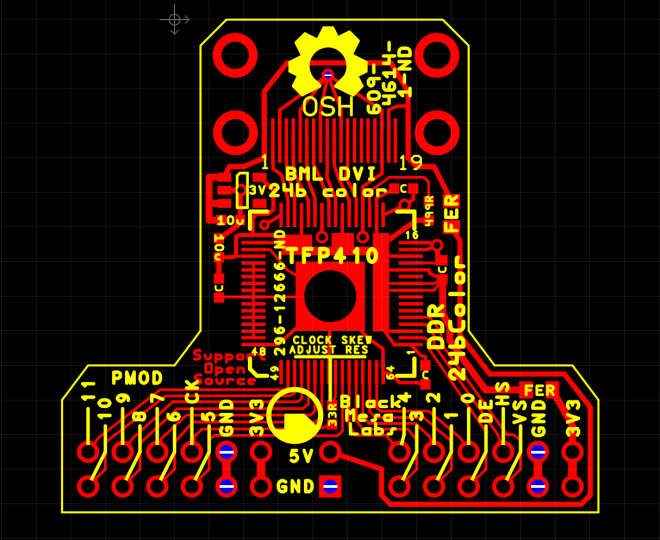
2017.12.15 : Black Mesa Labs is proud to present two open-source-hardware DVI video boards for adding TMDS digital video to FPGA platforms with standard PMOD connectors. These two boards are currently available to purchase as bare fabs directly from OSH-Park, or Gerbers and design files may be downloaded from BML here.
——————————————————–
BML 3bit DVI over single-PMOD:
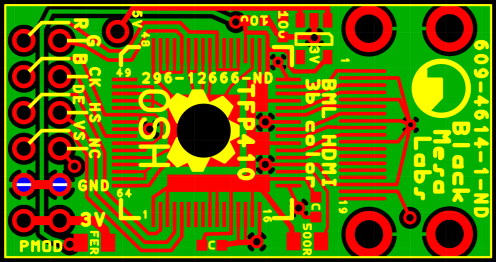
The BML 3bit DVI over single-PMOD uses 7 of 8 available LVCMOS 3.3 pins on a single PMOD to provide 3bit color ( R,G,B 100% On or Off ). Example Verilog design drives 800×600 using a 40 MHz dot clock. The TI TFP410 is very versatile in the resolutions it can generate and is really just limited by the clock that the FPGA can provide and the data rates the PMOD connectors are capable of. The bare 2-layer fab may be purchased from OSH-Park directly for $5 USD ( for 3 boards ) from this link. The TFP410 is about $8 USD. The IC and this HDMI Connector is pretty much the BOM, so the entire cost to assemble is less than $20 USD. The rest of the BOM is Qty-2 0603 0.1uF Caps ( 25V 20% X7Rs were used ), Qty-1 0603 10uF Cap, Qty-1 0805 500ohm 1% resistor and an optional 0805 Ferrite Bead ( 240-2390-1-ND was used, but may be replaced with a wire ). If you don’t want to power the TFP410 from your FPGA’s 3V rail, the Ferrite Bead may be removed and a BU33 ( or equivalent 5SSOP) 3.3V LDO regulator and 10uF cap may be stuffed and the board may be powered by a 5V input via.
The 3bit color Test Pattern from the board driven by FPGA sample design looks like this:
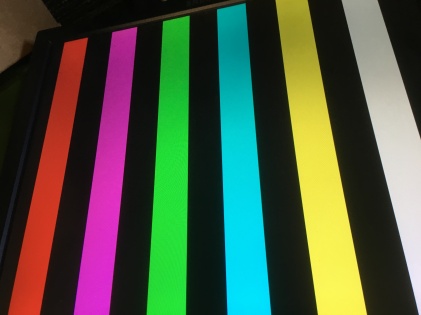
Note that blue exists, it is just off screen. With 3bits of color you get 8 colors by additive color mixing for Black, White, Red, Green, Blue, Yellow, Cyan, Magenta.
Below is a picture of the 3b board plugged into a Lattice ICE40 icoBoard which is available from Trenz here. The smaller iceZero board (PiZero dimensions), also a Lattice ICE40 is a joint BML and Trenz design and would also be a good platform for DVI video and is available here.
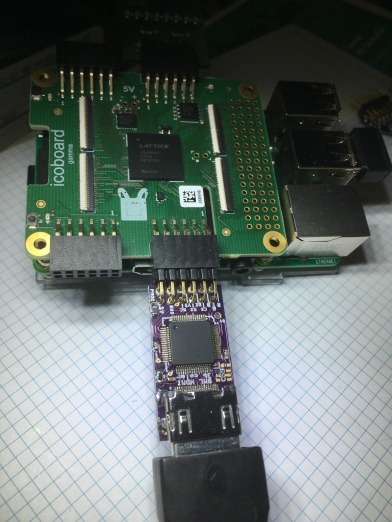
Design files for the board, including Gerbers, BOM and text netlist description may be downloaded from my public Dropbox here.

Hackaday Assembling At 35C3
Hackaday is going to be at the 35th annual Chaos Communication Congress (35C3), December 27th – 31st, and we’re putting together an assembly. If you’re coming to 35C3, come join us! If you’ve never been to a Congress before, it’s an amazing scene. This year over 15,000 hackers will take over the Leipzig Congress Hall,…
Ted Yapo: Dealing with a Cheap Spectrum Analyzer
Talk by Ted Yapo at the 2018 Hackaday Supercon:
Dealing with a Cheap Spectrum Analyzer
A surprisingly simple circuit, some interesting math, and an article in the inaugural edition of the Hackaday Journal of What You Don’t Know.
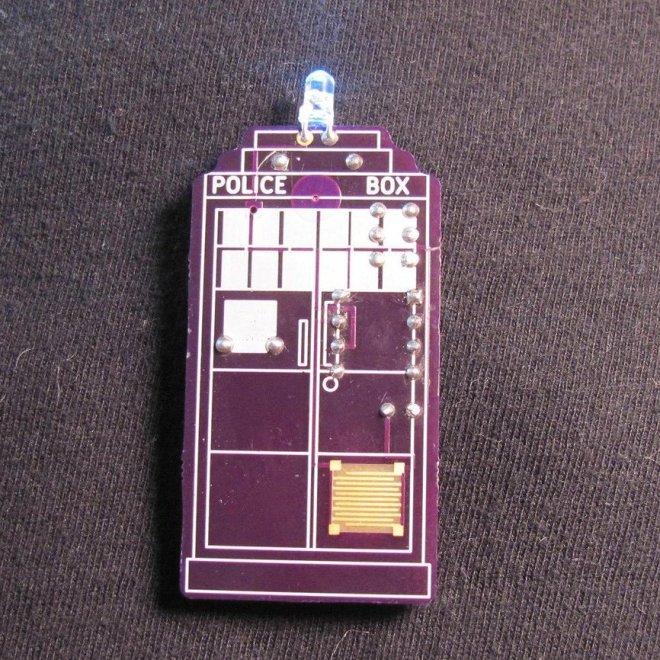
Soldering Kit for Doctor Who Fans
A soldering kit that is bigger on the inside:
8-bit TARDIS that is bigger on the inside.
Hackaday Supercon – Chris Gammell : Improve Your Circuit Toolbox in KiCad
Chris Gammell at Hackaday Supercon:
Simple designs will save your next product if you know which circuits to piece together. Utility circuits practical for everyday electronics. Hackaday Superconference: The greatest gathering of hardware hackers, builders, engineers and enthusiasts on the planet returns. Streaming Live talks from our ‘Main Stage’ in Pasadena, CA. Visit for full list of talks and workshops : https://hackaday.io/superconference/