Sometimes a project doesn’t have to be technically amazing to win over our hearts. [Malte]’s ESP8266-based weather station is so cute, and so nicely executed, that it’s easily worth a look. It could totally be a commercial product, and it’s smaller than a matchbox. It combines temperature, humidity, and barometric pressure sensors on one side…
Uncategorized
Chibiterm Is A Tiny Low-Cost VGA Terminal — Hackaday
A common sight in the days before cheap PCs conquered the world was the dumb terminal. A keyboard and a monitor with a serial port on the back that was usually hooked up to a minicomputer or even a mainframe, these were simple devices. Anything that came into the serial port was rendered on the…
Teensy LC – OSH Park Edition!
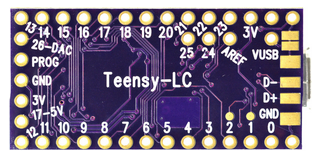
Teensy-LC (Low Cost) by Paul Stoffregen is a powerful 32 bit microcontroller board, with a rich set of hardware peripherals, at a very affordable price:
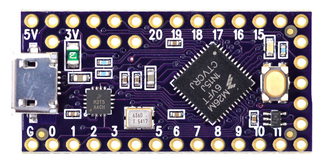
Teensy LC – OSH Park Edition $11.29 USD
Teensy-LC delivers an impressive collection of capabilities to make modern electronic projects simpler. It features an ARM Cortex-M0+ processor at 48 MHz, 62K Flash, 8K RAM, 12 bit analog input & output, hardware Serial, SPI & I2C, USB, and a total of 27 I/O pins:
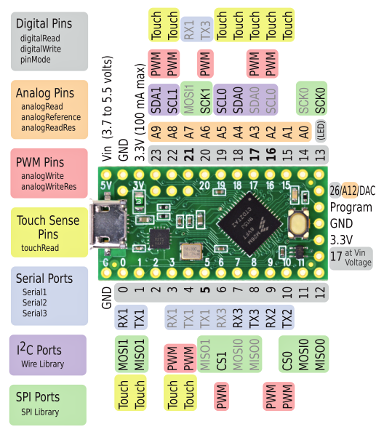
Teensy-LC maintains the same form-factor as Teensy 3.2, with most pins offering similar peripheral features:
- Real Hardware Serial
- Efficient USB Communication
- Hardware Timers
- Analog Input & Output at 12 Bit Resolution
- 5 Volt Buffer For WS2812/NeoPixel LED Projects

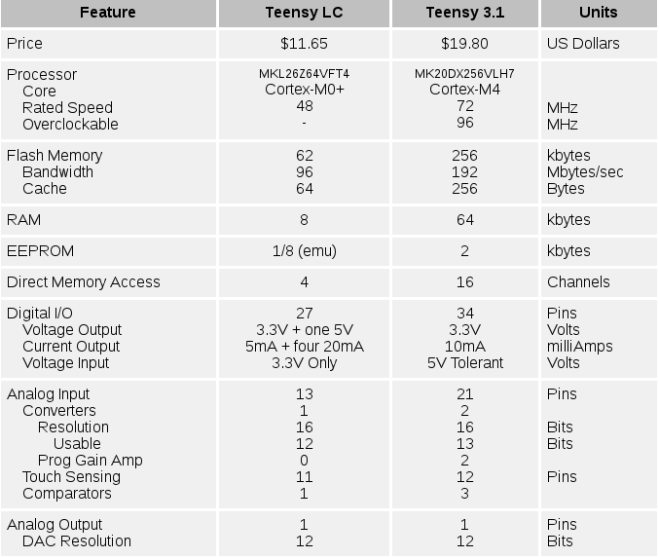
Compared With Teensy 3.2:
Some features of Teensy 3.2 simply aren’t available at this lower price point.
- The I/O pins are not 5V tolerant.
- The maximum speed is only 48 MHz, and the Cortex-M0+ omits M4’s special math instructions.
- CAN bus is not available.
- Teensy-LC has only 4 lightweight DMA channels, rather than 16 fully featured channels.
- Serial1 & Serial2 have only standard buffers, not FIFOs.
- Fewer hardware timers are available.
Hackaday Prize Entry: You Can Do Anything With A Bunch Of NANDs — Hackaday
Every few years, someone on the Internet builds a truly homebrew CPU. Not one built with a 6502, Z80, or a CPU from the 80s, either: one built completely out of 74-series logic chips or discrete transistor. We’re lucky enough to have [Alexander] document his build on Hackaday.io, and even luckier to have him enter it…
via Hackaday Prize Entry: You Can Do Anything With A Bunch Of NANDs — Hackaday
Hackaday Prize Entry: Powering A Pi From A Battery — Hackaday
Knocking a microcontroller into sleep mode and waking it up on demand or in intervals is common practice in many low power applications, enabling devices to stay in operation for years on a single coin cell battery. Since there are tons of applications where you might want to do similar things with a Raspberry Pi, [Patrick…
via Hackaday Prize Entry: Powering A Pi From A Battery — Hackaday
PICTIL: Remake of the TIL311 display
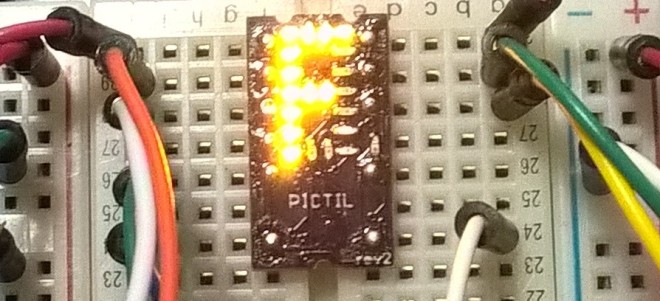
Yann Guidon (YGDES) and Alex (al1) on Hackaday.io have remade of the classic TIL311 hex LED display with a microcontroller:
Hackaday.io: PICTIL
The TIL311 is a nice but expensive, obsolete, power-hungry hexadecimal display. The size of the PCB is the same and […] the pin mapping is similar. The PIC16F527 is […] cheap and exactly the right number of IOs.
The firmware source code and hardware design files are on Bitbucket:
_al1/pictil
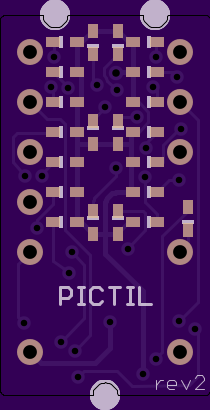
ALKR has shared the board on OSH Park:
PICTIL rev2
Making Music: new beginner challenge on Reddit
Following the exciting An Unconventional Clock contest, a new Beginner contest has been announced on /r/diyelectronics:
Making Music
Make something with electronics that makes music!
The rules include these constraints:
- Sound must come from the project itself
- Do not amplify or change sound from another device
- No music signal can be used as input to be processed
- Human input like knobs or buttons is OK
One winner will be decided by community vote, and one by the judge. Each winner will be awarded a $30 gift code for OSH Park.
Deadline to enter is July 12th. Winners will be announced on July 21st.
Toast-R-Reflow
Toast-R-Reflow
It seems like a right of passage for makers that progress to surface mount work: building your own oven (or other appliance) to do reflow soldering.
The design consists of a power board and a controller.
- Each channel of the power switcher is a basic opto-isolated triac circuit
- MOC-3020 opto-isolated driver triac
- BTA-20 power triac.
- Controller monitors oven temperature and controls the heating elements
- Thermocouple measures the temperature of the oven interior
- PID controller makes oven temperature arrive at a setpoint without overshoot, undershoot or instability.
The firmware is availble in this GitHub repo:
nsayer has shared the boards on OSH Park:
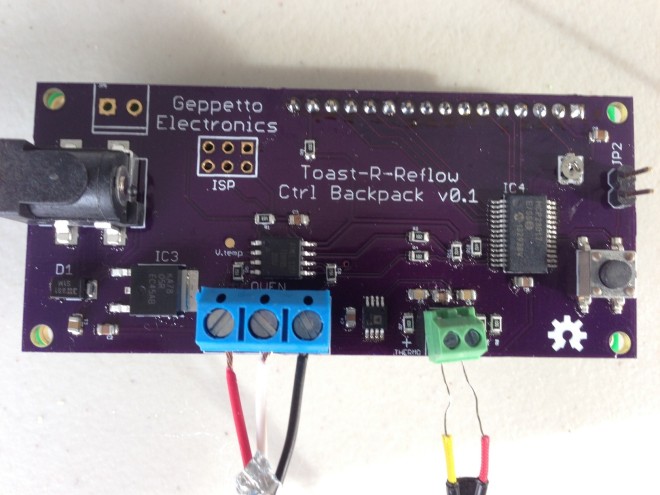
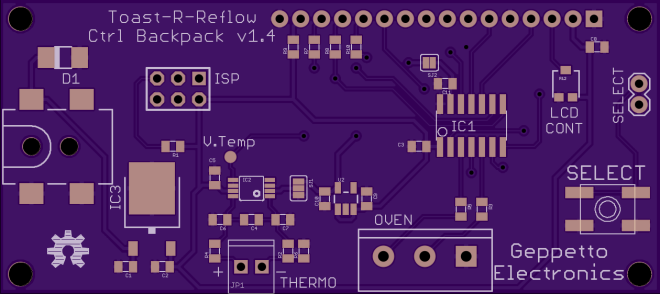
Controller & LCD backpack (ATtiny84)
This variant has an ATTiny84 and an AD8495 analog thermocouple amplifier. It’s cheaper than the model II controller, but the flash is full, so there’s no room for more features.

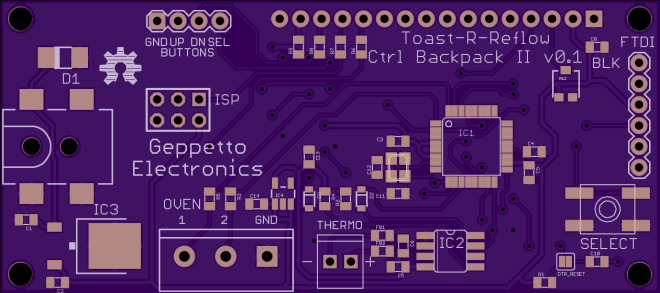
Controller & LCD backpack (ATMega328)

This variant uses an ATMega328P controller and a MAX31855 thermocouple amplifier. It’s more expensive than the model I controller, but there’s lots of room for more features in the flash, it has connections for 3 buttons instead of just 1 and an FTDI serial port
Nick’s Tindie store offers the following kits:
- power board
- Model I controller (ATTiny84/AD8495)
- Model II controller (ATMega328P/MAX31855 variant)
Getting to Blinky with Kicad 4.0
https://www.youtube.com/watch?v=JN_Y93RTdSo
Chris Gammell of Contextual Electronics and The Amp Hour teaches Kicad beginners how to design a simple board in this new video series:
Getting To Blinky 4.0
KiCad 4.0 introduced different methods of library management and workflow from the 2013 release which the original Getting To Blinky used:
We decided to re-do the Getting To Blinky series […] the software being out of sync has started to affect learners’ ability to really get going with KiCad and building electronics.
There are 3 new videos from the original series:
We enjoyed seeing purple pop-up several times!
Choose next beginner challenge on Reddit
We loved the winners of An Unconventional Clock contest and are excited /r/diyelectronics is planning a new beginner challenge:
Choose the topic of the next beginner challenge!
Now, we are looking for topics for the next beginner challenge. If you have an idea, please let everyone know, or respond to others’ ideas. This is a community thing, so the topic of the contest will of course be decided by you as well!
Here are some initial ideas:
- Powerful ATtiny
- What is the most powerful system you can make, controlled by an ATtiny?
- Renewable energy
- Make the most creative system to get energy for a circuit from wind, solar or another form of renewable energy!
- Attractive Circuits
- PCB’s are inherently beautiful to people who are interested in electronics, but can you make a really attractive circuit? Think along the lines of combining different materials in a PCB, or go homemade with perfboard and wires.


nsayer/Toast-R-Reflow