Riffle: Open Source data logger

John Keefe writes about his experience building an Open Source data logger:

Make Every Week: Circuit Boards, For Reals
medium_completed_board.jpg

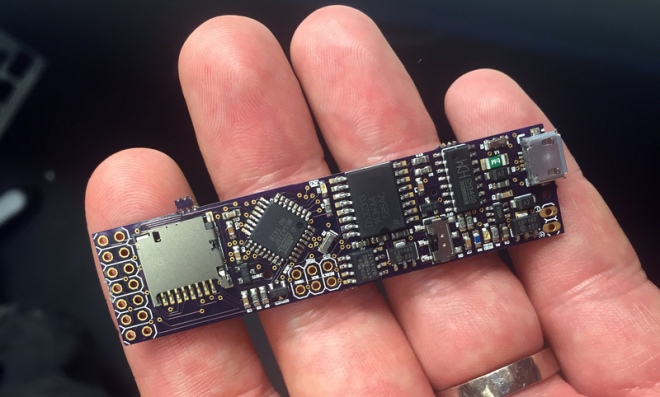
I always considered circuit boards like this something you bought, not something you made.  Not any more.  I actually helped to make the board in the picture above. And it was awesome fun.
medium_RiffleVerticalGood

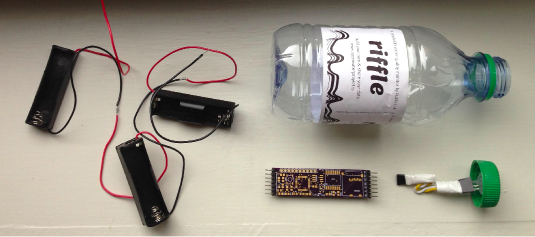
The board is designed to monitor the conductivity (and, possibly, contamination) of water in lakes and streams, with the wonderful feature that it fits through the mouth of a regular water bottle. It’s called Riffle and it is the brainchild of Don Blair, who’s working with Public Lab and the MIT Center for Civic Media.

The Public Lab wiki explains Riffle stands for Remote Independent Friendly Field-Logger Electronics:

Riffle: open source data logger


We are working to develop an open source hardware datalogger that can be placed in the field for extended deployments and measure common water parameters like temperature, conductivity, depth, and turbidity.


The hardware design files hosted on GitHub:

Riffle: Open Source data logger

Rotary encoder board with LED ring

Piotr Zapart of hexeguitar.com created this rotary encoder board with LED ring:

Mounting board for the Panasonic EVEP series rotary encoders equipped with I2C driven 16 LED ring.

LED driver is built around the MCP32017 16bit I2C IO expander. Up to 8 modules can be used on the same I2C bus.

hexeguitar has shared the board on OSH Park:

Encoder board

CfTjU-8WQAAkD2a
Order from OSH Park

Here’s a video of the project in action:

Rotary encoder board with LED ring

From KiCad to Digikey

cropped-lightbulbthing221bitknitting is automating the creation of a Bill of Materials (BoM) for Digi-Key from a Kicad project:

From Kicad to Digikey: Generating a BoM based on eeSchema

The goal of this post is to provide an overview of my MakeDigikeyBOM.py effort.  To do this, I will take a simple schematic created in Kicad.


Start of MakeDigikeyBoM Code Review: Walk Through of Block Diagram

The goal of this post is to start a code review MakeDigikeyBoM python project.  I’ll cover the block diagram I created to represent the “big picture”.


MakeDigikeyBOM Code Review: The Python Scripts

The goal of this post is to familiarize us with the structure and purpose of the MakeDigikeyBom Python package and individual modules.


Check out this on GitHub for the source code:


From KiCad to Digikey

Tinusaur: ATtiny85 Quick Start Boards

Neven Boyanov from Bulgaria started Tinusaur Project in 2013 as a tiny platform to learn microcontrollers with the Atmel ATtiny85:


Boyanov has recently launched a crowd funding campaign on Indiegogo:

The Tinusaur Project – ATtiny85 Quick Start Boards

Ever wanted to start with microcontrollers, the simplest way?  Well, you’ve just found it!  Get one of our kits, fetch your soldering iron and start.

Update #1:

Our first workshop for this year took place couple of weeks ago in Plovdiv at Hackafe. It was part of a much larger event about microcontrollers, robotics and internet-of-things.

bkznmg3d4xjoyragfuel

Many Tinusaur boards are shared on OSH Park by boyanov including:

Tinusaur Board v0.3 RC5


Order from OSH Park

Checkout Tinusaur on YouTube for fun examples like this:

Tinusaur: ATtiny85 Quick Start Boards

RF Gateway With Display for Particle Photon

Charles-Henri Hallard is working on a Ultra Low Power nodes project (formerly ULPNode).  He needed a powerful and small gateway, so  he created this RF Gateway with OLED display for Particle Photon or the older Spark Core:

Particle Universal Gateway for ULPNode


The gateway will be responsible of node ID attribution, acting like a DHCP server, once a new node is discovered and/or put in configuration mode, it can be connected to the network just like a classic computer, the Gateway will dedicate to it a specific Node ID, and once this node ID will be affected, the possibility to configure the node through the gateway web interface.

Another function of the Gateway will be to push the data to a IoT server (local or cloud) such as Emoncms or whatever dashboard available like Blynk (for phone and tablet)AdafruitParticle Dashboard or freeboard

Charles describes the features of the board:

  • Socket to plug a Spark Core or Particle Photon
  • Pins to connect I2C or SPI OLED 128×64
  • Pins to connect 2.2″ or 1.8″ TFT LCD
  • RFM69 or RFM12B on board module
  • Lipo Battery connector for testing and move the Gateway (no charger on board)
  • 3V3 On board regulator for harvesting devices if any to avoid pumping from Particle Regulator
  • Data connection for any cheap ebay ASK RX receiver
  • FTDI connection for those who want to debug serial or send data over real serial
  • 2 x grove I2C connector to connect other I2C devices


The design files and bill of materials (BoM) are hosted on GitHub:
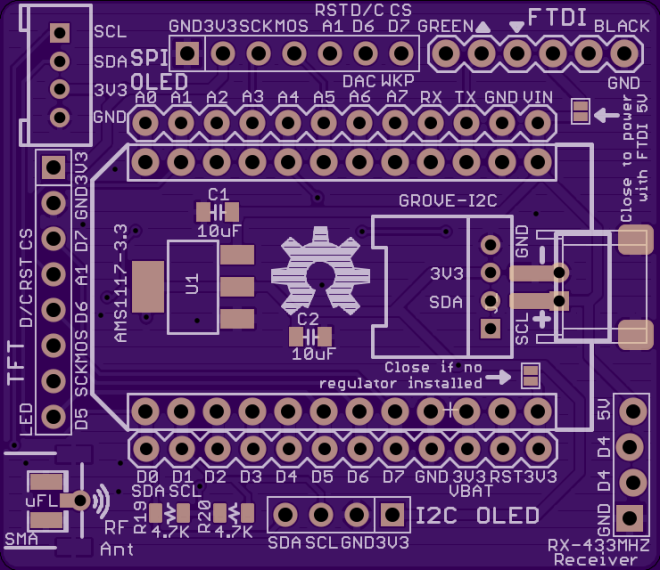
Particle-Gateway


hallard has shared the board on OSH Park:
Spark/Particle RF Gateway With Display

i (1)
Order from OSH Park

RF Gateway With Display for Particle Photon

4 digit charlieplexed segment display

bobricius is developing this nifty four digit 7-segment display that requires only 6 GPIO pins for 30 LEDs:

4 digit charlieplexed segment display

Maybe you need ultra thin custom display, this is solution …. Why charlieplexing? because it is for my like piece of magic.

The board is a thin 0.8mm tall thanks to our 2 Layer Half-Height Double-Copper service.  bobricius has shared 7seg-micro.brd on OSH Park.  However, he is still working on Arduino code to control the board.

4 digit charlieplexed segment display

WINXI: Arduino Zero compatible stick

bobricius is developing this Arduino Zero compatible project for the Hackaday Prize 2016:

9285971458382311302.jpg

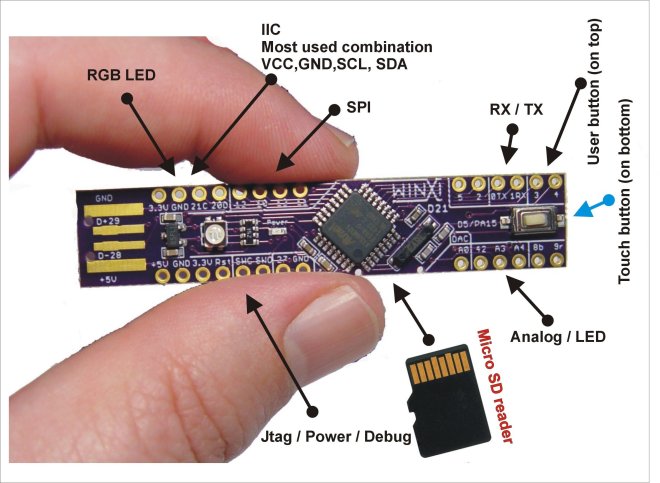
This board have unique compact design and is easy to assemblyBased on newest arduino zero board with powerfull mcu.   Native 3.3V, many sensors, modules and SD cards are working on this voltage level

Features include:

  • SD card reader
  • RGB LED
  • Touch pad
  • User button

The board uses the Atmel ATSAMD21E18 microcontroller:

  • ARM Cortex-M0+
  • 256KB of flash and 32KB of SRAM
  • Up to 48MHz operating frequency
  • 4 serial comm modules (SERCOM) configurable as UART/USART, SPI or I2C
  • Full Speed USB Device and embedded Host
  • Support for up to 60 touch channels

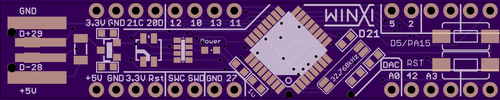
The EAGLE board file can be downloaded from hackaday.io:

samd21SLIM-sd-longer.brd

6231651458774220722.png

WINXI: Arduino Zero compatible stick

NeuroBytes: Build your own nervous system

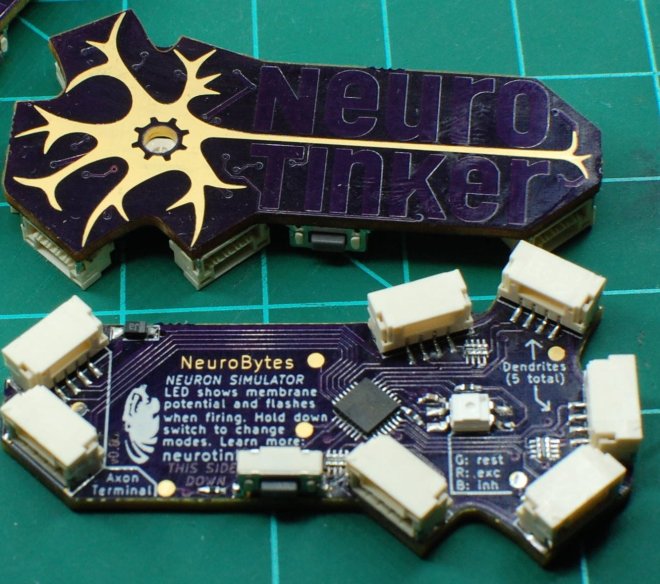
Zach Fredin and Joe Burdo of NeuroTinker entered NeuroBytes in the 2015 Hackaday Prize and were named a Best Product Finalist:
 
256201456586136855

NeuroBytes are stamp-sized electronic neuron models that can be freely connected to form complex and biologically representative neural circuits. The NeuroBytes platform is currently in its fourth prototype generation with approximately 100 individual elements built to date, along with numerous accessories that help constructed networks interface with the real world.


The NeuroTinker website highlights the many iterations of NeuroBytes:


Zach spoke at the Hackaday Superconference last November about “the process of going from prototype to 100-unit production”:


NeuroBytes: Build your own nervous system

Low Cost VGA Terminal Module

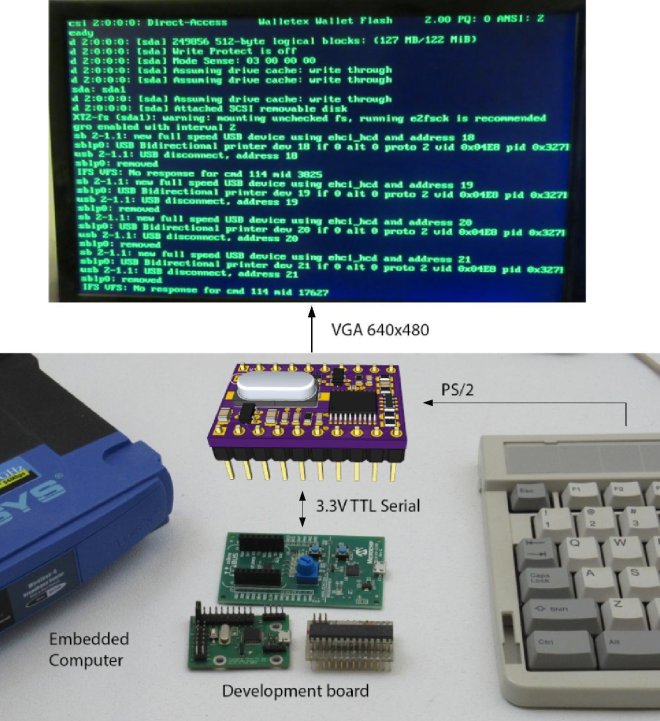
K.C. Lee created this low cost module to add VGA and keyboard connectivity to retro computer, development board or embedded computer via serial port:

8594801458418481660

K.C. describes his project on Hackaday.io:

This can be used as a stamp sized VGA and keyboard interface module in an embedded design. It can be connected to a VGA monitor, PS/2 keyboard and act as a terminal via TTL serial port.

While there are a lot of ARM based VGA projects out there, this is an exercise to see what can be done with the low end STM32F030F4 that has only 4K of RAM and 16K of FLASH. It boots up instantaneously so it doesn’t miss critical boot up messages from the host.

I named it Chibi Term. (Chibi = Small in Japanese)

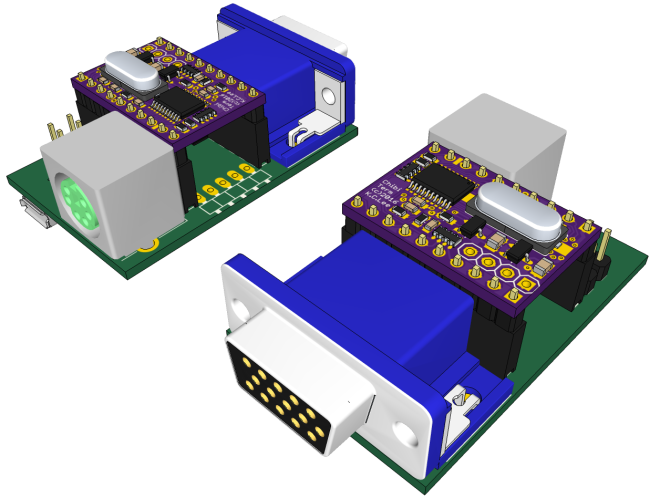
He posted this rendering of what a breakout board may look like:

8421731458529048791.png

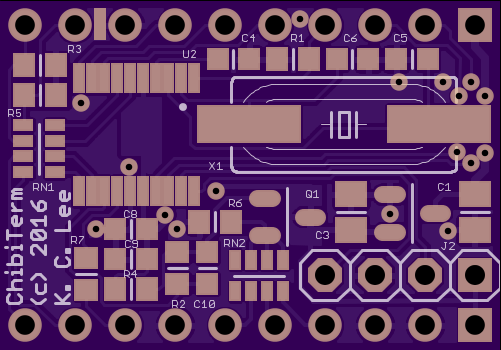
FPGA-Computer shared the board on OSH Park:

Low Cost VGA Terminal Module “ChibiTerm”

7560729aa43a80be6d9c21b6b720c54c.png


Low Cost VGA Terminal Module