
Did you read all 3000+ articles published on Hackaday this year? We did. And to help catch you up, we preset the Hackaday 2018 Year in Review podcast!
Join us for the podcast, available on all major podcasting platforms, as Editors Mike Szczys and Elliot Williams attempt the impossible task of distilling the entire year into a one hour discussion. We’ve included every story mentioned in the podcast, and a few more, in the show notes here. But since we can’t possibly mention every awesome hack, we encourage you to share your favorites, and pat the writers on the back, by leaving a comment below.
Quotes
iCEBreaker, The Open Source Development Board for FPGAs
From Brian Benchoff on the Hackaday blog:

iCEBreaker, The Open Source Development Board for FPGAs
The Hackaday Superconference is over, which is a shame, but one of the great things about our conference is the people who manage to trek out to Pasadena every year to show us all the cool stuff they’re working on. One of those people was [Piotr Esden-Tempski], founder of 1 Bit Squared, and he brought some goodies that would soon be launched on a few crowdfunding platforms. The coolest of these was the iCEBreaker, an FPGA development kit that makes it easy to learn FPGAs with an Open Source toolchain.
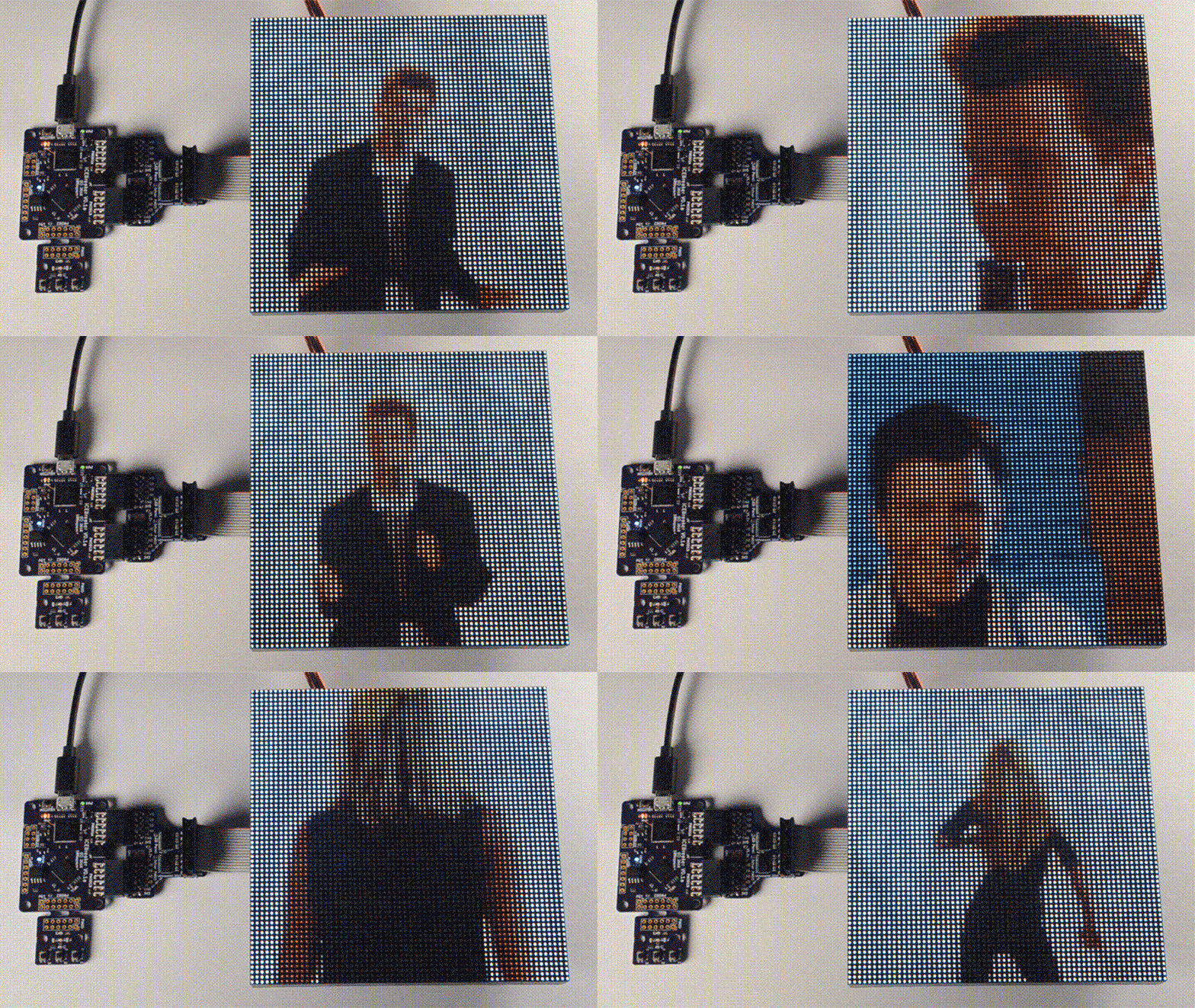
The hardware for the iCEBreaker includes the iCE40UP5K fpga with 5280 logic cells,, 120 kbit of dual-port RAM, 1 Mbit of single-port RAM, and a PLL, two SPIs and two I2Cs. Because the most interesting FPGA applications include sending bits out over pins really, really fast, there’s also 16 Megabytes of SPI Flash that allows you to stream video to a LED matrix. There are enough logic cells here to synthesize a CPU, too, and already the iCEBreaker can handle the PicoRV32, and some of the RISC-V cores. Extensibility is through PMOD connectors, and yes, there’s also an HDMI output for your vintage computing projects.
Vinduino Water-Smart Farming – Now with LoRa
From the Hackaday blog:
Vinduino Water-Smart Farming – Now with LoRa!
Vinduino started with [Reinier]’s desire to better understand what happens to irrigation water under the surface, measuring soil moisture at different depths. This knowledge informs more efficient use of irrigation water, as we’ve previously covered in more detail. What [Reinier] has been focused on is improving usability of the system by networking the sensors wirelessly versus having to walk up and physically attach a reader unit.
His thought started the same as ours – put them on WiFi! But adding WiFi coverage across his entire vineyard was not going to be cost-effective. After experimenting with various communication schemes, he has settled on LoRa. Designed to trade raw bandwidth for long range with low power requirements, it is a perfect match for a network of soil moisture sensors.
In the video [Reinier] gives an overview of LoRa for those who might be unfamiliar. Followed by results of his experiments integrating LoRa functionality into Vinduino, and ending with a call to action for hackers to help grow the LoRa network.
Intelligent Toasters: Retro CPC Dongle
From the Intelligent Toasters blog:
Retro CPC Dongle – Part 38
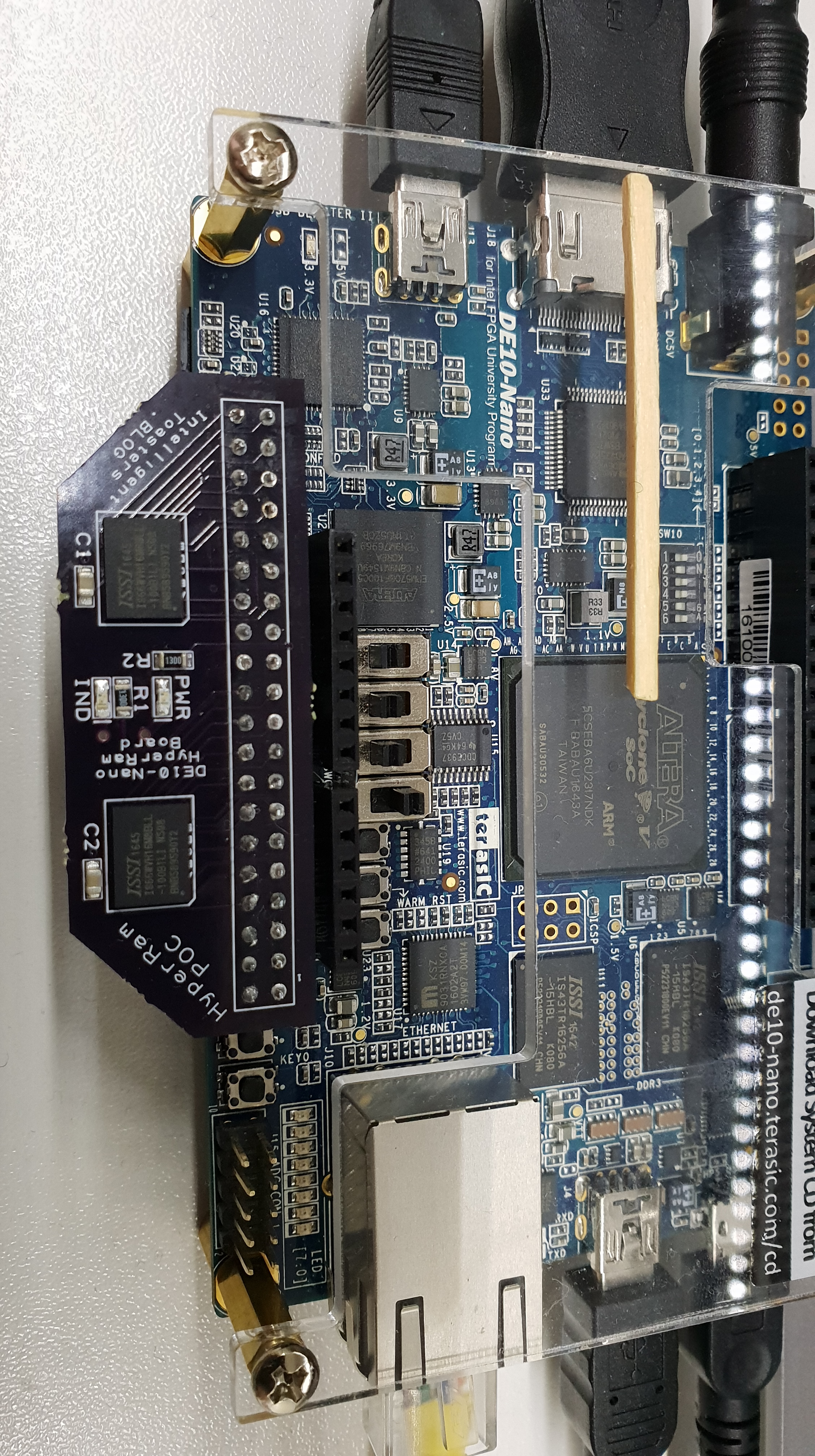
This post talks about HyperRAM, what it is, how to interface to it and how to improve the performance of high-speed parallel interfaces. HyperRAM is described well by Cypress. It is essentially a double data rate RAM with a compact 12-line interface that masks the underlying technology of a DDR SDRAM.
Since assembling the two HyperRAM chips on my new OSH Park prototype boards (above), work on the CPC2 has come on in bounds. This lack of large memory was really holding back progress. I’ve completed the ROM/RAM management cores, so that 64 ROMs and 4096KB of RAM is now available to the CPC2, managed by the support processor. Based on the required CPC personality, I can switch out the CPC464/664/6128 ROMs, the BASIC 1.0/1.1 ROM, the AMSDOS ROM and others like my beloved Maxam ROM. The ROMs are stored in the FPGA configuration Flash. Storing 64 ROMs beyond the FPGA configuration image takes just a small fraction of the Flash memory. As they never change, it’s a good place to hold these. In the future, ROMs will also be stored on the backing storage for more volatile images, such as ROMs under development.
The Circuit Sculpture Contest
Many artists are inseparably associated with their medium: Vincent Van Gogh had oil paint, Auguste Rodin had bronze, and Banksy has the spraycan and stencil. You have ICs, passives, wire, and solder. So often electronics are hidden away, but not today! We want to see you build electronic circuits that are beautiful in and of…
Keep Both Hands on the Probes With This Oscilloscope Footswitch
We’ve got two hands, so it’s natural to want to use both of them while diagnosing a circuit with an oscilloscope. Trouble is, keeping both hands on the probes makes it a touch difficult to manipulate the scope. If only there were some way to put your idle lower appendages to work.
This multipurpose oscilloscope footswitch interface makes so much sense that we wonder why such a thing isn’t standard equipment on more scopes. [Paul Roukema]’s interface relies on the USB Test and Measurement Class (USBTMC) protocol that allows most modern scopes to be remotely controlled, somewhat like the General Purpose Interface Bus (GPIB) protocol of old. [Paul]’s interface uses an STM32 microcontroller to talk USBTMC to either Keysight’s Infinium scopes or the Tektronix DPO line, since those were what he had to test against. Tapping the footswitch cycles the acquisition mode on and off or triggers a single acquisition. He’s thoughtfully included the USBTMC specs in his GitHub project, so adapting it to other scopes should be straightforward. We’d even wager that older scopes with GPIB could enjoy the same handsfree control.
via Keep Both Hands on the Probes With This Oscilloscope Footswitch
Building Portable Linux Devices: Never Been Easier, But Still Hard — Hackaday
We live in a Golden Age of single-board computers. There was a time when a portable computer that was any good was a relatively rare and expensive device, certainly not something you could expect to replicate for yourself. A Psion, or later a Palm or perhaps a WinCE device would have been a lot more…
via Building Portable Linux Devices: Never Been Easier, But Still Hard — Hackaday
Hackaday Assembling At 35C3
Hackaday is going to be at the 35th annual Chaos Communication Congress (35C3), December 27th – 31st, and we’re putting together an assembly. If you’re coming to 35C3, come join us! If you’ve never been to a Congress before, it’s an amazing scene. This year over 15,000 hackers will take over the Leipzig Congress Hall,…
Supercon: Alex Hornstein’s Adventures In Hacking The Lightfield
We are all familiar with the idea of a hologram, either from the monochromatic laser holographic images you’ll find on your bank card or from fictional depictions such as Princes Leia’s distress message from… 624 more words
via Supercon: Alex Hornstein’s Adventures In Hacking The Lightfield — Hackaday
It Happened at Supercon: Six Days of Fun in a Three Day Con
A weekend for people who love hardware, by people who love hardware. It’s a simple recipe and it makes a delicious event that we call the Hackaday Superconference.
via It Happened at Supercon: Six Days of Fun in a Three Day Con — Hackaday