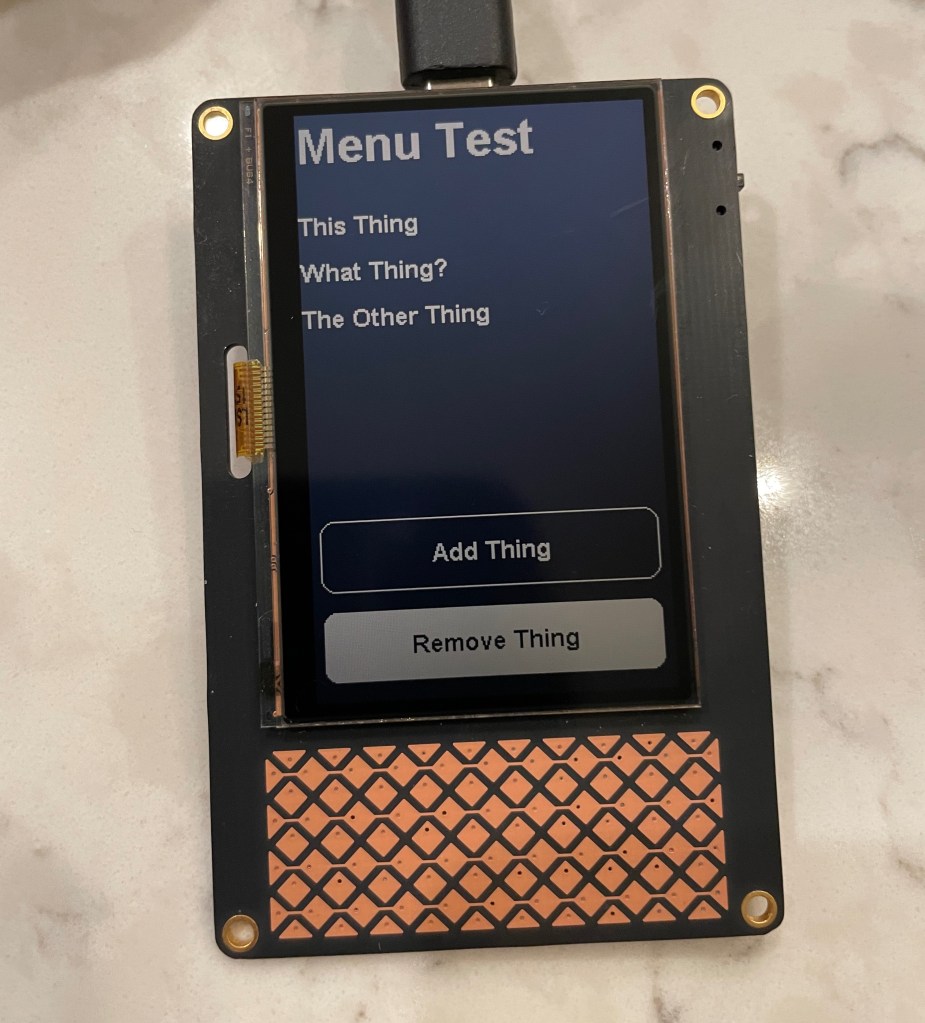
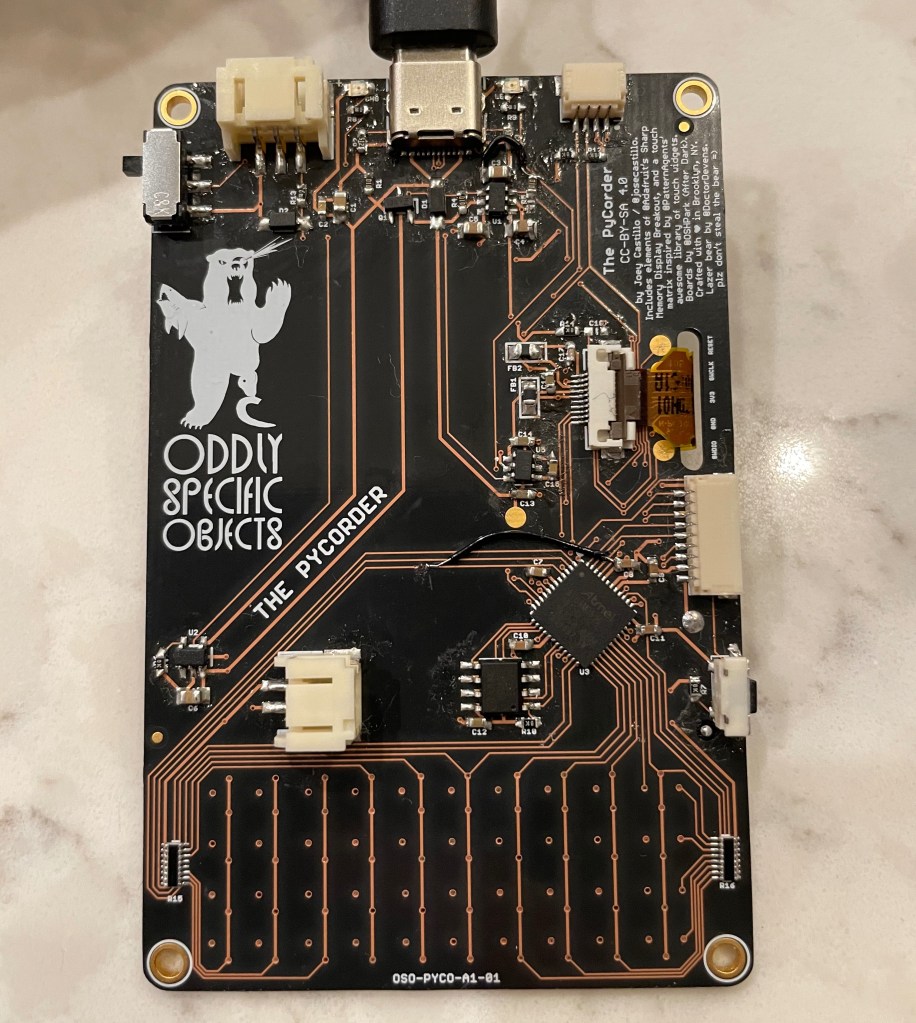
Joey Castillo is well-known for the awesome OpenBook e-reader project and has recently announced a new open source hardware project: the PyCorder!
Folks: meet the PyCorder! My take on a touchpad-based Sharp Memory Display gadget, in gorgeous @oshpark After Dark. More in the coming days, but feeling super stoked tonight because I finally got it up and running (and made a simple input task for circuitpyui; video in 2nd tweet) pic.twitter.com/5A9gXN4yPm
And has add-on sensors like moisture to monitor soil:
Now I wish I'd left it running longer, because about 20 minutes after this, it showed the moisture diffusing back up through the layers of soil. Alas, there are no more bone-dry plants in my house, so you'll have to take my word for it. Code here: https://t.co/vUJfJACle3pic.twitter.com/LbG2LpKnPr
The Pycorder isn’t remotely a medical gadget, but there’s tons of fun biosensing you can do with it. Here I’m using an infrared LED and phototransistor to visualize my pulse. The raw value dances around a bit, prolly in relation to blood oxygen lvl; still, a fun proof of concept! pic.twitter.com/qQ3itAKN49
The Open Hardware Summit (OHS) invites talk proposals for the eleventh annual summit! This year’s summit is virtual and will be held online on Friday 2021-04-09, 9:00 AM – 5:30 PM EDT.
The Open Hardware Summit is for presenting, discussing, and learning about open hardware of all kinds. The summit examines open hardware applications, practices, and theory, ranging from environmental sensors to 3D printable medical devices to open hardware processors and beyond. We are interested in open hardware on its own as well as in relation to topics such as software, design, business, law, and education. Past talks have featured topics such as advances in space propulsion, humanitarian projects, right to repair legislation, open hardware in education, and open hardware marketing.
For our eleventh edition we are especially looking for speakers who can offer insights around the role of open hardware in the COVID-19 pandemic, open hardware medical devices, and related topics.
We invite talk proposals from individuals and groups. Submissions are due by Thursday 2021-02-11 at 11 PM EDT.
In the last Circuit VR we looked at some basic op amp circuits in a simulator, including the non-inverting amplifier. Sometimes you want an amplifier that inverts the signal. That is a 5V input results in a -5V output (or -10V if the amplifier has a gain of 2). This corresponds to a 180 degree phase shift which can be useful in amplifiers, filters, and other circuits. Let’s take a look at an example circuit simulated with falstad.
Last time I mentioned two made up rules that are good shortcuts for analyzing op amp circuits…
Increasing government attention to “open” agendas, complemented by growing community capacity, have laid the groundwork for driving policy attention towards open hardware. The COVID-19 pandemic spotlighted the ability of open hardware communities to mobilize for disaster response, including through the design and production of personal protective equipment (PPE) and other medical supplies when traditional supply chains failed. A new Administration offers an opportunity to build on lessons learned from this unforeseen and extensive experiment in scaling open collaboration on hardware and also to revisit what has worked in the past for related fields such as community science and open source software. A whole-of-government approach to elevating open hardware, including for scientific research and disaster response, feels both timely and necessary in order to amplify effective activities and provide scaffolding for an even more impactful future.
To better understand potential opportunities, researchers and practitioners from the Wilson Center, Open Environmental Data Project, and University of Cambridge convened a workshop on October 28, 2020 to bring together members of the open hardware community, such as those involved in GOSH and OSHWA. Beginning with the question What are you most excited about in open science hardware right now, the workshop focused on establishing a value proposition for open hardware as a matter of public policy as well as elucidating open challenges that might be addressed by policy interventions. One goal of the workshop was to develop high-level consensus around “key messages,” for policy makers and a list of eleven suggestions was subsequently ranked by participants. This exercise made it clear that to refine these further, more work was needed to understand specific accelerators and barriers to the adoption and use of open hardware, and to align perspectives between the policy community and diverse developers and users of open hardware from academia, industry and community organisations operating across a broad range of disciplines.
[Nixie] was tired of using whatever happens to be around to hold things in place while soldering and testing. It was high time to obtain a helping hands of some kind, but [Nixie] was dismayed by commercial offerings — the plain old alligator clips and cast metal type leave a lot to be desired, and the cooling tube cephalopod type usually have the alligator clips just jammed into the standard tube ends with no thought given to fine control or the possibility of reducing cable count.
[Nixie] happened to have some unneeded cooling tube lying around and started designing a new type of helping hands from the ground plane up. Taking advantage of the fact that cooling tubes are hollow, [Nixie] routed silicone-jacketed wires through them for power and low speed signals. These are soldered to five banana jacks that are evenly spaced around an alligator clip.
Happy Lunar New Year! We would like to let our customers know that all OSH Park boards are manufactured in the United States, and we will be operating on a normal schedule during Lunar New Year:
Chips are tiny and phones are glass, so why are circuits still flat and green? The printed circuit board played a pivotal role in World War 2, and it’s barely changed since then. Nearly every modern device has at least one circuit board; they’re so ubiquitous, we just assume that electronics are flat rectangles. It wasn’t always that way – once upon a time, terrifying globs of exposed connections and miles-long webs of wrapped wires lurked behind the wood veneer.
See how the literal foundation of technology is made, learn about the modern features that enable powerful electronics, catch a glimpse of the advanced future, and most importantly, discover why, after 80 years of progress, we still put all our circuits on boards.
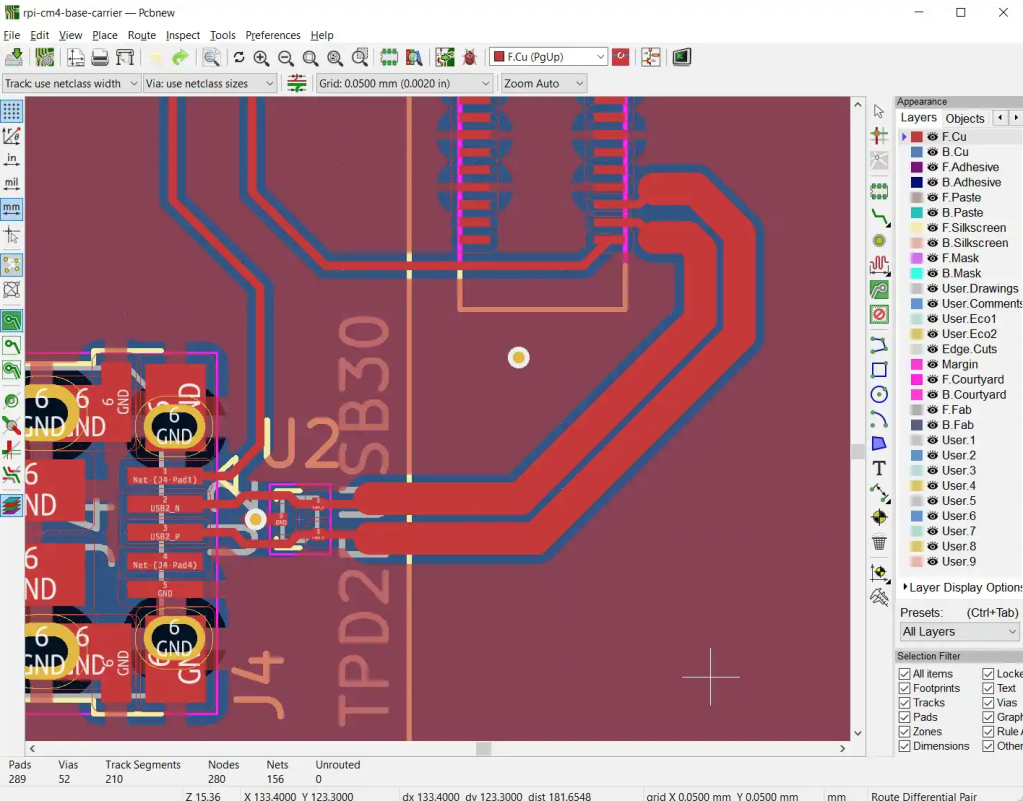
Routing differential pair lines in PCB layout software can be a tricky process. Luckily, KiCad has a few tools to help us with the process. In this tutorial, we’ll walk you through the process of calculating the differential impedance and using that information to create a pair of USB data lines in a project.
Interested in 3D printing, circuit bending, or synthesizers? Check out the POLY555 by Oskitone, a synth that uses twenty 555 timers to create polyphonic music!






 OSH Park