
Did you read all 3000+ articles published on Hackaday this year? We did. And to help catch you up, we preset the Hackaday 2018 Year in Review podcast!
Join us for the podcast, available on all major podcasting platforms, as Editors Mike Szczys and Elliot Williams attempt the impossible task of distilling the entire year into a one hour discussion. We’ve included every story mentioned in the podcast, and a few more, in the show notes here. But since we can’t possibly mention every awesome hack, we encourage you to share your favorites, and pat the writers on the back, by leaving a comment below.
Author: fustini
iCEBreaker, The Open Source Development Board for FPGAs
From Brian Benchoff on the Hackaday blog:

iCEBreaker, The Open Source Development Board for FPGAs
The Hackaday Superconference is over, which is a shame, but one of the great things about our conference is the people who manage to trek out to Pasadena every year to show us all the cool stuff they’re working on. One of those people was [Piotr Esden-Tempski], founder of 1 Bit Squared, and he brought some goodies that would soon be launched on a few crowdfunding platforms. The coolest of these was the iCEBreaker, an FPGA development kit that makes it easy to learn FPGAs with an Open Source toolchain.
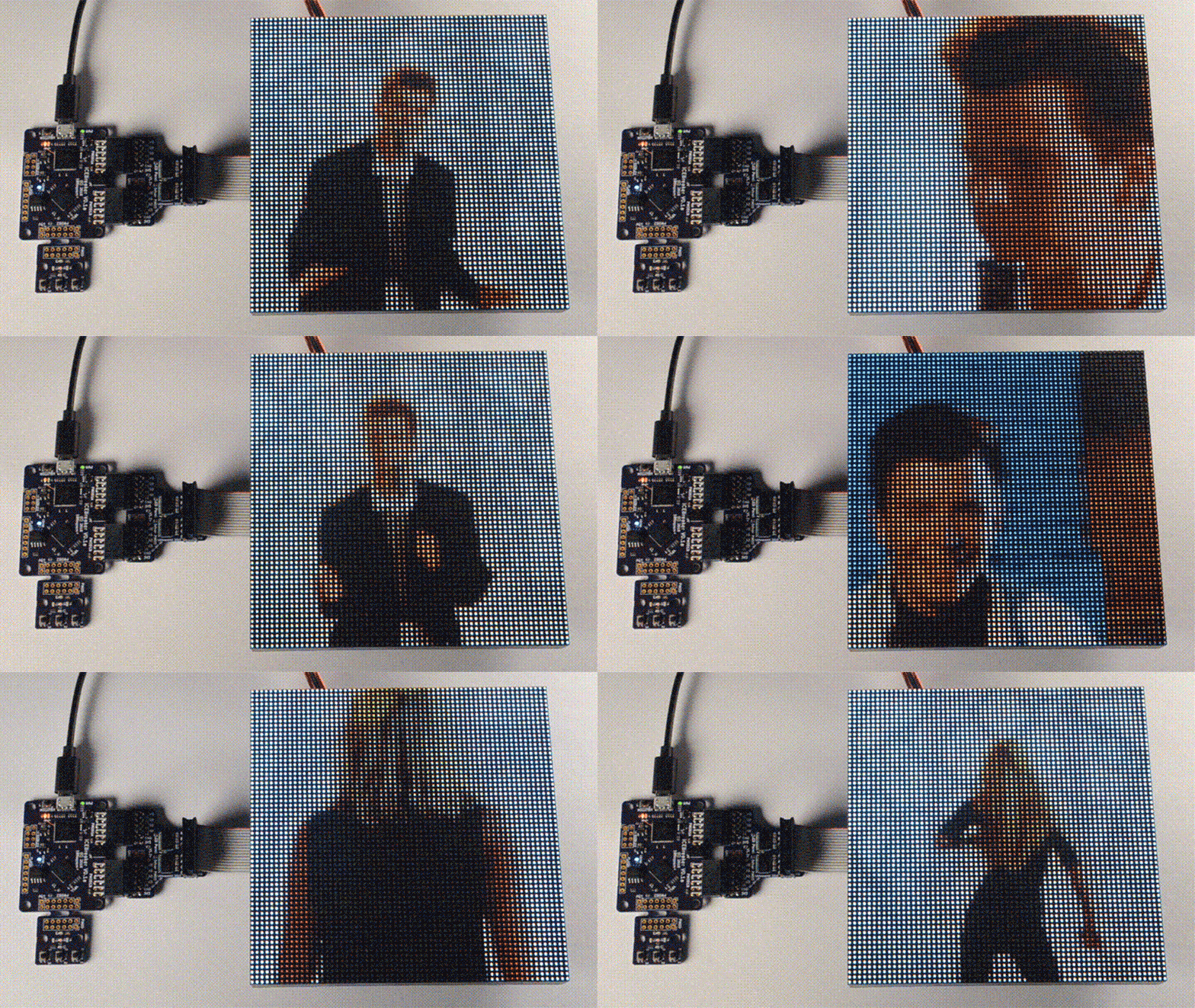
The hardware for the iCEBreaker includes the iCE40UP5K fpga with 5280 logic cells,, 120 kbit of dual-port RAM, 1 Mbit of single-port RAM, and a PLL, two SPIs and two I2Cs. Because the most interesting FPGA applications include sending bits out over pins really, really fast, there’s also 16 Megabytes of SPI Flash that allows you to stream video to a LED matrix. There are enough logic cells here to synthesize a CPU, too, and already the iCEBreaker can handle the PicoRV32, and some of the RISC-V cores. Extensibility is through PMOD connectors, and yes, there’s also an HDMI output for your vintage computing projects.
Vinduino Water-Smart Farming – Now with LoRa
From the Hackaday blog:
Vinduino Water-Smart Farming – Now with LoRa!
Vinduino started with [Reinier]’s desire to better understand what happens to irrigation water under the surface, measuring soil moisture at different depths. This knowledge informs more efficient use of irrigation water, as we’ve previously covered in more detail. What [Reinier] has been focused on is improving usability of the system by networking the sensors wirelessly versus having to walk up and physically attach a reader unit.
His thought started the same as ours – put them on WiFi! But adding WiFi coverage across his entire vineyard was not going to be cost-effective. After experimenting with various communication schemes, he has settled on LoRa. Designed to trade raw bandwidth for long range with low power requirements, it is a perfect match for a network of soil moisture sensors.
In the video [Reinier] gives an overview of LoRa for those who might be unfamiliar. Followed by results of his experiments integrating LoRa functionality into Vinduino, and ending with a call to action for hackers to help grow the LoRa network.
Hardware Happy Hour San Francisco
There is now a Hardware Happy Hour in San Francisco:
First Hardware Happy Hour (3H) SF!
https://www.meetup.com/hardwarehappyhoursf/events/257052887/
This group is based upon the idea that you are interested in hanging out and discussing hardware. Please bring a piece of hardware to show off or talk about. Are you interested in hardware, but you haven’t built anything yet? Show off software you have built! Or come prepared to talk about the projects you want to build.
There are no organized talks, it’s literally a show and tell at a bar or restaurant. In case you missed it two paragraphs ago, bring hardware. Seriously, just bring anything to talk about 🙂
Intelligent Toasters: Retro CPC Dongle
From the Intelligent Toasters blog:
Retro CPC Dongle – Part 38
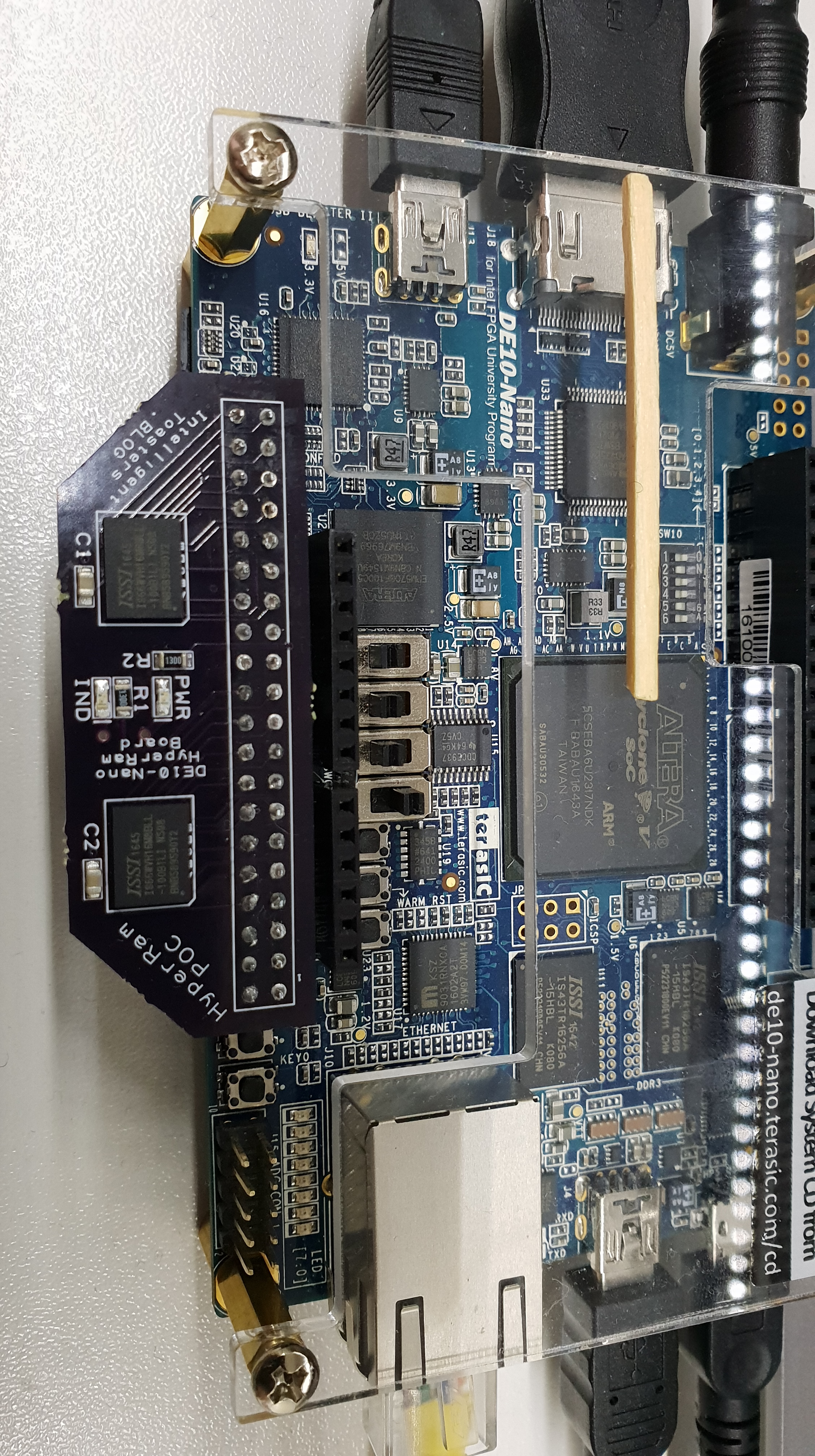
This post talks about HyperRAM, what it is, how to interface to it and how to improve the performance of high-speed parallel interfaces. HyperRAM is described well by Cypress. It is essentially a double data rate RAM with a compact 12-line interface that masks the underlying technology of a DDR SDRAM.
Since assembling the two HyperRAM chips on my new OSH Park prototype boards (above), work on the CPC2 has come on in bounds. This lack of large memory was really holding back progress. I’ve completed the ROM/RAM management cores, so that 64 ROMs and 4096KB of RAM is now available to the CPC2, managed by the support processor. Based on the required CPC personality, I can switch out the CPC464/664/6128 ROMs, the BASIC 1.0/1.1 ROM, the AMSDOS ROM and others like my beloved Maxam ROM. The ROMs are stored in the FPGA configuration Flash. Storing 64 ROMs beyond the FPGA configuration image takes just a small fraction of the Flash memory. As they never change, it’s a good place to hold these. In the future, ROMs will also be stored on the backing storage for more volatile images, such as ROMs under development.
Tindie: Breathe New Life into Your Game Boy’s Screen With This Bivert Module
From the Tindie blog:
Breathe New Life into Your Game Boy’s Screen With This Bivert Module
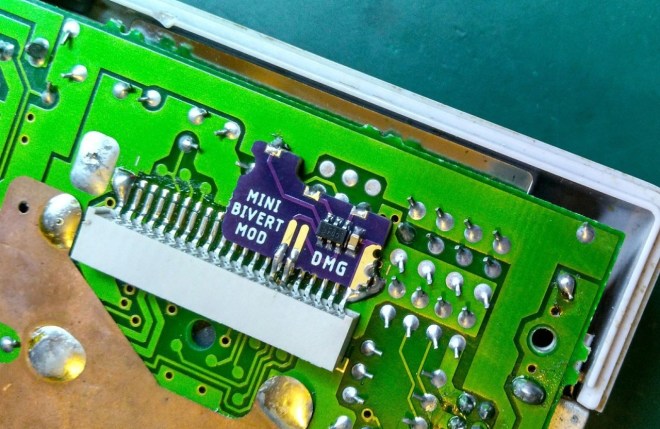
When they first came out, the Game Boy models were the cream of the crop. Even the original DMG model, the screen looked stunning for the time. Despite nostalgia being a powerful thing, the screens haven’t aged well in our post-4K world.
A great way to breathe some life into that screen is to use a bivert module. These modules enhance the contrast of LCD displays by biverting/inverting the pixel orientation on the screen. The difference is pretty noticeable too, with a sharp blue appearance and better grayscale saturation.
AXIOM SDI Plugin Module
From the apertusº Open Source Cinema project:
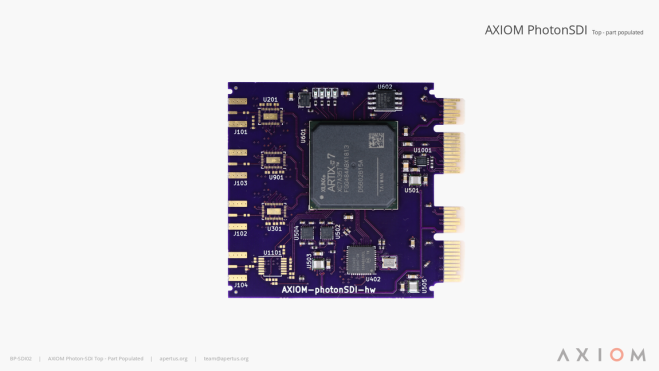
The AXIOM photonSDI hardware is an extension board for the apertusº AXIOM Beta open source camera that adds 6G SDI connectivity to its features.
The board has two independent 6G SDI outputs that can both output the same image, different images, or be used in a dual 6G configuration that allows the transmission of 4k video material at 60 frames per second. Additionally the board contains a 6G SDI input for synchronisation and blending and a legacy synchronization input.
KiCon 2019 Call for Talk Proposals
![]()
KiCon, a conference focused on KiCad, is happening April 2019 in Chicago and the call for talk proposals is open:
KiCon 2019 Call for Talk Proposals
KiCon 2019 is a conference for people who use and love KiCad. This is the first year of KiCon, but hopefully the first of many! It will take place April 2019 in Chicago IL, USA.
We are looking for community members to propose talks, which will be recorded and uploaded for the rest of the world to utilize. We’re looking for stories about tools, methods, and successes using KiCad in manufacturing, research and business. This conference will bring together the power users of the tool to talk about how they use KiCad on a regular basis and to share that knowledge with others.
Laptop Keyboard Conversion to USB
From Frank Adams on Hackster.io:
Laptop Keyboard Conversion to USB
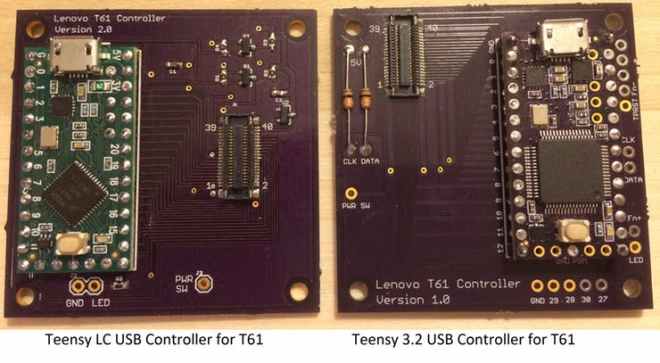
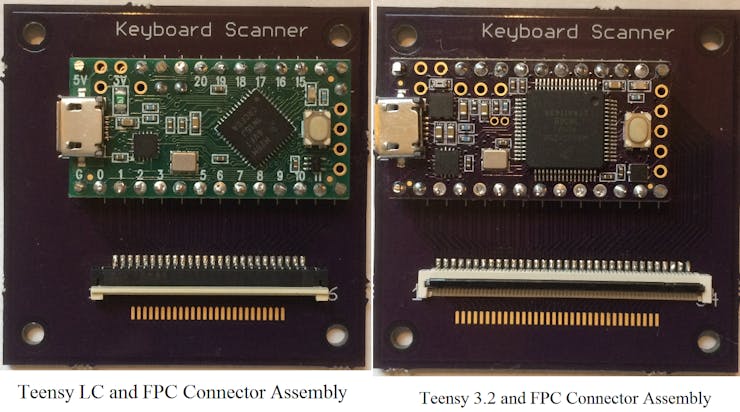
I made a “nearly universal” USB controller using a Teensy LC or 3.2 on an FPC connector board that will work with most laptop keyboards.
I did this project because I’ve seen many forum posts from people asking how to use the keyboard from their old broken laptop. Unfortunately the answers given are “it can’t be done,” “it’s too hard,” or “rip apart another USB keyboard and steal the controller circuit.” I believe I have a better answer by using a “nearly universal” keyboard controller based on a Teensy LC or 3.2 mounted on an FPC connector board. This board accepts keyboard cables with up to 34 pins on a 1 mm or 0.8 mm pitch. The board shown below won’t work on every keyboard but it will work on most.

The same circuit board is populated with either a Teensy LC or 3.2
The Circuit Sculpture Contest
Many artists are inseparably associated with their medium: Vincent Van Gogh had oil paint, Auguste Rodin had bronze, and Banksy has the spraycan and stencil. You have ICs, passives, wire, and solder. So often electronics are hidden away, but not today! We want to see you build electronic circuits that are beautiful in and of…