The Dutch organisation eth0 has run a series of informal small camps over the years, never with an attendance too far into three figures, and without pre-planned events or entertainment. What happens is at the instigation of the attendees, and the result is a weekend of much closer socialising and working together on projects than the large camps where you spend your time running around to catch everything.
The largest of hacker camps offer all the lights, robots, tschunk, and techno music you can stomach; they can be a blast but also overwhelming. I made my way eth0 over the past week weekend, enjoying the more intimate size and coming away having made friendships from spending time with great people at a large private camping hostel near Lichtenvoorde. This is in the far east of the country near the German border, to which in the company of a British hardware hacker friend I traveled in the tiny European hatchback. Netherlands roads are so easy to navigate!
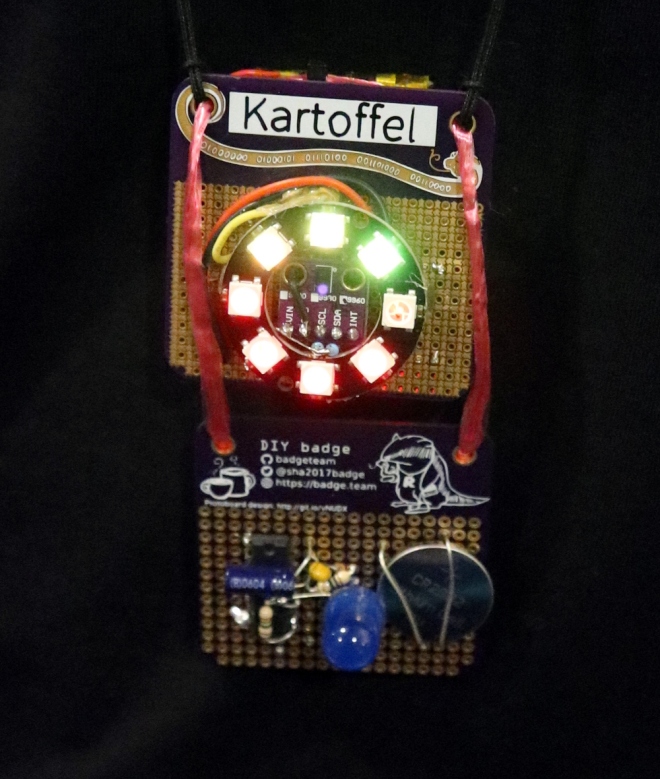
The badge itself has an interesting layout, because aside from a bit of badge.team and event related artwork it uses a multipurpose layout from Electronic Eel, that’s designed for both SMD and through-hole parts. This proved to be extremely versatile, but came with the slight burden that the through-hole pads were closely surrounded by the ground plane, making soldering a bit tricky. Despite this there was an enthusiastic take-up from camp attendees, with offerings that went well beyond the mundane.
For the majority of the attendees there was a badge bar, with plentiful supplies of LEDs ad other components. Some attendees made do with a pair of colour changing LEDs and a CR2032, but others made CMOS astable oscillators using 4093 Schmitt AND gates for the full flashing effect. It’s almost unexpected today when so much is done by microcontrollers to see people hacking logic gate oscillators, but there was a circuit bending element to it all that made for a more enjoyable experience.
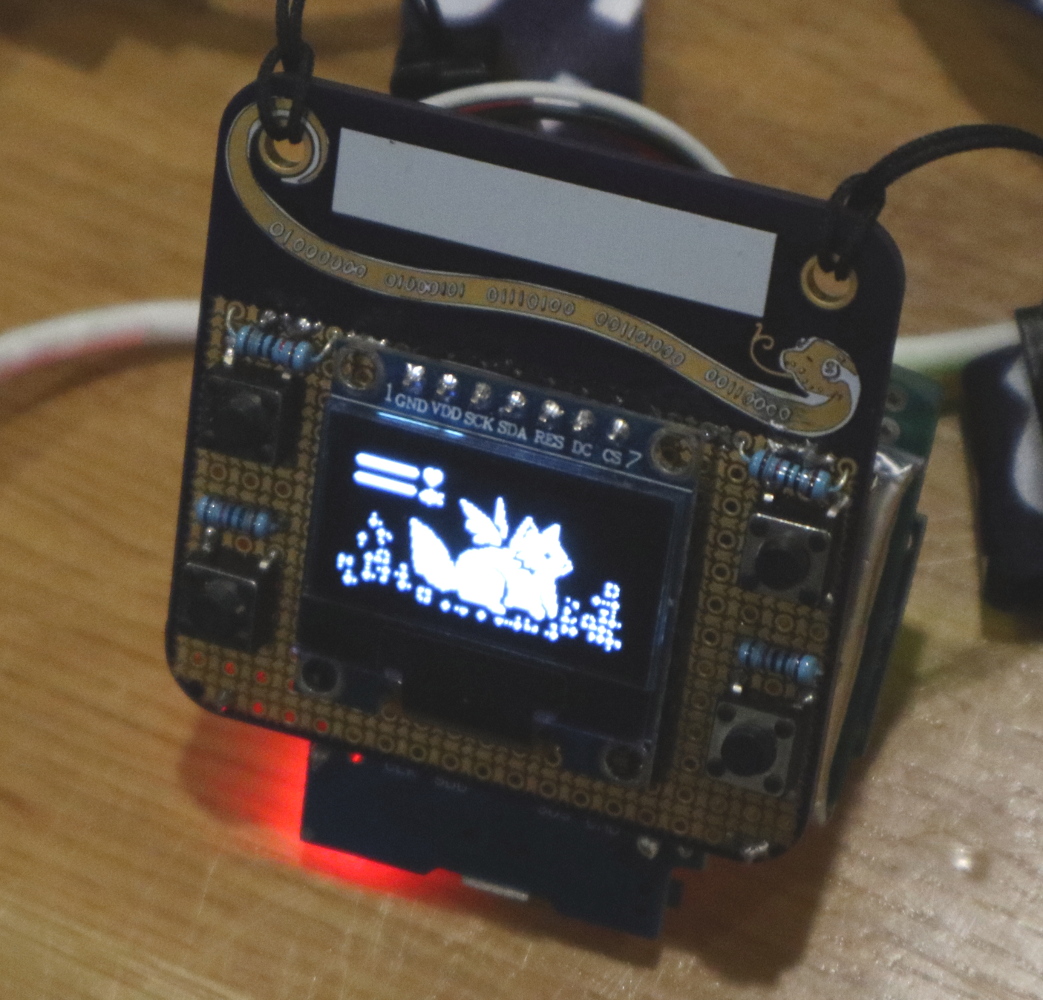
A fully functional event badge built upon an event badge. Fuchsia’s Tamafoxi runs the badge.team firmware.
One or two badges sported extra lighting in the form of Neopixels and similar. This staple of the LED badge is the obvious choice for one like the eth0 badge, even with its relative lack of space. The piece de resistance of the eth0 winter 2019 badges though did not feature any LED lights, instead it came with a small OLED display and a set of buttons. Fuchsia’e Tamafoxi is a fully functional tamagotchi clone that runs under the badge.team badge firmware, for which a Wemos ESP32 board had been fitted to the back of the badge. Power wasn’t quite so elegant, requiring a small protoboard and LiPo cell sandwiched to the back of the badge, but for the feat of getting a badge that wouldn’t disgrace a much larger event running on what was in effect a fancy protoboard, we’ll forgive all that. Plenty of event badge teams have set out to achieve this level of functionality and not quite made it, so to do so on an event badge like this one is a very significant feat indeed.
This was a short camp by the standards of some others, starting on a Friday evening and wrapping up at Sunday lunchtime. We left in the drizzle of a damp autumn afternoon for the easy trip to the overnight ferry across the billiard-table-smooth Dutch motorways, without some of the stress of limited access while packing that comes with the larger camps. It had been everything we’d wanted from a small hacker camp and more, so speaking personally I’d certainly head back to this one if the opportunity arose.
We are big fans Hackaday Supercon and several of the OSH Park team will be attending again this year from November 15 – 17. Here’s some of what to look forward to:
Four weeks from today the Hackaday Superconference comes alive for the fifth year. From engineering in challenging environments to elevating the art form of electronics, here are nine more talks that will make this a year to remember.
In addition to the slate of speakers below there are three other announcements, plus workshops. Jeroen Domburg (aka Sprite_TM) is designing this year’s badge based around a beefy FPGA running a RISC-V core and using open source synthesis tools. We’ll have more on that soon, but if you just can’t wait, check out the expansion board spec he just published, and join the conference chat room for the inside track. Badge hacking is sure to be the liveliest we’ve ever seen.
Tickets are sold out but you can still get on the waiting list and hope that one becomes available. If you are holding onto one of these hot commodities but are unable to use it, please return your ticket so that we can get it to someone waiting with their fingers crossed.
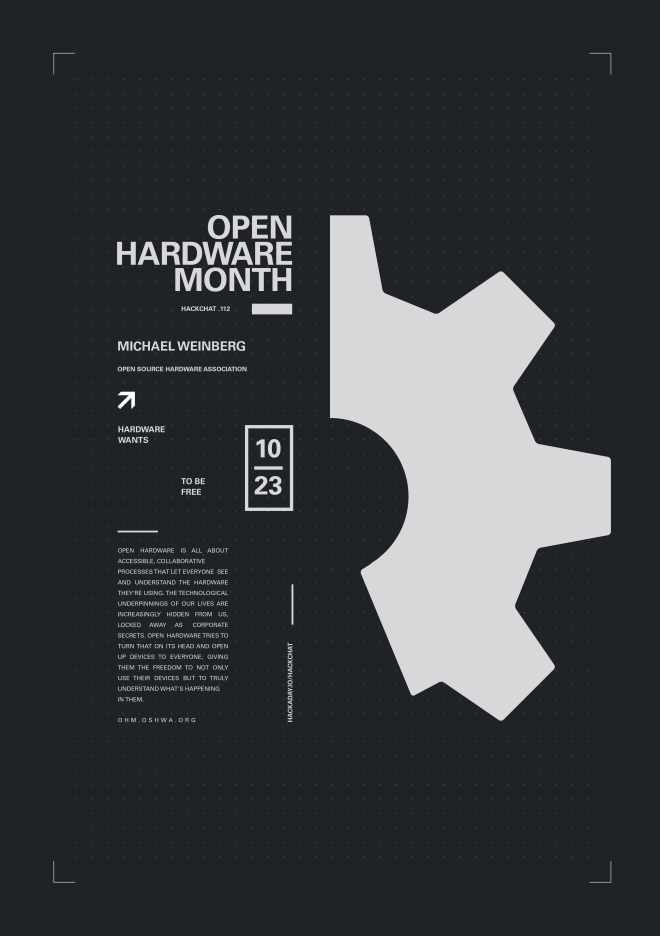
It seems like everything and everyone has a special day set aside on the calendar. You know the drill – aheadline declaring it National Grilled Cheese Day (sorry, you missed it – April 12) or National Bundt Pan Day (not even kidding, November 15). It seems only fair with all these silly recognition days floating around that we in the hacking community should have a day of our own, too, or even a whole month. That’s why the Open Source Hardware Association declared the entire month of October to be Open Hardware Month.
Open hardware is all about accessible, collaborative processes that let everyone see and understand the hardware they’re using. The technological underpinnings of our lives are increasingly hidden from us, locked away as corporate secrets. Open hardware tries to turn that on its head and open up devices to everyone, giving them the freedom to not only use their devices but to truly understand what’s happening in them, and perhaps repair, extend, and even modify them to do something new and useful. Celebrating that and getting the message out to the general public is certainly something worth doing.
Michael Weinberg is a board member at OSHWA, and he’ll be joining the Hack Chat on October 23 (National Boston Cream Pie Day) to discuss Open Hardware Month and open-source hardware in general. We’ll learn about some of the events planned for Open Hardware Month, how open hardware is perceived beyond the hacker community, and what’s on tap for the 10th anniversary Open Hardware Summit in 2020.
Click that speech bubble to the right, and you’ll be taken directly to the Hack Chat group on Hackaday.io. You don’t have to wait until Wednesday; join whenever you want and you can see what the community is talking about.
David Shah looks at where we have come from with the IceStorm tool chain, and looks at how this has developed recently and expanded Ice40 Lattice support to include new lower power, lower cost, reduced pincount FPGAs to include their Ultra & Ultra Plus range.
Open Source FPGA Hardware past to present
Alan Wood talks about the journey through the early history of OpenSource FPGA open hardware from IcoBoard through myStorm too recent UltraPlus offerings recently made available.
Open Source FPGA Tooling present to future
Icestorm was aimed at a narrow family of Ice40 FPGAS, the new Symbiflow family of tools expands the opensource tooling exponentially. David Shah takes a look at NextPNR which lies at the heart of the toolset and deals with specific FPGA family functionality, in particular he concentrates on the Lattice ECP5 family support he has developed with Project Trellis as part of NextPNR and the recent 1.0 version supporting this new family and high end FPGA features.
Open Source FPGA Hardware present to future
What comes next for opensource FPGA hardware, after the success of tinyFPGA and myStorm we are beginning to see ECP5 opensource hardware emerging first with Radiona’s ULX3S and being followed up by offerings from both tinyFPGA and myStorm dev board stables, with new hardware comes new features building on NextPNRs tooling like DSP, SerDES IO Gearing and DDR memory etc, Alanplots the course for these new powerful open source development boards…
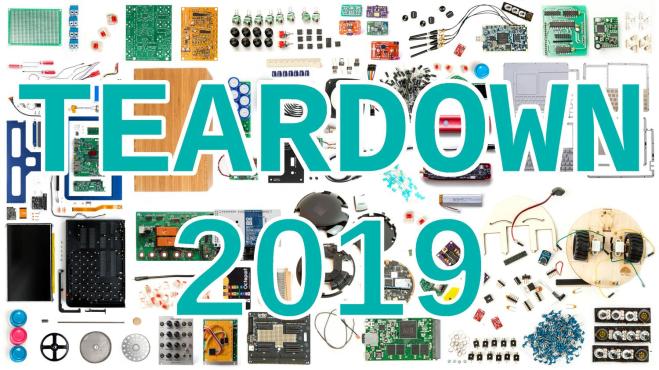
Teardown is about the practice of hardware: prototyping, manufacturing, testing, disassembling, and circumventing, all while having fun. Leave the marketing glitz and talk of venture capital at the door and come prepared to learn and teach.
Please bring your latest project with you! Anything you’re working on, electrical, mechanical or software works! We want to see the stuff that you’re interested in!
Hackaday is known for having the best community around, and we prove this all the time. Every month, we hold meetups across the United States. This, in addition to conferences and mini-cons across the globe mean Hackaday is the premiere venue for technical talks on a wide variety of hardware creation. Everything from Design for Manufacturing, to the implementation of blinky bling is an open topic.
Now, we’re looking for the talk you can give. The Hardware Developers Didactic Galactic is a monthly gathering hosted by Supplyframe, the Overlords of Hackaday. It’s filled with the technical elite of San Francisco, usually held on the last Thursday of the month. We’re looking for a talk you can give, whether it’s about your IoT irrigation system, or that time you created something out of transistors and capacitors. We’re looking for speakers for all of 2019, and if you have a tale of the trials and tribulations of injection molding or Bluetooth pairing, we want to hear from you.
There are thousands of people in the Hackaday community that have tons to contribute, and this is your chance. You are the best of the best, and we want to hear what you have to teach the rest of the community.
I have arrived at SparkleCon! I had thought this event was just at the hackerspace 23b Shop, but it is actually spread across several venues in the same business park. The original plan also included activity in the parking lot between these venues, but a powerful storm ruined those plans. Given this was in Southern California the locals are not very well equipped to handle any amount rain, never mind the amount that came pouring from the sky today. So people packed into the indoor venues where it was warm and dry. STAGESTheatre is where some talks were held, like.Helen Leigh’s talk From Music Tech Make to Manufacture demonstrating her Mini Mu.
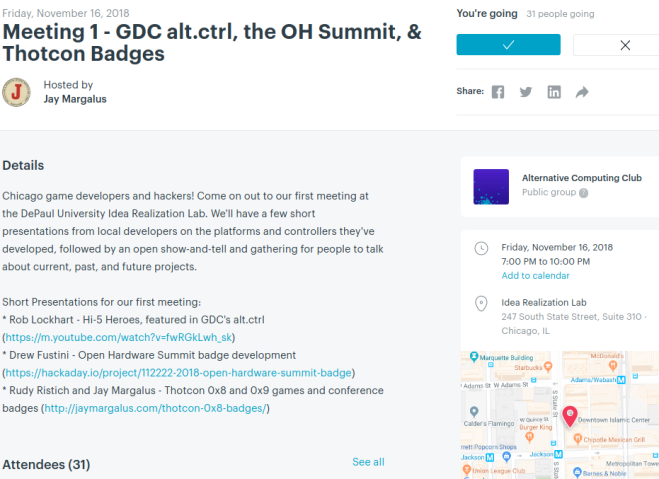
Chicago game developers and hackers! Come on out to our first meeting at the DePaul University Idea Realization Lab. We’ll have a few short presentations from local developers on the platforms and controllers they’ve developed, followed by an open show-and-tell and gathering for people to talk about current, past, and future projects.








 OSH Park