The seventh part of this series is all about the sensor board. It hosts the position sensor and four fill sensors. Speaking of sensors sounds complex, but these are just pairs of IR-LEDs and phototransistors. All design files for the board are in the GitHub repository and if you missed one of the previous parts, look at the overview page.
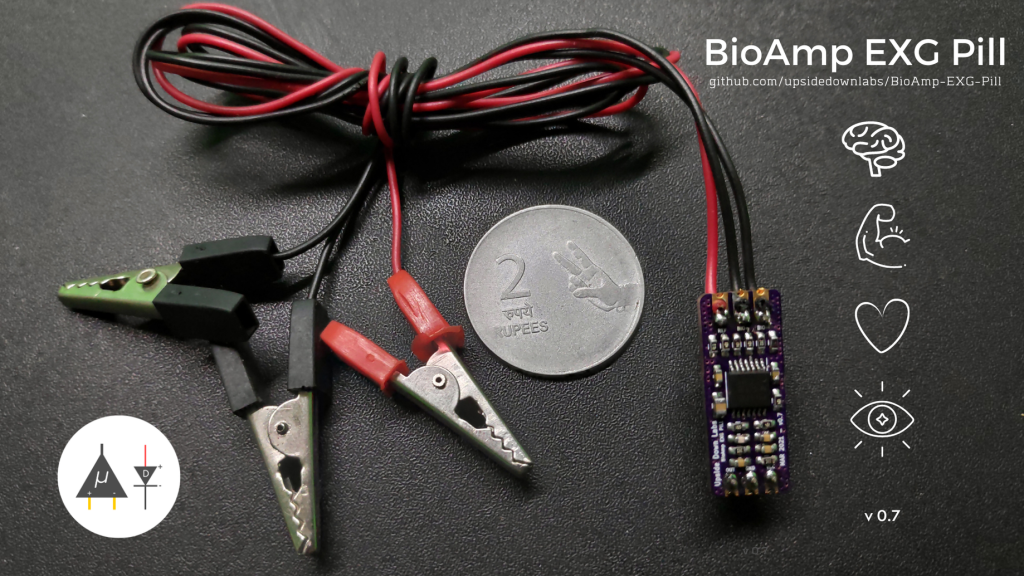
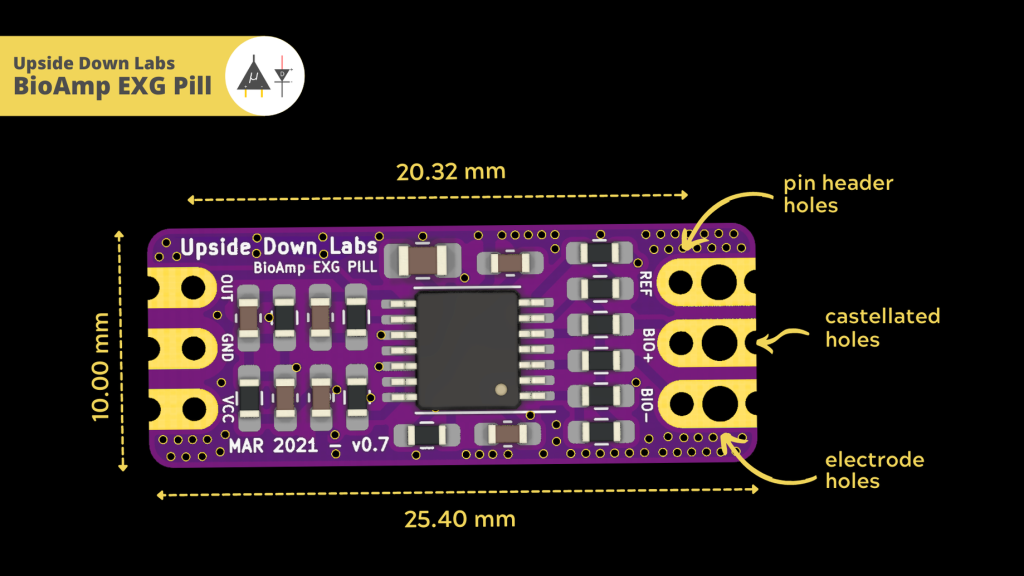
BioAmp EXG Pill is a small and elegant BioPotential board that you can use with any 5v micro with an ADC. It can be used to record research-grade ECG, EMG, EOG, and EEG without incorporating any filtering circuit/code!
Preferring to spend hours typing code instead of graphically pushing traces around in a PCB layout tool, [James Bowman] over at ExCamera Labs has developed CuFlow, a method for routing PCBs in Python. Whether or not you’re on-board with the concept, you have to admit the results look pretty good.
Key to this project is a concept [James] calls rivers — the Dazzler board shown above contains only eight of them. Connections get to their destination by taking one or more of these rivers which can be split, joined, and merged along the way as needed in a very Pythonic manner. River navigation is performed using Turtle graphics-like commands such as left(90) and the appropriately named shimmy(d)that aligns two displaced rivers. He also makes extensive use of pin / gate swapping to make the routing smoother, and there’s a nifty shuffler feature which arbitrarily reorders signals in a crossbar manner. Routing to complex packages, like the BGA shown, is made easier by embedding signal escapes for each part’s library definition.
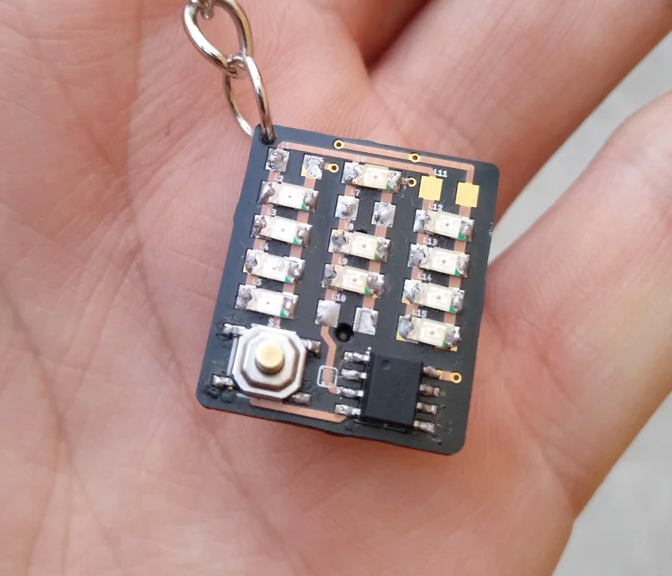
Today I am going to show you how to make a very cool LED keychain. To do this, we are going to use an ATtiny to make the LEDs blink and fade. This is going to help us to learn how to solder SMD components and also how to program an ATtiny.
You can also find the code here in case you want to modify it or even create a new one! This code has 4 modes: All on, slow blink, fade and fast blink that change every time we press the button and then it enters in sleep mode to save battery.
Once we have finished, we can carry our creation around with our keys as a keychain!
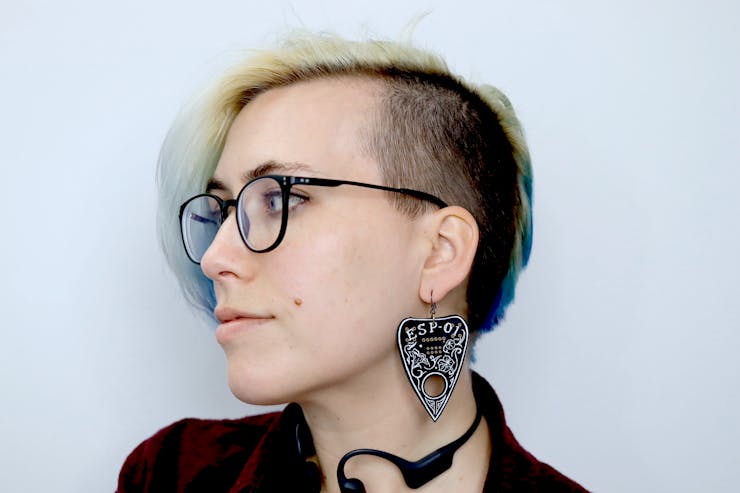
I’m building a suite of arcane tech tools that make everyday electronics tasks more beautiful. This one came out so nicely that the final version has a hole for an earring hoo
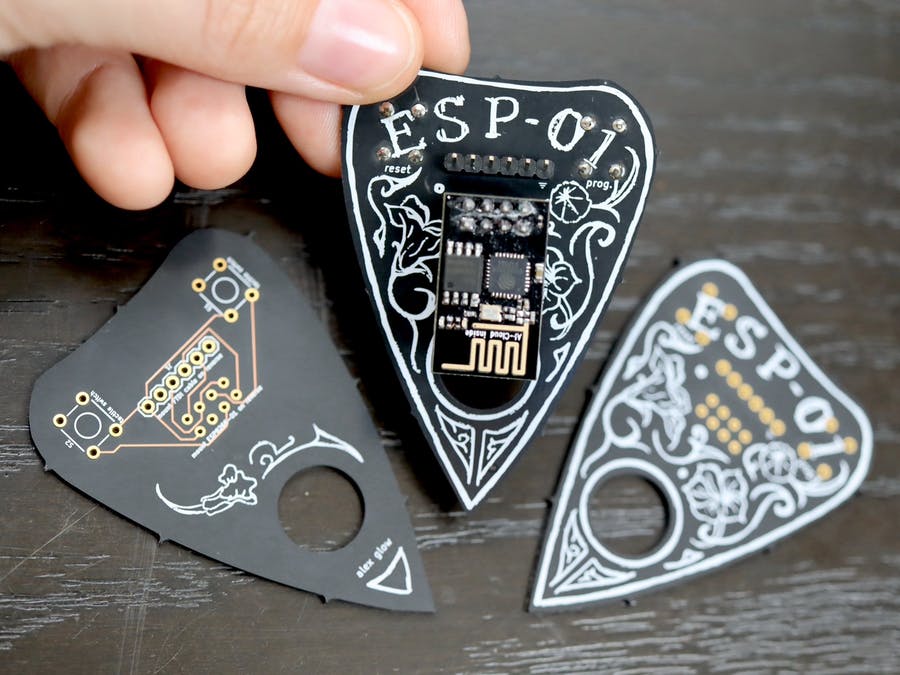
I’ve built a couple of ESP8266 programming jigs based on this in the past, and while they usually worked, sometimes there’d be issues attributable to loose wires, or other causes that would take ages to debug. So, when I decided to play with the ESP-01 module again, it was a no-brainer to design a PCB version.
Given the “ESP” naming of Espressif modules, I thought it’d be fun to make it in the shape of an Ouija-style talking board planchette.
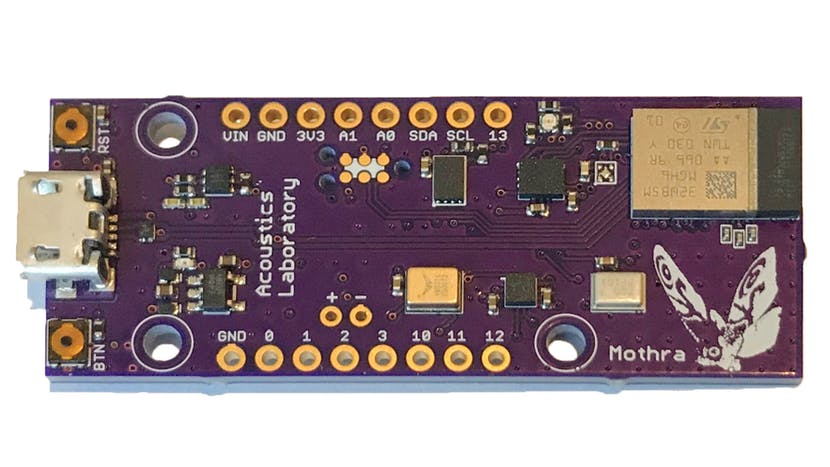
Many development boards feature a plethora of sensor types intended for prototyping an IoT device. Among those types are generally one sound sensor and one vibration sensor. Kris Winer, a one-person maker shop, is developing a purpose-specific sensor board containing multiple types of the same sensors. That board is Mothra, an acoustics laboratory on a stick.
The difference Mothra offers over traditional “all-in-one” sensor boards is that it only has two types of sensors: microphone and accelerometer. However, it has two of each, giving the board high sensitivity and offering very low-power sleep modes where either type of event can wake the microcontroller.
For the microcontroller module, Winer is using the STMicroelectronics BLE-enabled STM32WB. This module contains two microcontroller cores and a Bluetooth Low Energy radio. We hesitate to say “dual-core” because the cores are not at parity. One is an Arm Cortex-M0+ running at 32 MHz focused on BLE operations. While the other is an Arm Cortex-M4F running at 64 MHz and intended as the application processor. The module has 1 Mbyte flash, 256 kByte SRAM, and 68 GPIO pins. However, Mothra’s design uses 52 of those pins. The board breaks out eight digital I/O, two analog pins, and access to I2C.
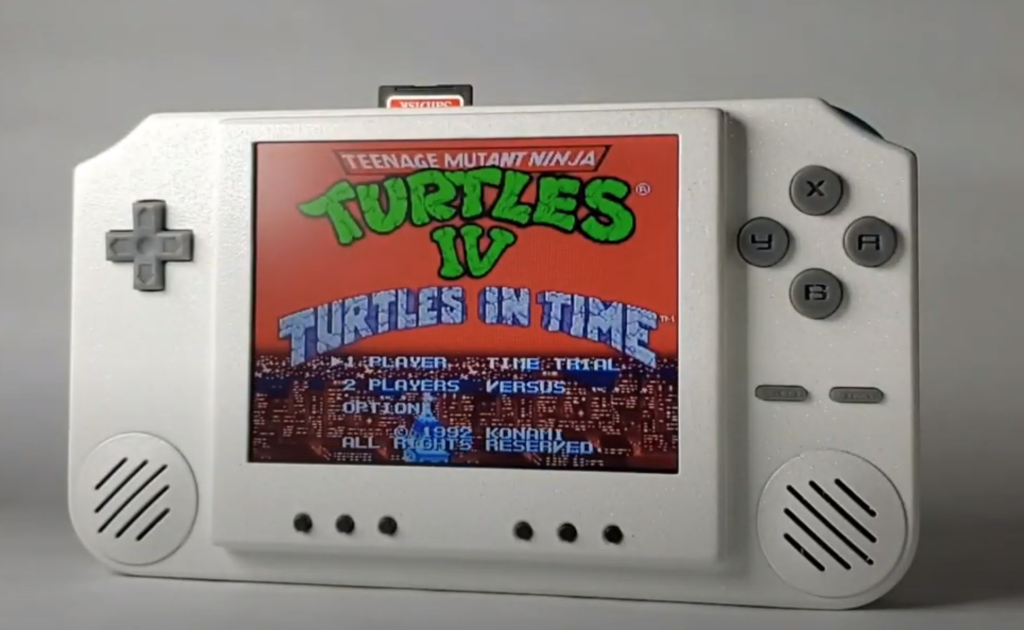
There’s always a story behind every project ever completed, and although this one started nearly 2 and a half years ago, I don’t feel that the most relevant side of this project was ever told. This was partially my fault with the original video I made to showcase it, as it really didn’t go into detail at all about what this actually was, why it was (self-proclaimed) the first one in the world and why there are likely to be no more ever made.
A short update about the progress with the sensor panel and photos of the final input panel board. I assembled the new boards and are testing the sensors. As soon as all tests are done, and I am happy with the results and the board’s design, I will write the next part. These are 940nm…
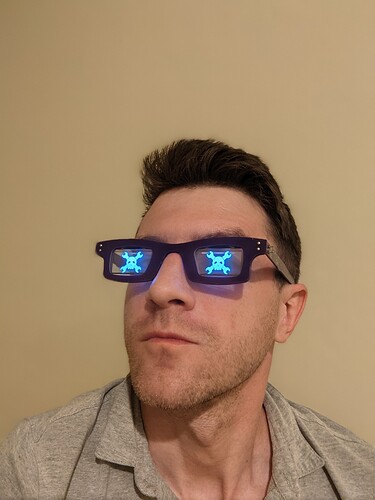
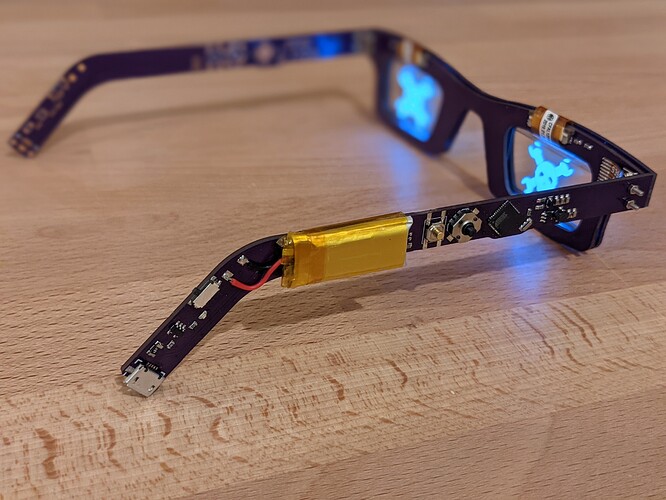
The glasses are made out of printed circuit boards from OSH Park. The electronics driving the two displays are entirely on the right side stem of the glasses along with a small 100mAh rechargeable battery that will run the glasses for a little more than an hour. The left side stem is the same PCB, just unpopulated.
The Open Hardware Summit is the annual conference organized by the Open Source Hardware Association a 501(c)(3) not for profit charity. It is the world’s first comprehensive conference on open hardware; a venue and community in which we discuss and draw attention to the rapidly growing Open Source Hardware movement.
Speakers include world renowned leaders from industry, academia, the arts and maker community. Talks cover a wide range of subjects from electronics, mechanics to related fields such as digital fabrication, fashion technology, self-quantification devices, and IP law. As a microcosm of the Open Source Hardware community, the Summit provides an annual friendly forum for the community. For over five years we have had an established fellowship which supports travel and admission for women and other minorities as well as hardship tickets for low income individuals. The Open Hardware Summit was founded in 2010 by Alicia Gibb and Ayah Bdeir with support from Peter Semmelhack and Bug Labs in its founding years. Read more about the history of the organization and feel free to contact us with any questions.





 OSH Park