The US is primed and ready for open source hardware to accelerate scientific breakthroughs, but open source hardware needs a cemented place on the intellectual property landscape within the sciences enabling a faster, more efficient acceleration. If we can cement science using open source hardware, we’ve got a path to expanding American manufacturing. Many businesses profit from open source hardware, demonstrating that it is a lucrative business model. The field of science needs equipment for all sorts of experiments and lab work. Let’s apply the groundwork already laid in the United States for open source hardware to be the default for science.
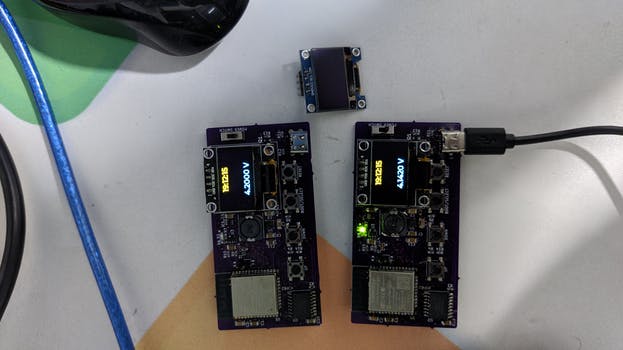
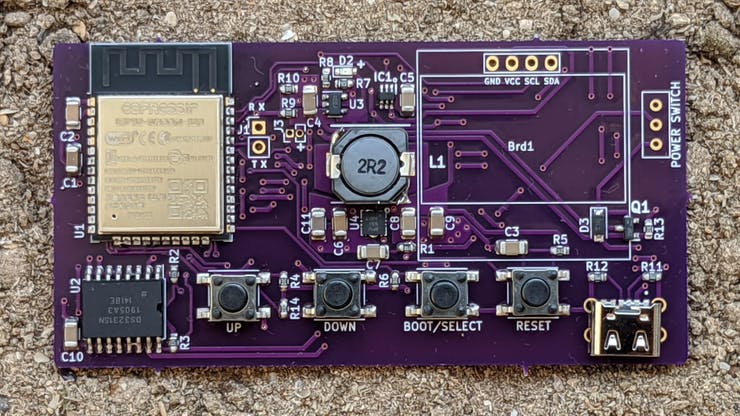
Cabe Atwell writes on Hackster about Open Authenticator by Vedant Parajape which uses an ESP32 to secure data and features an OLED display, 300mAh LiPo battery, and a USB Type-C port for charging:
“I fired up google and tried to search about it, and surprisingly it used a pretty amazing concept. It had a shared key with the server, and then it did some computation on the shared key and current UTC time to get a 6-digit number. So, the remote device just had to be accurate at timekeeping,” Parajape noted in his project log. He then took that information and designed his initial Open Authenticator prototype using a development kit he had on hand and an ESP32 module. It worked well enough, but he wanted a more streamlined platform, similar to RSA’s SecureID Key FOB.
Some people like to use hardware authenticators or security keys when working with public or company computers to keep their data private, certainly so when hackers can easily steal unprotected information. There are many great authenticators on the market that can be had for cheap, but others such as developer Vedant Parajape have designed their own platforms using readily-available hardware. Parajape became interested in authenticators after seeing his dad’s security keys and wondered how they could generate code without being connected to a network.
It sometimes seems as though antennas and RF design are portrayed as something of a Black Art, the exclusive preserve of an initiated group of RF mystics and beyond the reach of mere mortals. In fact though they have their difficult moments it’s possible to gain an understanding of the topic, and making that start is the subject of a video from [Andreas Spiess]. Entitled “How To Build A Good Antenna”, it uses the design and set-up of a simple quarter-wave groundplane antenna as a handle to introduce the viewer to the key topics.
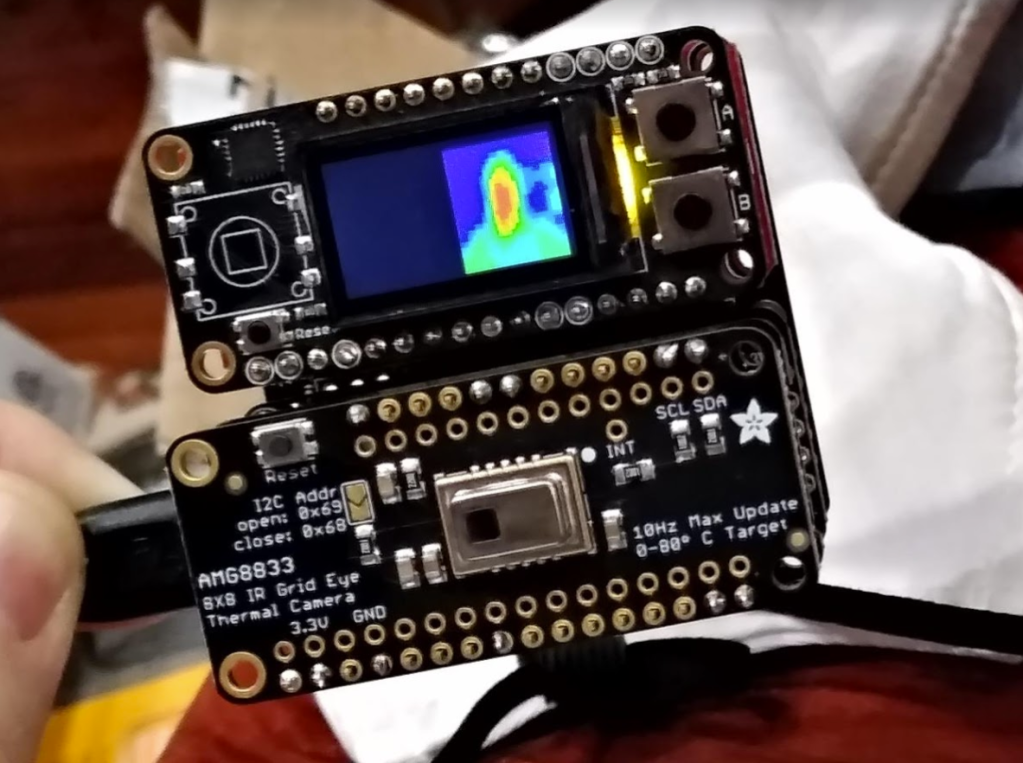
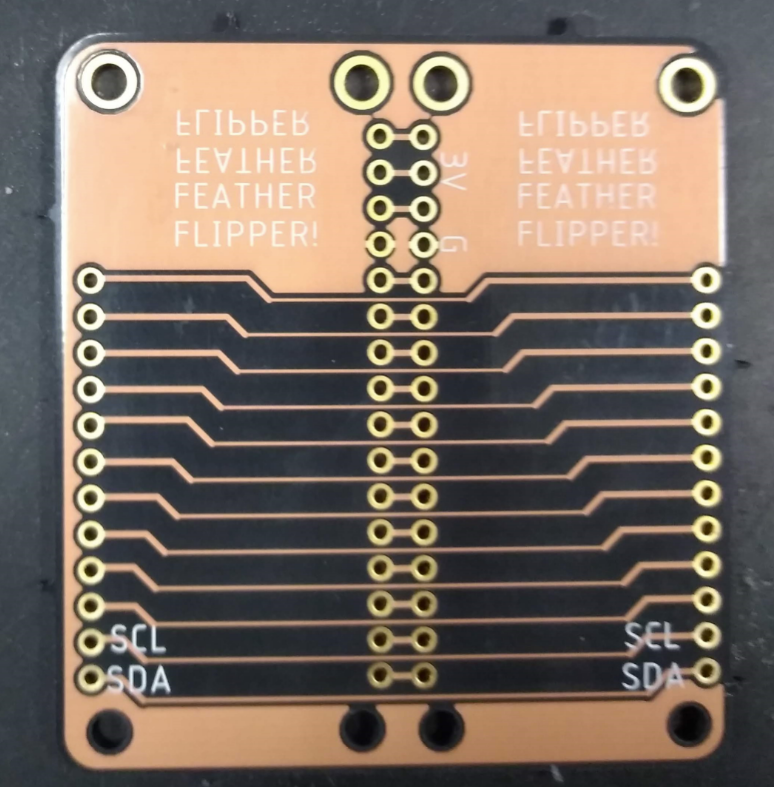
Lex Kravitz designed a small PCB for flipping the orientation of a feather board that is useful for flipping the orientation of a camera or screen wing:
I wanted to use an Adafruit AMG8833 thermal camera feather wing with the mini color TFT feather wing. Stacking them together with a Feather doubler board works fine (and the AMG8833 data looks very nice on the tiny screen!) but the problem is that the thermal camera is looking in the same direction as the screen. When you look at the screen all you see is…. you!
Hackaday has among its staff a significant number of writers who also hold amateur radio licenses. We’re hardware folks at heart, so we like our radios homebrew, and we’re never happier than when we’re working at high frequencies.
Amateur radio is a multi-faceted hobby, there’s just so much that’s incredibly interesting about it. It’s a shame then that as a community we sometimes get bogged down with negativity when debating the minutia. So today let’s talk about a few of my favourite things about the hobby of amateur radio. I hope that you’ll find them interesting and entertaining, and in turn share your own favorite things in the comments below.
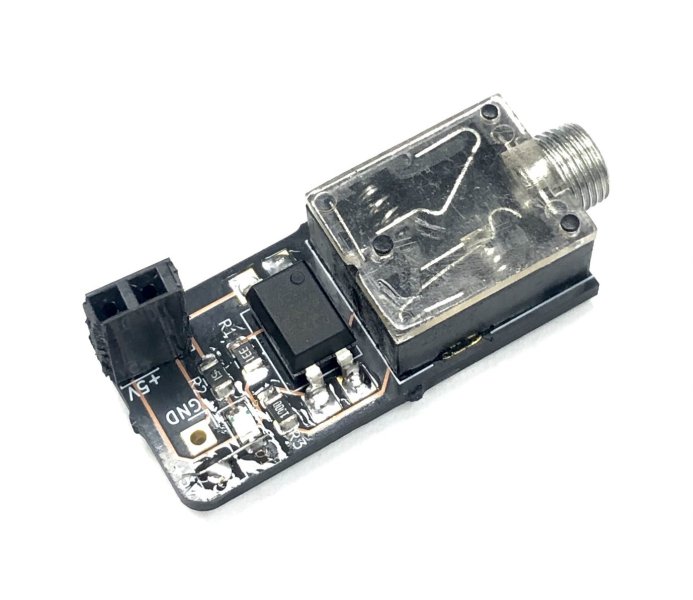
Many DSLR camera’s have the ability to have their shutters triggered remotely, this is often useful for keeping the camera perfectly still, but if you can automate the triggering it’s perfect for time lapse photography. This interface sits between a Raspberry Pi and a range of DSLR cameras creating lots of time lapse possibilities.
It’s compatible with Octoprint Octolapse plugin which means that you can use a high end DSLR to create beautiful time lapses of 3D prints magically growing out of your printer bed. Also on the product page there are example python scripts that enable quick setup for high quality time lapse. We note that although it’s sold as a Raspberry Pi interface, this device is happy with a 3.3V or 5V input and that it could be triggered by most micro controllers. If you have a Sony, Canon or Nikon DSLR then this should work out of the box, for other DSLR you might need an audio adaptor to get up and running.
On this episode of On the Metal, we interview @starsandrobots, autonomous aviation visionary, insatiably curious engineer, and relentless optimizer.https://t.co/nr6rEzAVsC
Welcome back to the second of our three part bonus season of On the Metal: episodes that we recorded after the end of Season 1 but before the onset of the pandemic.
On this episode of On the Metal, we interview Star Simpson, autonomous aviation visionary, insatiably curious engineer, and relentless optimizer. Join us as we learn how a pirated C++ compiler at an impressionable age pushed Star towards electronics, how a friend jockeying for Hacker News karma landed her work on late-night TV — and why you definitely didn’t want to be test pilot on the Piasecki PA-97. And if you find yourself hankering for a good read, you’re in luck: this episode ends with a flurry of book recommendations sure to sate your inner aviation buff.
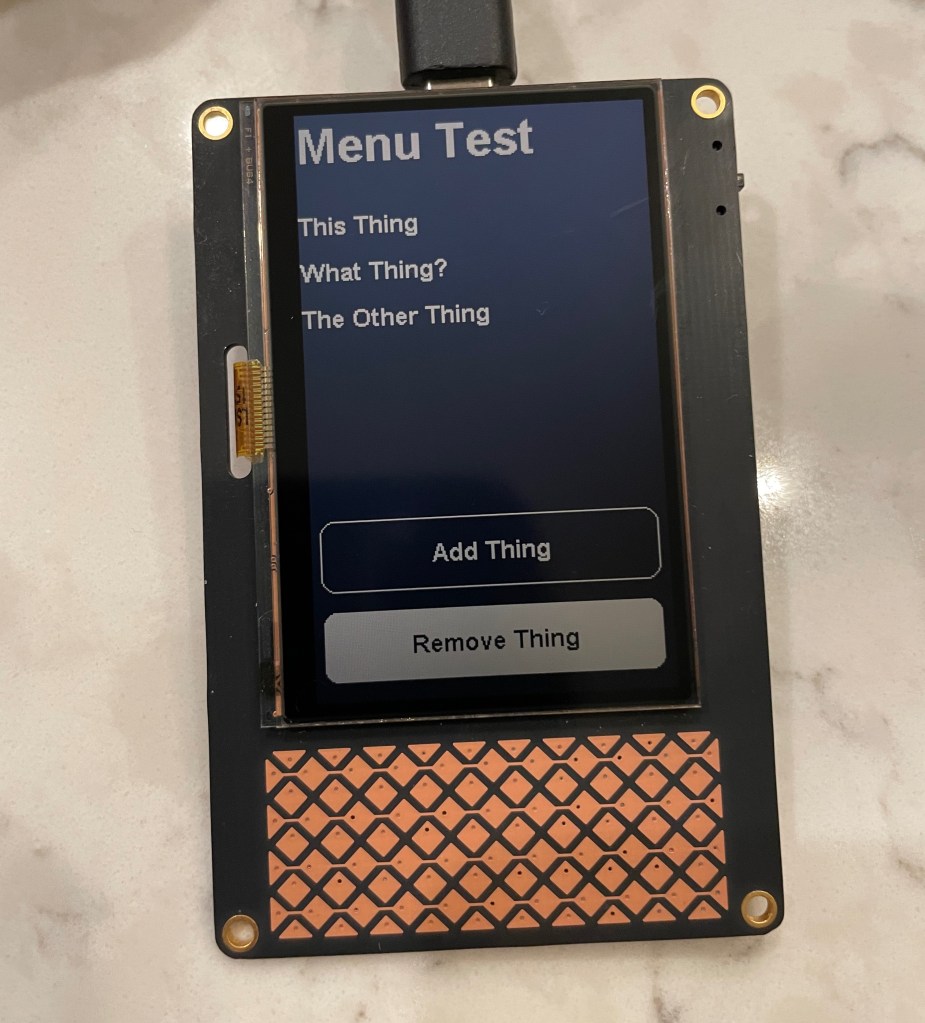
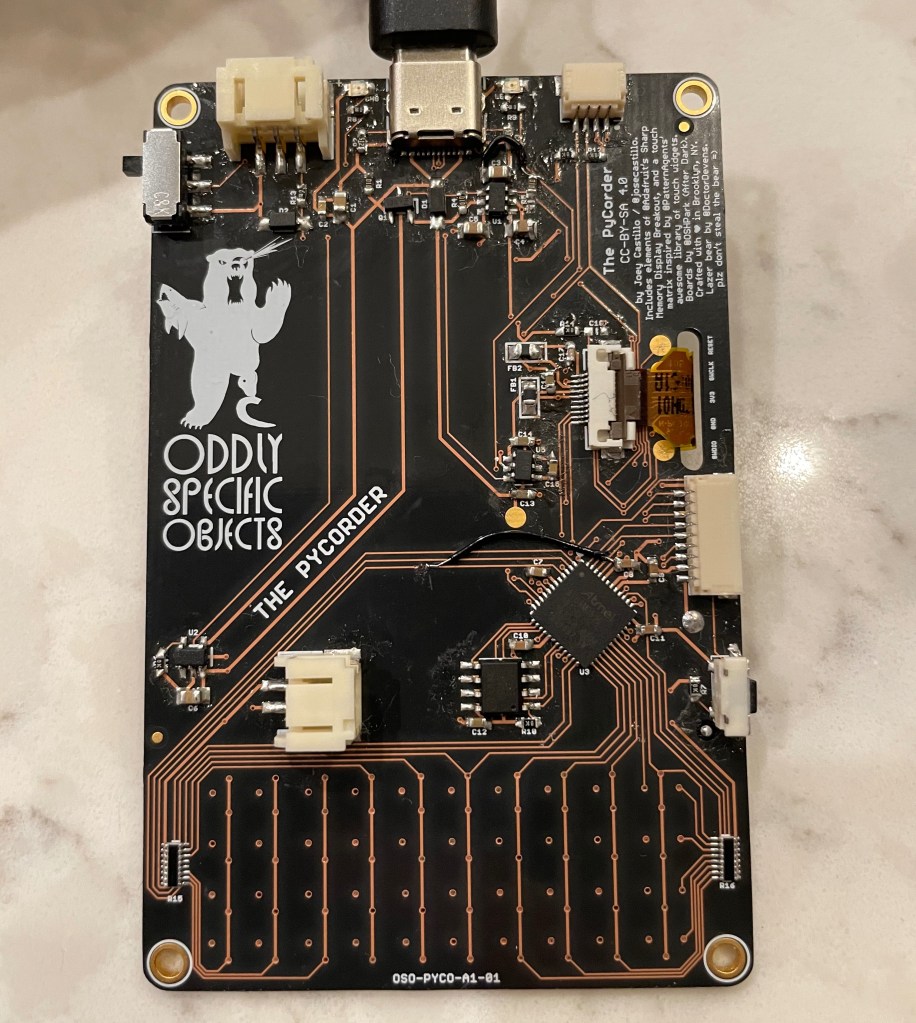
Joey Castillo is well-known for the awesome OpenBook e-reader project and has recently announced a new open source hardware project: the PyCorder!
Folks: meet the PyCorder! My take on a touchpad-based Sharp Memory Display gadget, in gorgeous @oshpark After Dark. More in the coming days, but feeling super stoked tonight because I finally got it up and running (and made a simple input task for circuitpyui; video in 2nd tweet) pic.twitter.com/5A9gXN4yPm
And has add-on sensors like moisture to monitor soil:
Now I wish I'd left it running longer, because about 20 minutes after this, it showed the moisture diffusing back up through the layers of soil. Alas, there are no more bone-dry plants in my house, so you'll have to take my word for it. Code here: https://t.co/vUJfJACle3pic.twitter.com/LbG2LpKnPr
The Pycorder isn’t remotely a medical gadget, but there’s tons of fun biosensing you can do with it. Here I’m using an infrared LED and phototransistor to visualize my pulse. The raw value dances around a bit, prolly in relation to blood oxygen lvl; still, a fun proof of concept! pic.twitter.com/qQ3itAKN49
In the last Circuit VR we looked at some basic op amp circuits in a simulator, including the non-inverting amplifier. Sometimes you want an amplifier that inverts the signal. That is a 5V input results in a -5V output (or -10V if the amplifier has a gain of 2). This corresponds to a 180 degree phase shift which can be useful in amplifiers, filters, and other circuits. Let’s take a look at an example circuit simulated with falstad.
Last time I mentioned two made up rules that are good shortcuts for analyzing op amp circuits…
Increasing government attention to “open” agendas, complemented by growing community capacity, have laid the groundwork for driving policy attention towards open hardware. The COVID-19 pandemic spotlighted the ability of open hardware communities to mobilize for disaster response, including through the design and production of personal protective equipment (PPE) and other medical supplies when traditional supply chains failed. A new Administration offers an opportunity to build on lessons learned from this unforeseen and extensive experiment in scaling open collaboration on hardware and also to revisit what has worked in the past for related fields such as community science and open source software. A whole-of-government approach to elevating open hardware, including for scientific research and disaster response, feels both timely and necessary in order to amplify effective activities and provide scaffolding for an even more impactful future.
To better understand potential opportunities, researchers and practitioners from the Wilson Center, Open Environmental Data Project, and University of Cambridge convened a workshop on October 28, 2020 to bring together members of the open hardware community, such as those involved in GOSH and OSHWA. Beginning with the question What are you most excited about in open science hardware right now, the workshop focused on establishing a value proposition for open hardware as a matter of public policy as well as elucidating open challenges that might be addressed by policy interventions. One goal of the workshop was to develop high-level consensus around “key messages,” for policy makers and a list of eleven suggestions was subsequently ranked by participants. This exercise made it clear that to refine these further, more work was needed to understand specific accelerators and barriers to the adoption and use of open hardware, and to align perspectives between the policy community and diverse developers and users of open hardware from academia, industry and community organisations operating across a broad range of disciplines.





 OSH Park