Watch Linux Boot On Your Hackaday Superconference Badge

Last year’s Hackaday Superconference badge was an electronic tour de force, packing an ECP5 FPGA shoehorned into a Game Boy-like form factor and shipping with a RISC-V core installed that together gave an almost infinite badge hacking potential. It did not however run Linux, and that’s something [Greg Davill] has addressed, as he’s not only running Linux on his badge, but also a framebuffer that allows him to use the badge screen as the Linux terminal screen. Finally you can watch Linux boot on your Superconference badge itself, rather than over its serial port.

He’s achieved this by changing essentially everything: from the new VexRiscv CPU core, to new video drivers and a VGA terminal courtesy of Frank Buss, now part of the LiteVideo project. It’s not quite a fully fledged Linux powerhouse yet, but you can find it in a GitHub repository should you have a mind to try it yourself. Paging back through his Twitter feed reveals the effort he’s put into this work over the last few months, and shows that it’s been no easy task.

For those keeping score at home, this is an open hardware design, running an open CPU core, with community-designed open-source peripherals, compiled by an open-source toolchain, running an open-source operating system. And it’s simply a fantastic demo for the badge, showing off how flexible the entire system is. One of the best parts of writing for Hackaday is that our community is capable of a huge breadth of amazing pieces of work, and this is an exemplar of that energy. We can’t wait to see what Greg and any other readers tempted to try it will come up with.

If you’d like to refresh your memory over the 2019 Supercon badge, here’s our write-up at the time.

via Watch Linux Boot On Your Hackaday Superconference Badge — Hackaday

Quote

Software Defined Everything with Mike Ossmann and Kate Temkin


Software defined radio has become a staple of the RF tinkerer, but it’s likely that very few of us have ever taken their software defined toolchain outside the bounds of radio. It’s an area explored by Mike Ossmann and Kate Temkin in their newly published Supercon talk as they use GNU Radio to do some things that you might find unexpected.

For most people, a software defined radio is a device. An RTL-SDR dongle perhaps, or the HackRF that a popular multi-tool for working in the radio frequency realm. But as they explain, the SDR hardware can be considered merely as the analogue front end, being just the minimal analogue circuitry coupled with a digitiser. The real software-defined part comes — as you might expect — in the software

Kate and Mike introduce GNU Radio Companion — the graphical UI for GNU Radio — as their tool of choice and praise it’s use as a general purpose digital signal processing system whether or not that includes radio. Taking their own Great Scott Gadgets GreatFET One USB hackers toolkit peripheral as an input device they demonstrate this by analysing the output from a light sensor. Instantly they can analyse the mains frequency in a frequency-domain plot, and the pulse frequency of the LEDs. But their bag of tricks goes much deeper, exploring multiple “atypical use cases” that unlock a whole new world through creative digital signal processing (DSP).

via Software Defined Everything with Mike Ossmann and Kate Temkin — Hackaday

Quote

Chat about Open-Source Neuroscience Hardware today on Hackaday

Join us on Wednesday, February 19 at noon Pacific for the Open-Source Neuroscience Hardware Hack Chat with Dr. Alexxai Kravitz and Dr. Mark Laubach!

There was a time when our planet still held mysteries, and pith-helmeted or fur-wrapped explorers could sally forth and boldly explore strange places for what they were convinced was the first time. But with every mountain climbed, every depth plunged, and every desert crossed, fewer and fewer places remained to be explored, until today there’s really nothing left to discover.

Unless, of course, you look inward to the most wonderfully complex structure ever found: the brain. In humans, the 86 billion neurons contained within our skulls make trillions of connections with each other, weaving the unfathomably intricate pattern of electrochemical circuits that make you, you. Wonders abound there, and anyone seeing something new in the space between our ears really is laying eyes on it for the first time.

But the brain is a difficult place to explore, and specialized tools are needed to learn its secrets. Lex Kravitz, from Washington University, and Mark Laubach, from American University, are neuroscientists who’ve learned that sometimes you have to invent the tools of the trade on the fly. While exploring topics as wide-ranging as obesity, addiction, executive control, and decision making, they’ve come up with everything from simple jigs for brain sectioning to full feeding systems for rodent cages. They incorporate microcontrollers, IoT, and tons of 3D-printing to build what they need to get the job done, and they share these designs on OpenBehavior, a collaborative space for the open-source neuroscience community.

Join us for the Open-Source Neuroscience Hardware Hack Chat this week where we’ll discuss the exploration of the real final frontier, and find out what it takes to invent the tools before you get to use them.

Our Hack Chats are live community events in the Hackaday.io Hack Chat group messaging. This week we’ll be sitting down on Wednesday, February 19 at 12:00 PM Pacific time. If time zones have got you down, we have a handy time zone converter.

via Open-Source Neuroscience Hardware Hack Chat — Hackaday

Quote

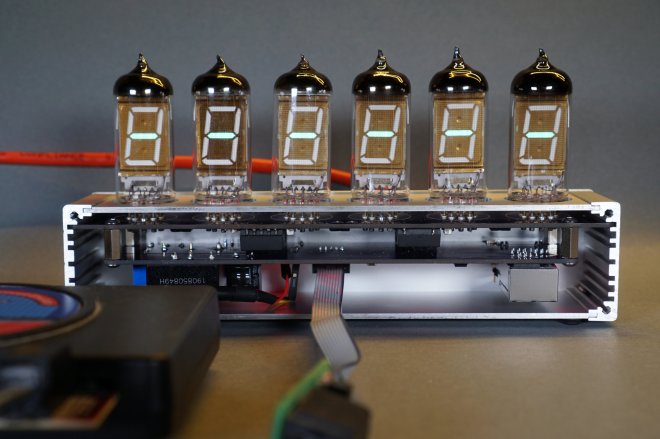
A Network Attached VFD Tube Clock

The elegance of Power over Ethernet (PoE) is that you can provide network connectivity and power over a single cable. Unfortunately not nearly enough hardware seems to support this capability, forcing intrepid hackers to take matters into their own hands. The latest in this line of single-cable creations is this beautiful Vacuum Fluorescent Display (VFD) clock from [Glen Akins].

3

One of the key advantages VFDs have over their Nixie predecessors is greatly reduced energy consumption, and after [Glen] ran the numbers, he saw that a display using six VFD tubes could easily be powered with standard PoE hardware. With this information, he started designing the PCB around the early 1990s era IV-12 tube, which has the advantage of being socketed so he could easily remove them later if necessary.

[Glen] first had to create a schematic and PCB footprint for the IV-12 tube that he could import into Eagle, which he was kind enough to share should anyone else be working with these particular tubes down the line. After a test of the newly designed socket was successful, he moved onto the rest of the electronics.

The clock is powered by a Microchip PIC18F67J60, which connects to the Ethernet network and pulls the current time down from NTP. After seeing so many clocks use an ESP to connect to the Internet over WiFi, there’s something refreshing about seeing a wired version. The tube segments are driven by a HV5812, also Microchip branded. Lastly, [Glen] used a number of DC/DC converters to generate the 1.5 V, 3.3 V, 5 V, and 25 V necessary to drive all the electronics and VFDs.

We absolutely love the simplicity of this clock, from its sleek aluminum enclosure to that single RJ45 jack on the back. But if you’re looking for something with a bit more flash, [Glen] also put together some PoE Christmas lights over the holidays which share a number of design elements with this project.

via A Network Attached VFD Tube Clock — Hackaday

Quote

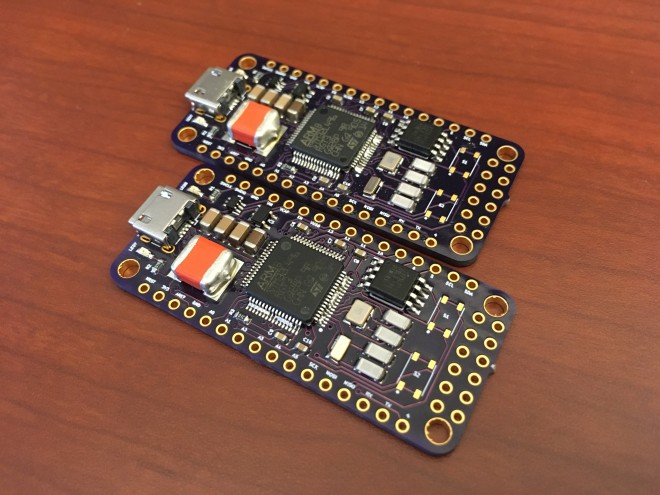
Junebug Chipsat dev board

Brad Denby designed this chipsat dev board for low-power, embedded computing in space that is one of the winners of the Take Flight with Feather contest:
3538901577800839667

Junebug

Chipsat development board for low-power, embedded computing in space

Junebug is a cutting-edge addition to the Feather ecosystem. It acts as a development board for chipsats – an emerging class of space system. It offers unique support for batteryless, intermittent computing. The FPU, DSP instructions, and storage space allow advanced sensor data processing with ML. Junebug is easy to manufacture, with parts selected to allow hand-assembly.

The schematic, PCB design, Gerber and Drill files, bill of materials, and other files are provided in the linked GitHub repository.

Junebug Chipsat dev board

Winners of the Take Flight with Feather Contest

Congratulations to Joey Castillo for winning the Take Flight with Feather contest with the The Open Book by Oddly Specific Objects:

Hackaday: Winners of the Take Flight with Feather Contest

It’s hard to beat the fidelity and durability of printed text on paper. But the e-paper display gets pretty close, and if you couple it will great design and dependable features, you might just prefer an e-reader over a bookshelf full of paperbacks. What if the deal is sweetened by making it Open Hardware? The Open Book Project rises to that challenge and has just been named the winner of the Take Flight with Feather contest.

This e-reader will now find its way into the wild, with a small manufacturing run to be put into stock by Digi-Key who sponsored this contest. Let’s take a closer look at the Open Book, as well as the five other top entries.

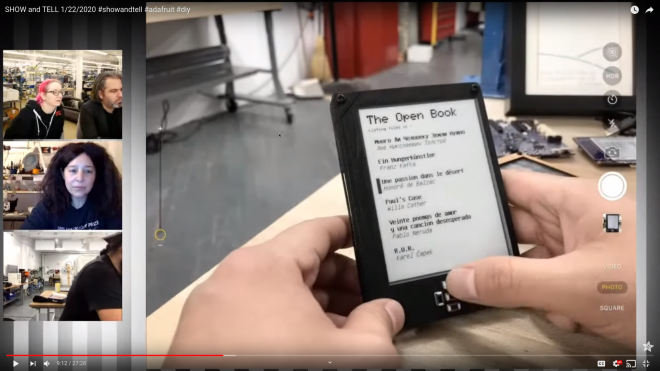
You may remember seeing the Open Book back in October when Tom Nardi looked in on early testing for the board. It was prototyped using the Adafruit Feather, which of course was the main requirement of the contest. The controller is now built into the board for standalone functionality with the Feather header providing an opportunity for expansion.

The screen is 4.2″ with a resolution of 300×400. It reads files from a microSD card and uses seven buttons on the front of the board for user input. A dedicated flash chip stores language files with the character sets of your choice. The small LiPo cell can be charged via the USB port, and of course e-paper helps greatly in reducing the power consumption of the reader.

You’ll find a few extras on the back. There’s a headphone jack for listening to audio books, and get this, a built-in microphone and a TensorFlow-trained model allow for voice control! There are STEMMA headers to add your own hardware options, and designs for laser-cut and 3D-printed enclosures.

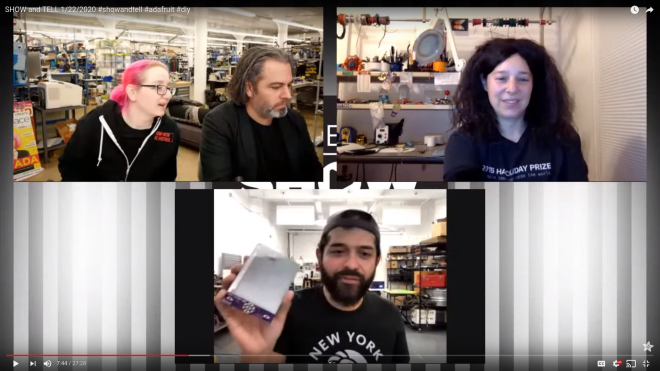
and checkout Joey on Adafruit Show n Tell last night!

Screenshot from 2020-01-23 11-01-14

Screenshot from 2020-01-23 10-58-16

Quote

Open Laptop Soon to be Open For Business

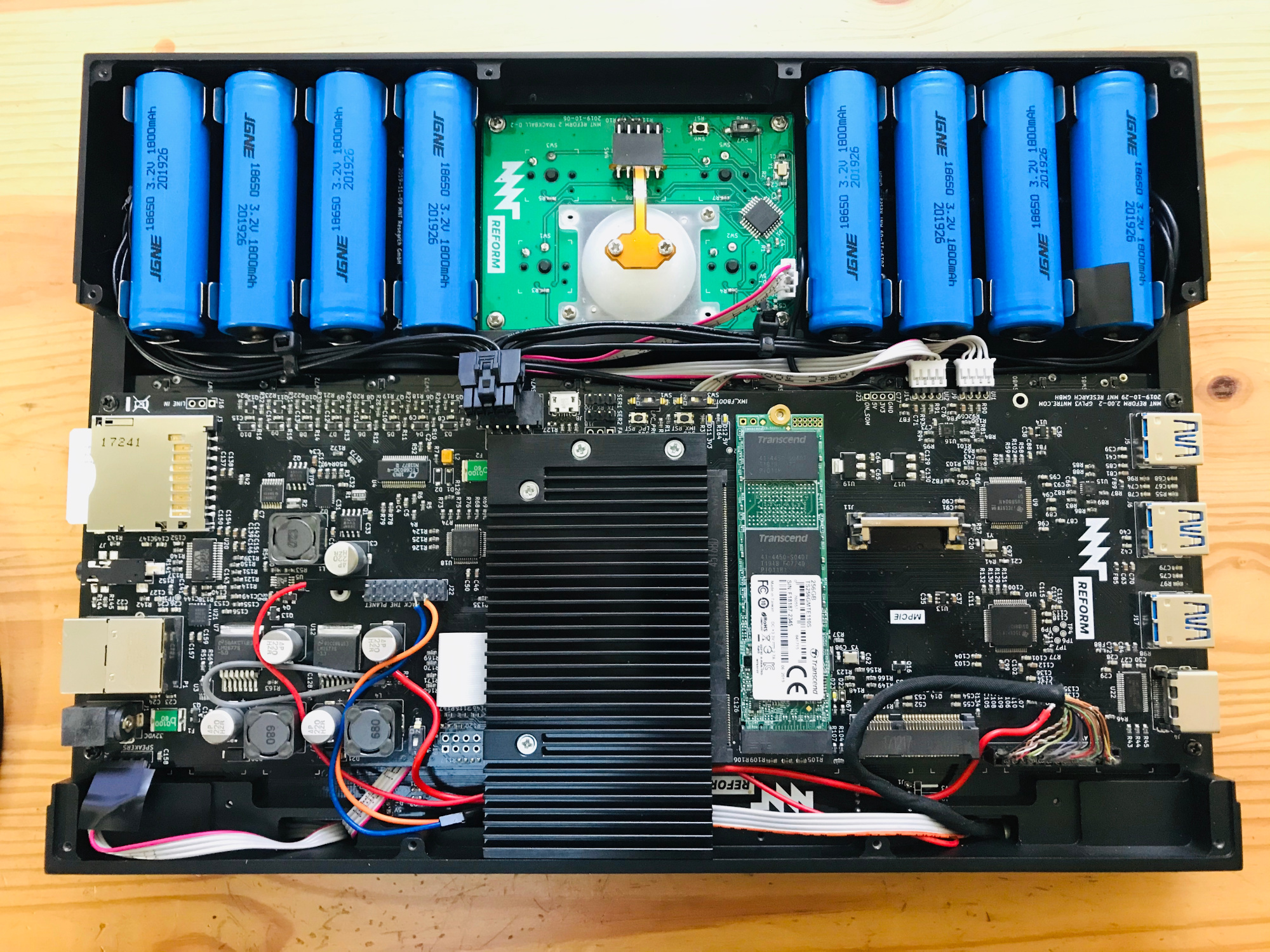
How better to work on Open Source projects than to use a Libre computing device? But that’s a hard goal to accomplish. If you’re using a desktop computer, Libre software is easily achievable, though keeping your entire software stack free of closed source binary blobs might require a little extra work. But if you want a laptop, your options are few indeed. Lucky for us, there may be another device in the mix soon, because [Lukas Hartmann] has just about finalized the MNT Reform.

Since we started eagerly watching the Reform a couple years ago the hardware world has kept turning, and the Reform has improved accordingly. The i.MX6 series CPU is looking a little peaky now that it’s approaching end of life, and the device has switched to a considerably more capable – but no less free – i.MX8M paired with 4 GB of DDR4 on a SODIMM-shaped System-On-Module. This particular SOM is notable because the manufacturer freely provides the module schematics, making it easy to upgrade or replace in the future. The screen has been bumped up to a 12.5″ 1080p panel and steps have been taken to make sure it can be driven without blobs in the graphics pipeline.

via Open Laptop Soon to be Open For Business — Hackaday

Quote

Why Do Resistors Have a Color Code?

One of the first things you learn in electronics is how to identify a resistor’s value. Through-hole resistors have color codes, and that’s generally where beginners begin. But why are they marked like this? Like red stop signs and yellow lines down the middle of the road, it just seems like it has always been that way when, in fact, it hasn’t.

Before the 1920s, components were marked any old way the manufacturer felt like marking them. Then in 1924, 50 radio manufacturers in Chicago formed a trade group. The idea was to share patents among the members. Almost immediately the name changed from “Associated Radio Manufacturers” to the “Radio Manufacturer’s Association” or RMA.  There would be several more name changes over the years until finally, it became the EIA or the Electronic Industries Alliance. The EIA doesn’t actually exist anymore. It exploded into several specific divisions, but that’s another story.

This is the tale of how color bands made their way onto every through-hole resistor from every manufacturer in the world.

via Why Do Resistors Have a Color Code? — Hackaday

Quote

LC Oscillators, Animated

e wish that all the beautiful animations that are available today to understand math and electronics had been around when we were in school. Nonetheless, they are there for today’s students and [Learn Engineering] has another gorgeous one covering LC oscillation. Check it out, below.

If you are thoroughly grounded — no pun intended — in LC circuits, you probably won’t learn anything new. However, the animations are worth watching, just to admire them, if nothing else.

We were amused by his statement: “… looks as if the capacitor is saying: ‘you take the energy’ and the inductor then says, ‘no, you take my energy.’” Then we were further amused by [Seraph’s] comment which added, “Resistance in the circuit: ‘Alright, I’ll take the energy, then.’”

Of course, there are other ways to think of an LC circuit. The math isn’t that hard. Most of us learned that the circuit’s mechanical analog is a mass on a spring or a pendulum. The mass’s potential energy stretches out the spring until the spring then pulls it back until the potential energy of the mass pulls it back down.

If you want to experiment virtually, try the Falstad simulator. Just remember that if you think the sine wave isn’t dampening to look at the scale. As the sine wave dampens, the simulator will adjust the scale so you keep seeing approximately the same size sine wave.

We never get tired of watching the Fourier series explained graphically. Or anything from [3Blue1Brown].

via LC Oscillators, Animated — Hackaday

Quote

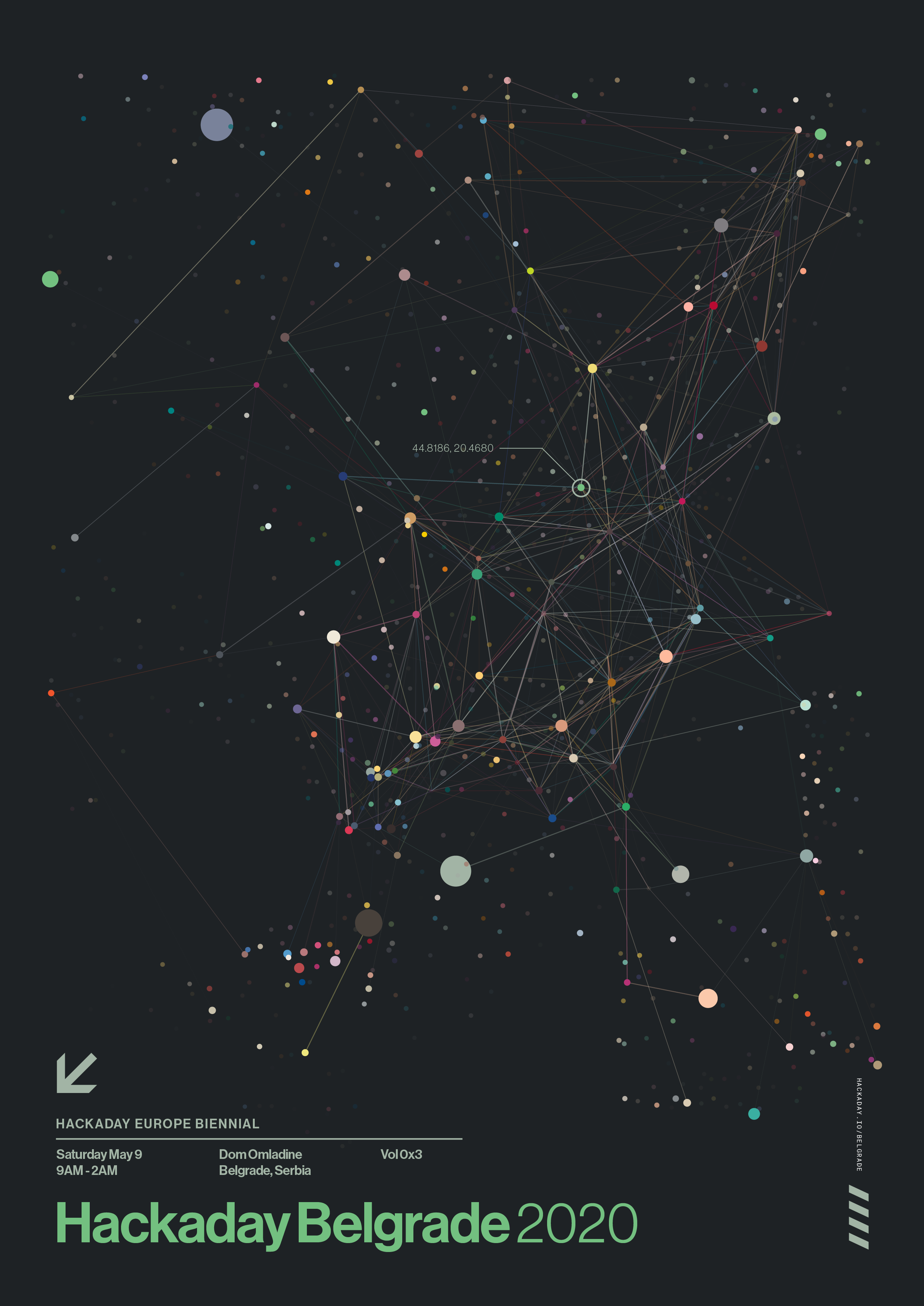
Hackaday Belgrade: Call for Proposals

Join Hackaday in Belgrade, Serbia on May 9th, 2020 for the Hackaday Belgrade conference!

The biennial hardware conference is just seventeen weeks from now. Early Bird tickets will go on sale shortly, but beginning right now you can hack your way into the conference by submitting a talk proposal. Accepted speakers receive free admission, plus everyone who submits a quality talk proposal will be given priority when tickets go on sale.

Yes, I’m talking to you. Hackaday strives to include first-time speakers in the slate of presenters at our conferences. We’re looking for unique, cutting-edge, whimsical, crazy, formidable, or world-changing topics revolving around hardware creation. From learning new tools or techniques to fabrication adventures, from code-wrangling that firmware project to pulling off an art installation, and from forgotten hardware history to the impossible made possible on your own workbench, we need to hear your stories!

That project for which you went into the deep weeds and worked your way back out again? Everyone at a Hackaday conference wants to hear about it and in the greatest detail possible. After all, we’re your fellow hackers. In fact, you should probably bring the hardware along for the ride.

WE NEED YOU

None of this happens in a vacuum. This is the third Hackaday Belgrade conference, which have now settled into a tick-tock cadence of even-numbered years. The first two both sold out, this one will as well, and the result is always an action-packed, nearly 24-hour marathon sprint of talks, workshops, and hardware hacking. But the only reason this works is because amazing people just like you make it a priority in their life to be there.

via Hackaday Belgrade: Call for Proposals — Hackaday

Quote