We’ve been big fans of the Arduboy since [Kevin Bates] showed off the first prototype back in 2014. It’s a fantastic platform for making and playing simple games, but there’s certainly room for improvement. One of the most obvious usability issues has always been that the hardware can only hold one game at a time. But thanks to the development of an official add-on, the Arduboy will soon have enough onboard storage to hold hundreds of games
Even the rear silkscreen was a community effort.
The upgrade takes the form of a small flexible PCB that gets soldered to existing test points on the Arduboy. Equipped with a W25Q128 flash chip, the retrofit board provides an additional 16 MB of flash storage to the handheld’s ATmega32u4 microcontroller; enough to hold essentially every game and program ever written for the platform at once.
Of course, wiring an SPI flash chip to the handheld’s MCU is only half the battle. The system also needs to have its bootloader replaced with one that’s aware of this expanded storage. To that end, the upgrade board also contains an ATtiny85 that’s there to handle this process without the need for an external programmer. While this is a luxury the average Hackaday reader could probably do without, it’s a smart move for an upgrade intended for a wider audience.
We’re proud to announce the Hackaday Remoticon, taking place everywhere November 6th – 8th, 2020. It’s a weekend packed with workshops about hardware creation, held virtually for all to enjoy.
But we can’t do it without you. We need you to host a workshop on that skill, technique, or special know-how that you acquired through hard work over too many hours to count. Send in your workshop proposal now!
What is a remoticon?
The Hackaday Remoticon achieves something that we just couldn’t do at the Hackaday Superconference: host more workshops that involve more people. Anyone who’s been to Supercon over the past six years can tell you it’s space-limited and, although we do our best to host a handful of workshops each day, those available seats are always in high demand.
We’re sad that we can’t get together in person for Supercon this year, but now we have an opportunity to host more workshops, engaging more live instructors and participants because they will be held virtually. This also means that we can make recordings of them available so that more people can learn from the experience. This is something that we tried way back during the first Supercon with Mike Ossmann’s RF Circuit Design workshop and 140,000 people have watched that video. (By the way, that link is worth clicking just to see Joe Kim’s excellent art.)
Now I’m not saying that your workshop will have a view count into six digits. What I am saying is that you have skills worth sharing, and people are hungry to learn. Since traveling to massive conferences is on pause for a while, spinning up a way to share your experience with others is a superb use of your time.
We need you to submit a workshop proposal! This can take any shape that makes sense for your topic, but here’s the gist of how this might work. Each accepted workshop makes a list of necessary materials and where to get them so that participants can order ahead of time and follow along. Live workshops will be held via video conference, with periods of instruction, work time, and recap that lets participants ask questions and show results as they go.
Wait, wait, wait. Before you click away to the next awesome Hackaday article, don’t assume you have nothing to teach. In fact, do the opposite. Assume you have rare and specialized knowledge on something (because you do!) and seek that out. Then unleash your mind to form a workshop idea around it. Hackaday is filled with weird, wild, and interesting projects, and we always want to see more of them. Share the wealth so that more people begin to walk the path of the hardware hacker
It’s like the dystopian future arrived out of the blue. From one year to the next we went from holing up in overly air-conditioned hotel ballrooms and actually meeting our fellow meatbags in the flesh, to huddling in our pods and staring at the screens. I’m looking for the taps to hook me in to the Matrix at this point.
But if you haven’t yet received your flying car or your daily Soma ration, you can still take comfort in one thing: all of the hacker conferences are streaming live, as if it were some fantastic cyber-future! In fact, as we type this, someone is telling you how to print your way to free drinks on USAir flights as part of HOPE’s offering, but the talks will continue for the next few days. (Go straight to live stream one.)
And next weekend is DEF CON in Safe Mode with Networking. While we can totally imagine how the talks and demo sessions will work, the Villages, informal talks and hack-togethers based on a common theme, will be a real test of distributed conferencing.
As we’ve said many times in the past, the creation of custom cases and enclosures is one of the best and most obvious applications for desktop 3D printing. When armed with even an entry-level printer, your projects will never again have to suffer through the indignity of getting hot glued into a nondescript plastic box. But if you’re printing with basic PLA, you need to be careful that nothing gets too hot inside.
Which was a problem when [Oleg Vint] started work on this 3D printed case for the popular TS100 soldering iron. But with the addition of a standard 608 bearing, the case provides a safe spot for the iron to cool off before it gets buttoned back up for storage. Of course, you can also use the flip-out perch to hold the iron while you’re working.
As [Oleg] explains on the Thingiverse page for the case, he actually blended a few existing projects together to arrive at the final design. Specifically, the idea of using the 608 bearing came from a printable TS100 stand originally designed in 2017 by [MightyNozzle]. Released under Creative Commons, [Oleg] was able to mash the bearing stand together with elements from several other printable TS100 cases to come up with his unique combined solution.
Jerry Lawson was an engineer from New York who had arrived at Fairchild Semiconductor in 1970 after having worked at various companies in the defense electronics industry. Working as part of their customer engagement effort, he achieved prominence in the company by revolutionising the point of contact with the customer using an RV (yes, a camping vehicle) converted as a demonstration lab for Fairchild products. He was lucky enough to be in the right place at the right time to be a member of the famous Homebrew Computer Club, cradle of so much of the later microcomputer industry, which put him at the center of a web of contacts covering the games business as it was in the early 1970s.
Though his employer was not involved in gaming, Jerry got his start in that field as a side project. When his friend Allan Alcorn installed the first Pong machine in Andy Capp’s Tavern it suffered from customers interfering with its coin mechanism to score free plays, so Jerry produced a game cabinet of his own called Demolition Derby that had a more robust system. This led to Fairchild Semiconductor International offering him the chance to start their new video game division, and the road to the Channel F was laid.
[..]
There are many names from the annals of computing history who roll off the tongue. People such as Jobs and Wozniak, Bushnell, Dabney, Sinclair, Miyamoto, or Miner. We should also add Jerry Lawson to that list, as his vision to make one console and sell multiple games, done inexpensively with the use of the PCB edge connector, set the standard for decades to come.
[LearnElectronics] was skeptical of the 100 MHz claim and it looks like it is more like a 30 MHz analog bandwidth. Despite that, it does seem like a pretty capable 30 MHz scope in a very handy form factor and a very cheap price: as little as $120 or so, depending on where you shop.
The Dream Team program is an exciting new element of the 2020 Hackaday Prize, with twelve people accepted to work full-time on a specific problem for each of our non-profit partners this summer. Each team of three is already deep into an engineering sprint to pull together a design, and to recognize their efforts, they’ll be receiving a $3,000 monthly microgrant during the two-month program.
Join us after the break to meet the people that make up each of the teams and get a taste of what they’re working on. We’ll be following along as they publish detailed work logs on the Dream Team project pages.
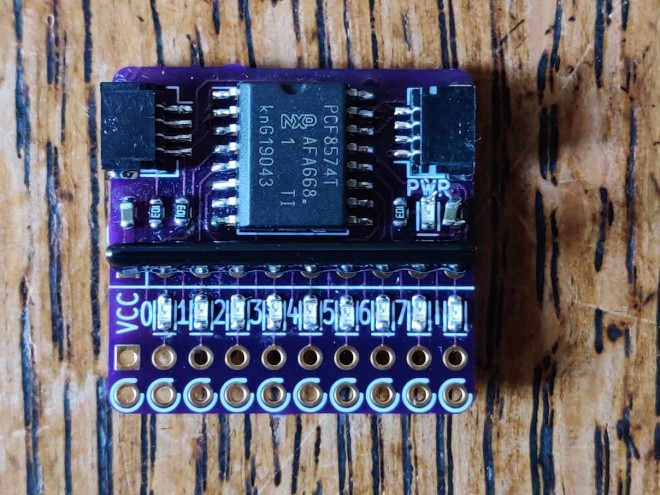
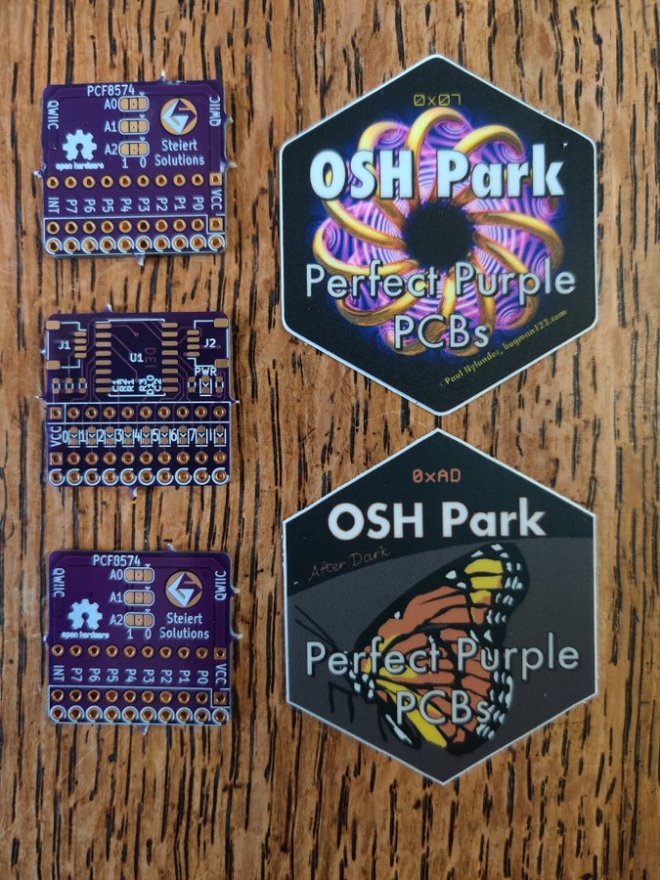
This is a handy general purpose input/output Qwiic board. It provides 8 GPIO each with an LED indicator, and goes to a pin in a dual row 100mil header. The LEDs provides a nice visual output. The second row on the header is grounded, so jumpers can be used to drive the pins low for basic inputs. The 100mil pitch headers are also convenient for connecting to external circuits as well. The interrupt and VCC pins also have their own LEDs and header pins. There are two Qwiic connectors for pass through connections.
Classes are Tuesdays at 19:00 IST. Classes are recorded and released on the course page within a few weeks so you can learn at your convenience. Office Hours are Fridays at 1630 IST and limited to 30 people per session. A second session in evening PDT will be offered August 2020.
The complete course is 4 classes long. For those who would like to attend each class, please sign up for each class individually.
Overview: We’ll start off with a hand drawn schematic, and progress from schematic capture to creating production files such as Gerbers, BoM, and 3D CAD export. We’ll then switch to FreeCAD and do a simple enclosure design for our project.
Schedule: The course will consist of four sessions total. Each section will contain a video component and an office hour component where the instructor will be available for questions.
Prerequisites: It will help to have a good understanding of electronics and some basic understanding of engineering drawing.
HackadayU has a new class, KiCad + FreeCAD with instructor @anool!
If you’ve got a few self-designed PCBs under your belt, you probably know the pain of missing some little detail and having to break out the bodge wires to fix it. So we feel for [Arsenio Dev], who placed an SD card slot next to an SoC, only to find that it was the wrong way round. Rather than tossing it in the bin, he decided to employ a particularly crafty set of bodge wires that curve over the board and connect to an SD card adapter on the other side.
Our attention was taken by the board itself, he’s posted little information about it and taken pains to conceal one of the pieces of text on it. Since it has an Octavo Systems BeagleBone-on-chip, a slot for a cellular modem, and a connector marked “CONNECT AERONET HERE” which we are guessing refers to the Aeronet sun photometry network, we’re guessing it might be a controller for remotely-sited nodes for that system. Either way it’s enough to have us intrigued, and we wish him every success with the next spin.





 OSH Park