
Watch Ben Heck assemble his Z80 Note board this video:
Uncategorized
Why Does Solder Smoke Always Find Your Face?

For some of us the smell of rosin soldering flux vaporizing from the tip of an iron as a project takes shape is as evocative as the scent of a rose on a summer’s day. We’ve certainly breathed enough of it over the years, as it invariably goes from the piece of work directly into the face of the person doing the soldering. This is something that has evidently troubled [AlphaPhoenix], who has gone to extravagant lengths to research the problem using planar laser illumination and a home-made (and possibly hazardous) smoke generator.
He starts with a variety of hypotheses with everything from a human-heat-driven air vortex to the Coandă effect, but draws a blank with each one as he models them using cardboard cut-outs and boxes as well as himself. Finally he has the light bulb moment and discovers that the key to the mystery lies in his arms coming across the bench to hold both iron and solder. They close off an area of lower-pressure dead space which draws the air current containing the smoke towards it, and straight into his face. It’s something that can be combated with a small fan or perhaps a fume extractor, as despite some video trickery we have yet to master soldering iron telekinesis.
via Why Does Solder Smoke Always Find Your Face? — Hackaday
FemtoBeacon ESP32-PICO-D4 wireless IMU coin
Femtoduino has designed a dime sized (18mm diameter) Wi-Fi/Bluetooth wireless IMU (inertial measurement unit) that runs MicroPython:
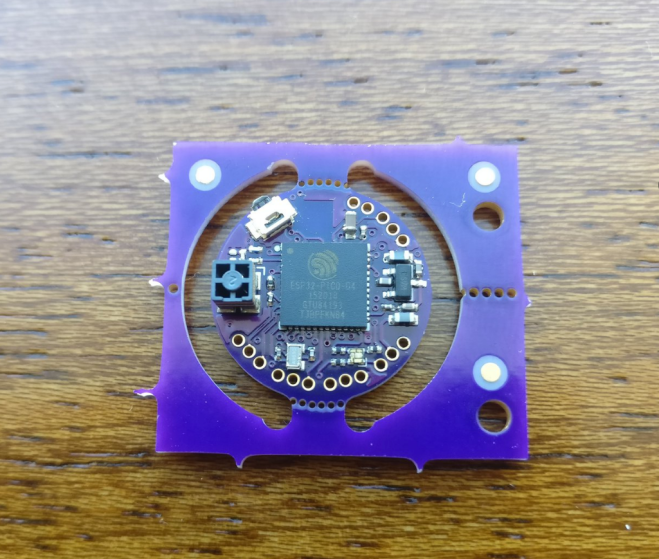
FemtoBeacon ESP32-PICO-D4 (4MiB) wireless IMU coin
What is it?
The world’s smallest open-source Wireless IMU. It has an ICM-20948 MPU (9-axis: accelerometer, gyroscope, magnetometer), and an MS561101BA03-50 precision altimeter/temperature sensor.
The coin uses the ESP32-PICO-D4 chip (4MiB) and has all peripherals attached via SPI (hSPI).
Requires a USB to UART adapter that can provide pass-through 5V to coin VIN pin and at least 500mA to 3V3 pin.
Pin Out:
- RGB LED, Red pin: 26
- RGB LED, Green pin: 4
- RGB LED, Blue pin: 5
- hSPI SCK pin: 14
- hSPI MOSI pin: 13
- hSPI MISO pin: 12
- MPU Chip Select pin: 15
- Altimeter Chip Select pin: 27
Why did you make it?
I made these for use in personal projects where I need a very small motion processing unit.
What makes it special?
It’s incredibly small, light weight, and open source!
DipDuino: Arduino-compatible slim as a DIP
AtomSoft has designed this Arduino-compatible board that’s as slim as a DIP chip:
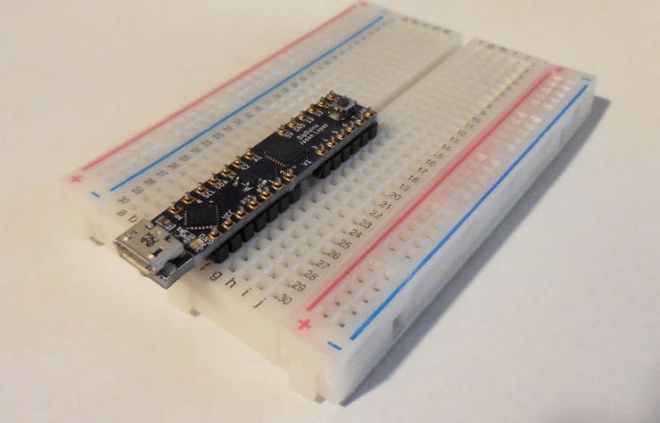
dipDuino Is an Arduino-Compatible Board That’s as Slim as a DIP Chip
Take up fewer rows on your breadboard with this ATmega328P-based board.
One reason the Arduino Nano became a popular form factor is that it fits onto a breadboard. The compact size is nice but makes the board a bit larger in the width dimension. To solve that issue, AtomSoftTech designed the dipDuino as an Arduino-compatible as narrow as a DIP package.
dipDuino has the same ATmega328P found in the other 8-bit Arduino boards like the Uno and Nano, however measures just 0.37 x 1.82 in (9.3 x 46.26 mm) in size. Its DIP package compatibility comes from the pin row to pin row pitch at 0.3 in (7.62mm).
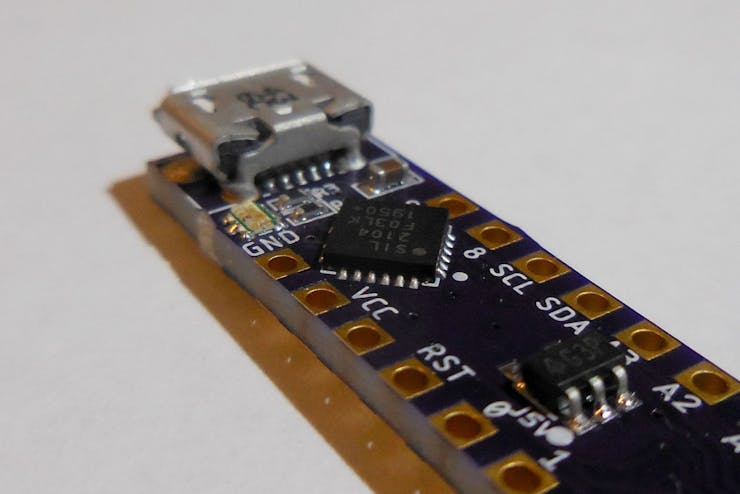
The DIP-compatible form factor has all of the same pins found on those other boards: 13 digital, five analog, VCC, RESET, and GND. The silkscreen labels A4 and A5 as SDA and SCL since they have a shared function (same as the Uno and Nano).
The ATmega328P SMD packages have two extra analog inputs available that the DIP-style package does not. (This difference is why boards like the Pro Mini and Nano have A6 and A7.) Even though dipDuino has an SMD AVR chip, it does not break out the extra analog pins.
Custom themes for KiCad
Thanks to the wonderful hardware designer Greg Davill for this suggestion on Twitter:
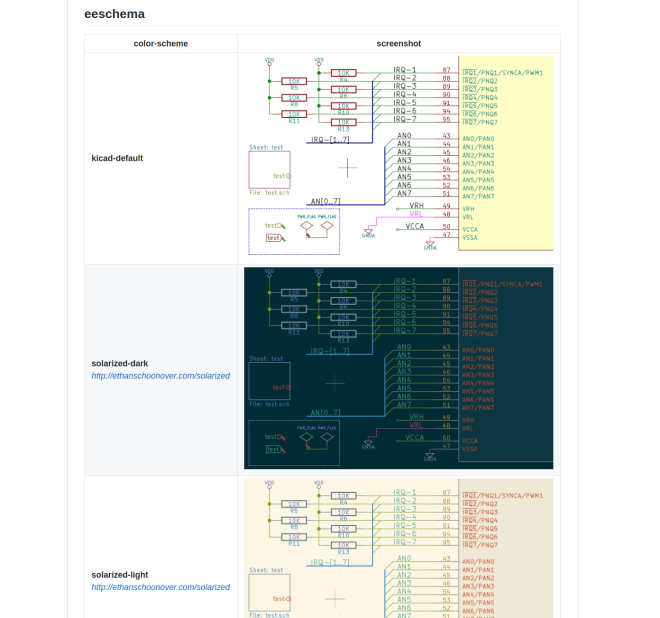
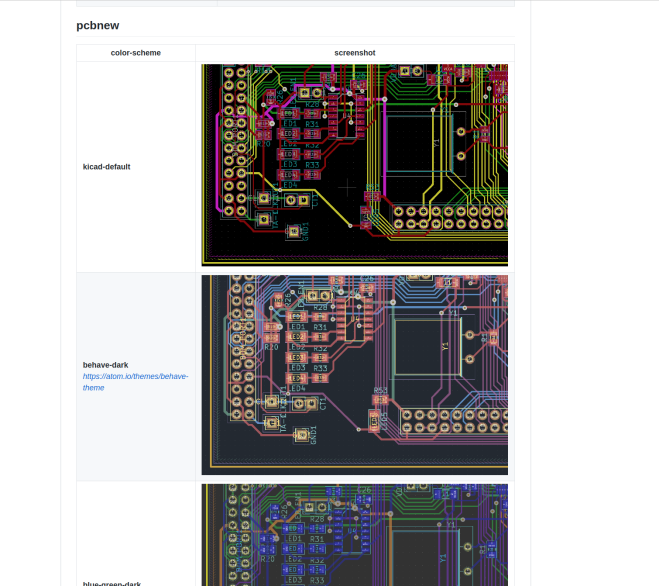
Several custom themes for KiCad are available from this GitHub repo:
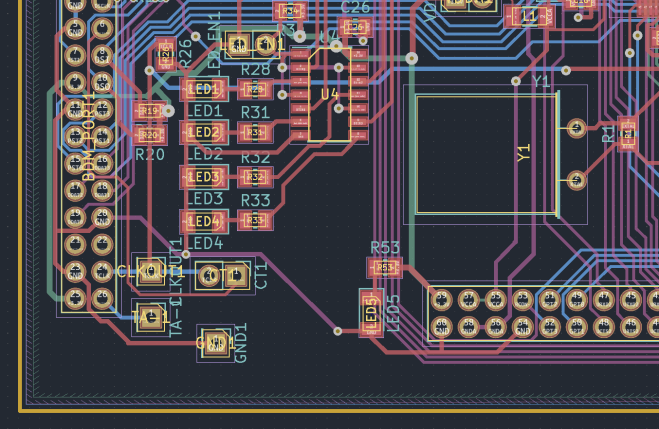
pointhi/kicad-color-schemes
Want to change the color scheme of KiCad? Look here for Inspiration.
Check out the readme to see all the options. Here are a few:
Hackaday Prize and Conservation X Labs Issue Design Challenges to Address Extinction Crisis

When most people think of extinct species, they likely imagine prehistoric creatures such as dinosaurs or woolly mammoths. Extinction is something you read about in history books, nature’s way of removing contestants in the great game of life. It’s a product of a cruel and savage world, and outside of a few remaining fringe cases, something that humanity’s advanced technology has put a stop to.
Unfortunately, the truth is far more complicated than that. The planet is currently going through its sixth major extinction event, and this time, it’s our fault. Humanity might not be willfully destroying the natural habitats of the plants, fish, birds, and other lifeforms that have been eradicated, but we’re responsible for it just the same. Humans are an apex predator unlike any the world has ever seen before, and the only force that can stop us is ourselves.
Founded in 2015, Conservation X Labs is devoted to doing everything it can to end this sixth wave of extinction. Unsatisfied with the pace of traditional conservation, they leverage technology and open innovation to develop unique new ways of combating the damage our species has done to life on this planet. After all, it’s the only one we’ve got.
We’ve partnered with this organization to help develop solutions to some of these problems. This includes an open call challenge that anyone can enter, and a Dream Team program that you can get involved with if you act quickly. Let’s take a look at what Conservation X Labs is all about, and what is involved with the challenges at hand.
THE CHALLENGE OF HACKING THE PLANET
With such a worthy goal and their embrace of out-of-the-box thinking, Conservation X Labs was a perfect partner for the 2020 Hackaday Prize. Saving species that have become endangered by human activity requires robust real-world solutions, but if they’re to have any chance at being adopted on a large scale, they need to be deployable at minimal cost and with the least amount of disruption as possible. That can be a difficult balance for large commercial entities to strike, but it’s the sort of thing that the hacking and making community absolutely excels at.
For the 2020 Hackaday Prize, Conservation X Labs has tasked competitors with developing innovative solutions for protecting marine life and combating invasive species. Building hardware that can survive the harsh ocean environment adds an extra dimension of challenge to these entries, and we’re excited to see how the submitted designs take it into account.
According to Sam Kelly, the Conservation Technology Program Manager at Conservation X Labs and mentor for this year’s Hackaday Prize, teams that want to tackle these challenges need to plan ahead if their design is to have any chance of surviving. “Between the salt, weather, pressure, and water, any solution needs to be ready for ingress and corrosion. It is also essential to consider the potential inaccessibility of any deployed device – for both maintenance and communication.”
Teams also have to make special considerations for the end-user. If you’re developing a device that needs to be operated by fishermen on a rocking boat in the middle of the ocean, a tiny touch screen probably isn’t going to work out very well. If it’s too difficult or time consuming to operate, then in all likelihood it just won’t get used.
Learn more about Flexible PCBs
We are very excited to that more and more of our customers are discovering our flexible PCB service and how it can benefit their projects.
https://twitter.com/oshpark/status/1266055123484192769
Insulectro’s Chris Hunrath joined Royal Circuits in a recent webinar that dives into the details of Flexible PCBs:
Breadboard Buddy by AtomSoftTech

There are a few versions of the breadboard buddy. I started this PCB years ago. To be honest im not sure when. It started off just as a pcb to help power my breadboard and grew into something more. Breadboard Buddy History There are currently about 4 versions of breadboard buddy in the wild.
Hackaday Prize Hack Chat With Majenta Strongheart on May 27
Coming up this Wednesday, May 27th:

Hackaday Prize Hack Chat With Majenta Strongheart
Join us on Wednesday, May 27 at noon Pacific for the 2020 Hackaday Prize Hack Chat with Majenta Strongheart!
It hardly seems possible, but the Hackaday Prize, the world’s greatest hardware design contest, is once more at hand. But the world of 2020 is vastly different than it was last year, and the challenges we all suddenly face have become both more numerous and more acute as a result. We’ve seen hackers rise to the challenges presented by the events of the last few months in unexpected ways, coming up with imaginative solutions and pressing the limits of what’s possible. What this community can do when it is faced with a real challenge is inspiring.
Now it’s time to take that momentum and apply it to some of the other problems the world is facing. For the 2020 Hackaday Prize, we’re asking you to throw your creativity at challenges in conservation, disaster response, assistive technology, and renewable resources. We’ve teamed up with leading non-profits in those areas, each of which has specific challenges they need you to address.
With $200,000 in prize money at stake, we’re sure you’re going to want to step up to the challenge. To help get you started, Majenta Strongheart, Head of Design and Partnerships at Supplyframe, will drop by the Hack Chat with all the details on the 2020 Hackaday Prize. Come prepared to pick her brain on what needs doing and how best to tackle the problems that the Prize is trying to address. And find out about all the extras, like the “Dream Team” microgrants, the wild card prize, and the community picks.
Our Hack Chats are live community events in the Hackaday.io Hack Chat group messaging. This week we’ll be sitting down on Wednesday, May 27 at 12:00 PM Pacific time. If time zones have got you down, we have a handy time zone converter.
Apertus Open Source Cinema: AXIOM Beta Power Board
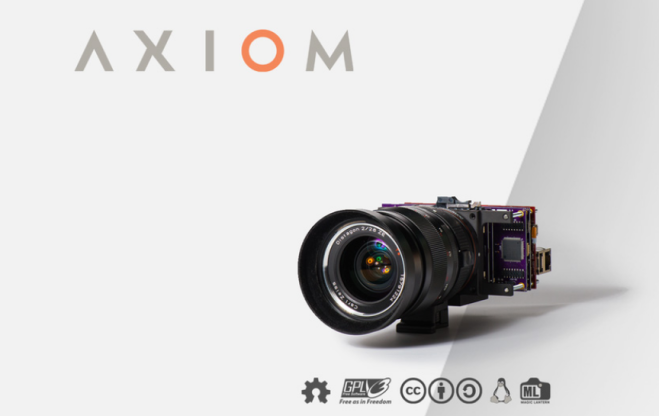
The Apertus AXIOM Open Source cinema camera projects is one of our favorites and we are excited to see that are making progress on the Beta Power Board:
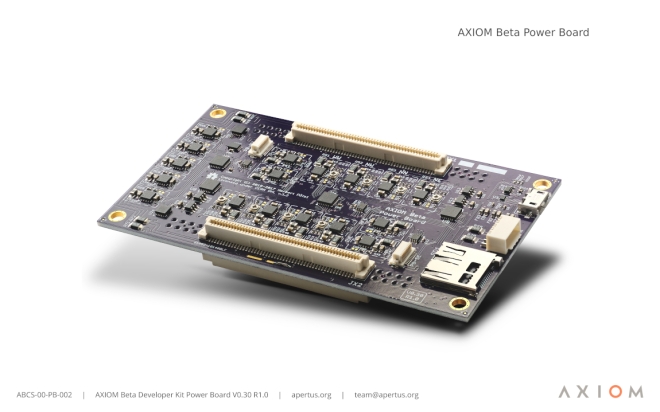
The AXIOM Beta Power Board sits between the Beta Main Board and the MicroZed™ in the camera’s PCB stack. It generates all the different supply voltages for the chips and logic on the other PCB’s inside the camera. It also monitors currents so that it can estimate remaining power based on the recorded consumption. Version 1 of the Beta Power Board has the 8 different voltage rails calibrated at factory. In case of a future hardware upgrade that require any power rail to have a different reference voltage this calibration needs to be redone.
 OSH Park