Digikey Tips Its Hat To Kicad With Its Own Library

Digikey might wow us with their expansive stock, but now they’re wowing us with a personal gesture. The US-based electronics vendor is nodding its head in approval to KiCad users with its very own parts library. What’s more, [Chris Gammell] walks us through the main features and thought process behind its inception.

With all the work that’s going into this library, it’s nice to see features showing that Digikey took a thorough look at KiCad and how it fits into the current state of open-source PCBA design. First off, this library follows a slightly different design pattern from most other KiCad libraries in that it’s an atomic parts library. What that means is that every symbol is linked to a specific manufacturer part number and, hence, gets linked to a specific footprint. While this style mirrors EagleCad’s; KiCad libraries usually separate symbols from footprints so that symbols can be reused and parts can be more easily swapped in BOMs. There’s no “best” practice here, so the folks at Digikey thought they’d expose the second option.

via Digikey Tips Its Hat To Kicad With Its Own Library — Hackaday

Digikey Tips Its Hat To Kicad With Its Own Library

Sneak Preview: DIY SMT Pick & Place Machine with OpenPnP

I will present that project at the Embedded Computing Conference 2018 (June 5th), both in a conference talk and have the machine in the exhibition area.

The machine is based on OpenPnP framework, and is not finished yet, and I have published status updates on Twitter. It uses mostly standard components, special parts have been 3D printed or produced with a laser cutter.

via Sneak Preview: DIY SMT Pick & Place Machine with OpenPnP — MCU on Eclipse

Sneak Preview: DIY SMT Pick & Place Machine with OpenPnP

Beginner Robotics Workshop with Hackaday in San Francisco

Hone your skills at basic robot building. You’re invited to join Hackaday for a Beginner Robotics Workshop on Saturday, May 12. For this workshop we’re pairing up with FIRST robotics mentors and students from the Bay Area. FIRST is an international high school robotics competition and you won’t believe what these teams can do. The…

via San Francisco: Let’s Learn to Build Some Robots! — Hackaday

Beginner Robotics Workshop with Hackaday in San Francisco

These Twenty Amazing Projects Won The Open Hardware Design Challenge

Right now, we’re running the greatest hardware competition on the planet. The Hackaday Prize is the Academy Awards of Open Hardware, and we’re opening the gates to thousands of hardware hackers, makers, and artist to create the next big thing. 1,011 more words

via These Twenty Amazing Projects Won The Open Hardware Design Challenge

These Twenty Amazing Projects Won The Open Hardware Design Challenge

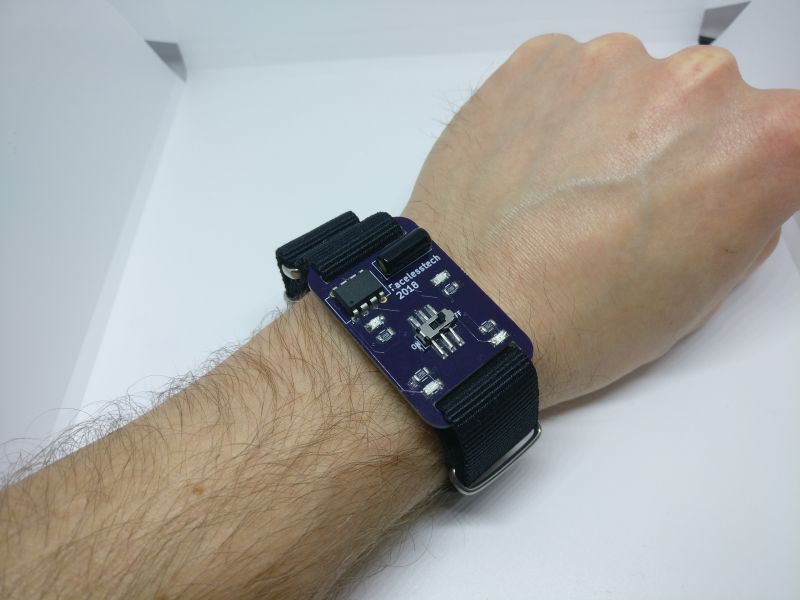
ATTiny wearable by Facelesstech

tl;dr It’s a foundation for a wearable platform. It’s a Nato watch strap threaded through a PCB with a coin cell battery holder between the PCB and the strap. I’m using a Attiny85 this time around but could be used for most chips/dev boards. This is a proof of concept to iron out any problems […]

via Attiny wearable — Facelesstech

ATTiny wearable by Facelesstech

Hardware meetup this Thursday in SF

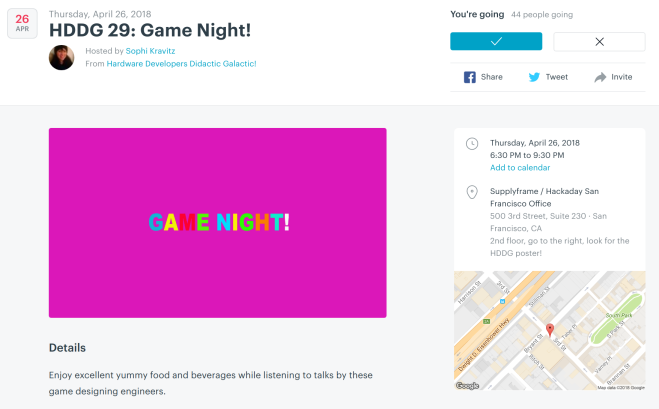
The next  Hardware Developers Didactic Galactic (HDDG) is this Thursday, April 26th, at SupplyFrame’s office in San Francisco:

Screenshot from 2018-04-24 09-24-28

HDDG 29: Game Night!

Enjoy excellent yummy food and beverages while listening to talks by these game designing engineers.

Richard Hogben – Mixed Reality Smartphone Game
Adelle Lin – Multiplayer Games in Public Spaces

HDDG is excited to host Adelle Lin this month. Adelle Lin (http://touchtech.io/ and http://adelleninja.com/) recently moved to San Francisco from New York and is an engineer at Intel. A lover of indie-games, she started building hardware so that she could create games that connect people in space. She has worked on projects shown at Paris Fashion Week, Play NYC, Come Out and Play, PlayTimesSquare, AR World Expo, Burning Man, and Maker Faire.

Developing games for public spaces is challenging and even more so when you introduce hardware components. Adelle will talk through various options to consider through the lens of games that she built for PlayTimesSquare (Symphonic Picnic) and PlayNYC (Star Catcher VR) – networking, hardware specs, interfaces, installation.

We are equally excited to welcome Richard Hogben (https://hackaday.io/rich ). Richard Hogben lives in San Francisco and works as a front end engineer at Supplyframe. His previous projects include a flying Hasselblad medium format film camera. Richard is currently organizing a project on Hackaday.io to build and assemble an Open NSynth Super synthesizer.

At HDDG, Rich will talk about a recent game that he designed and presented at the Hackaday Superconference. The game is called Pinned, and it is a mixed reality smartphone game with Unreal Engine and SteamVR room scale tracking.

After the talks, there will be demos, community announcements, and socializing. If you’d like to give a 2 minute demo/ community announcement, please see the organizers when you arrive to get set up.

A community announcement includes looking for a project partner, a job, offering a project/ job, the announcement of your startup launch, your Crowdfunding pitch, etc

https://www.meetup.com/Hardware-Developers-Didactic-Galactic/events/249704120/

Hardware meetup this Thursday in SF

PCB Artwork Hack Chat Transcript

The transcript has been posted from the Hack Chat last Friday with Andrew Sowa about Circuit Board artwork:

739811524251396115.png

PCB Artwork & Photo Conversions Hack Chat Transcript

PCB Art is likely as old as the manufacturing process itself. It has evolved over time from engineers hiding easter eggs in wasted space to whole companies devoted to the intricate authentic design. Andrew has created his own style by using each layer of the PCB to make multi-color images from computer generated designs.  In this chat he will talk about his process of turning photos into PCBs as well as tricks to getting high resolution results with KiCad.


In this chat, we’ll be talking about PCB artwork:

  • Bitmap to SVG Converstion (Inkscape and Illustrator)
  • Kicad Footprint creation
  • PCB Fabrication Limits
  • Backlighting
  • Halftones
PCB Artwork Hack Chat Transcript