PCB Artwork Hack Chat Transcript

The transcript has been posted from the Hack Chat last Friday with Andrew Sowa about Circuit Board artwork:

739811524251396115.png

PCB Artwork & Photo Conversions Hack Chat Transcript

PCB Art is likely as old as the manufacturing process itself. It has evolved over time from engineers hiding easter eggs in wasted space to whole companies devoted to the intricate authentic design. Andrew has created his own style by using each layer of the PCB to make multi-color images from computer generated designs.  In this chat he will talk about his process of turning photos into PCBs as well as tricks to getting high resolution results with KiCad.


In this chat, we’ll be talking about PCB artwork:

  • Bitmap to SVG Converstion (Inkscape and Illustrator)
  • Kicad Footprint creation
  • PCB Fabrication Limits
  • Backlighting
  • Halftones
PCB Artwork Hack Chat Transcript

Robotics Module Challenge: Build Robot, Win Prizes

Brand new today, we’re going to go all in with the Robotics Module Challenge! This is the newest part of the 2018 Hackaday Prize which is only six weeks old, and already we’ve seen almost six hundred incredible entries. But a new challenge means a fresh start and a perfect time for you to begin your entry. This…

via Robotics Module Challenge: Build Robot, Win Prizes — Hackaday

Robotics Module Challenge: Build Robot, Win Prizes

This Is Your Last Chance To Design The Greatest In Open Hardware

This is the last weekend to get in on the Open Hardware Design Challenge, the first challenge of the 2018 Hackaday Prize. We’re looking for the boldest idea you can come up with. We want to see the beginnings of the next great bit of Open Hardware, and this is your chance to do it.…

via This Is Your Last Chance To Design The Greatest In Open Hardware — Hackaday

This Is Your Last Chance To Design The Greatest In Open Hardware

The Amp Hour podcast with guest Andrew Sowa

Electrical engineer and PCB designer Andrew Sowa recently joined Chris Gammell on The Amp Hour podcast:

Episode #386 – An Interview with Andrew Sowa

Screenshot from 2018-04-23 11-33-03.png

The Amp Hour podcast with guest Andrew Sowa

New Laser Time of Flight Breakout Board

From  on the Tindie blog:

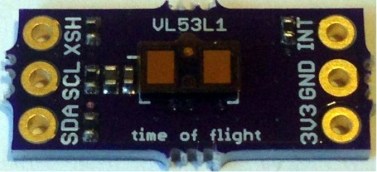
vl53l1-breakout-board-676x309-wb

New Laser Time of Flight Breakout Board Brings Out The Best in VL53L1 Long-Range Sensors

Watching your robotic creation take flight is an incredible feeling, but watching it collide with something or crash can make your stomach turn. One common sensor you may reach for in a case like this is the VL53L0. But it only provides ranging to a distance of 2 meters. For many of us, this is just shy of a range we would be comfortable with.

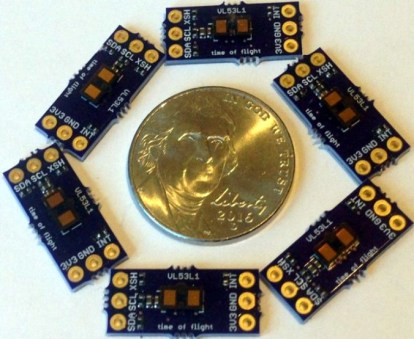
vl53l1-sensor-wb

Thankfully, a new sensor has appeared which doubles the range. The VL53L1 extends the accurate distance detection to 4 meters. It also uses a patented ranging technology that harnesses time-of-flight from a 940 nm laser.

This results in estimation independent of surface reflectivity and high accuracy in a variety of weather and environmental conditions. This breakout board sold by Pesky Products is designed to bring out all the best capabilities of the VL53L1 from ST Microelectronics.


New Laser Time of Flight Breakout Board

BeagleDrone fixed-wing autopilot

AndiceLabs writes about a fixed-wing autopilot project:

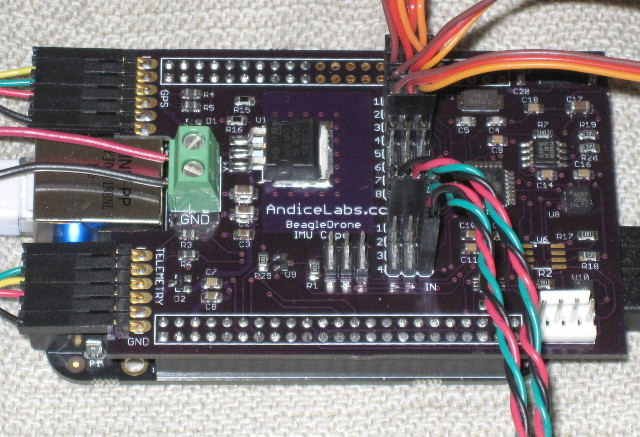
IMG_0823s.jpg

BeagleDrone

The BeagleDrone is fixed-wing autopilot project based on the BeagleBone and the IMU cape.  The IMU cape provides a 3-axis magnetometer, accelerometer, gyro and a barometer on the BeagleBone’s I2C bus.  There is also an AVR micro on the I2C bus that handles output pulse timing of the 8 servo channels and input pulse timing on the 4 radio signal channels.  Two of the BeagleBone’s UARTs are exposed via FTDI-compatible connectors to allow connection of external modules like GPS and telemetry.  It also has a regulator that provides 5VDC for the BeagleBone, AVR, and servos from the RC battery.

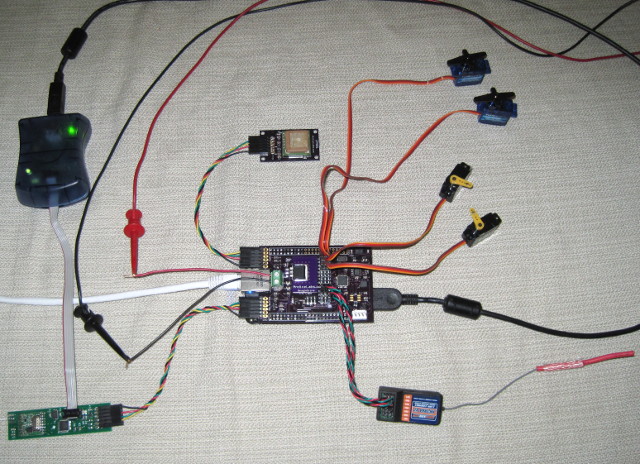
IMG_0822s.jpg

The BeagleBone provides the power of Linux in a footprint that is acceptable for RC and the Black has now made the platform even more affordable.  With Linux’s extensive libraries and utilities almost any feature should be quickly realizable and development enjoyable.  And unlike an autopilot powered by an 8 or 16 bit micro-controller, there is no need to worry about code and data size or overloading the processor with whatever crazy navigation features you can dream up.

I enjoy flying electric RC planes whenever I get the chance and building a fixed-wing autopilot for the BeagleBone has been on my list for a while now.  Of course, there’s no reason that the BeagleBone couldn’t also control a multi-rotor aircraft.  A flying Linux box is going to have very few limitations!

BeagleDrone fixed-wing autopilot

Simple Mechanism Gives Support for SMT Assembly

 on the Hackaday blog:

pick-and-place-e1523119167760.png

Simple Mechanism Gives Support for SMT Assembly

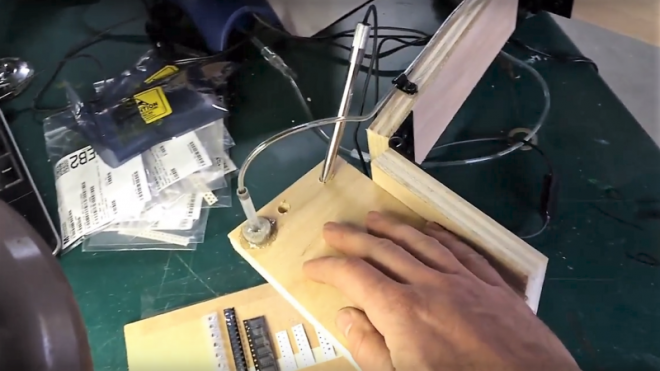
To fight the shakes, you can do one of two things: remove the human, or improve the human. Unable to justify a pick and place robot for the former, [Tom] opted to build a quick hand support for surface-mount work, and the results are impressive considering it’s built entirely of scrap.

It’s just a three-piece arm with standard butt hinges for joints; mounted so the hinge pins are perpendicular to the work surface and fitted with a horizontal hand rest, it constrains movement to a plane above the PCB. A hole in the hand rest for a small vacuum tip allows [Tom] to pick up a part and place it on the board — he reports that the tackiness of the solder paste is enough to remove the SMD from the tip.

Simple Mechanism Gives Support for SMT Assembly