Microgamer Is A Micro:Bit Handheld Console

From on the Hackaday blog:

Screenshot from 2018-02-27 18-25-39.png

 Microgamer Is A Micro:Bit Handheld Console

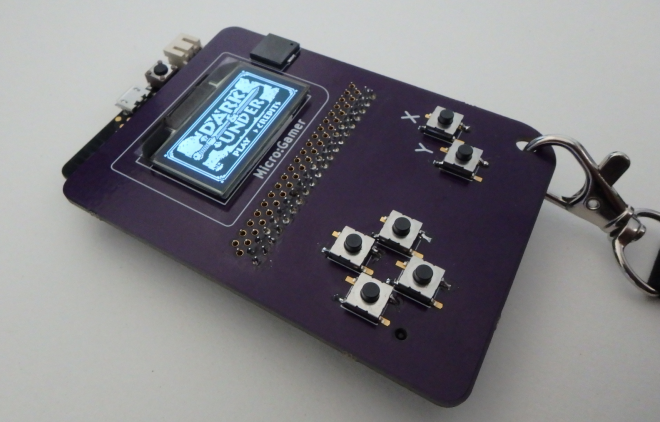
The BBC micro:bit single board ARM computer aimed at education does not feature as often as many of its competitors  in these pages. It’s not the cheapest of boards, and interfacing to it in all but the most basic of ways calls for a slightly esoteric edge connector. We’re then very pleased to see that edge connector turned from a liability into a feature by [Fabien Chouteau] with his handheld console, he uses micro:bits preprogrammed with different games in the manner of game cartridges in commercial consoles.
Screenshot from 2018-02-27 18-24-23.png

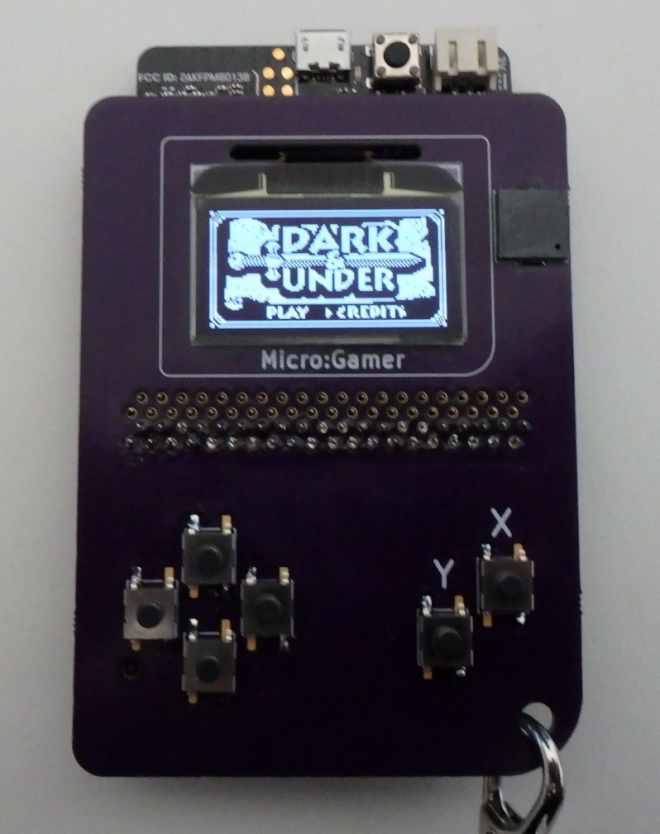
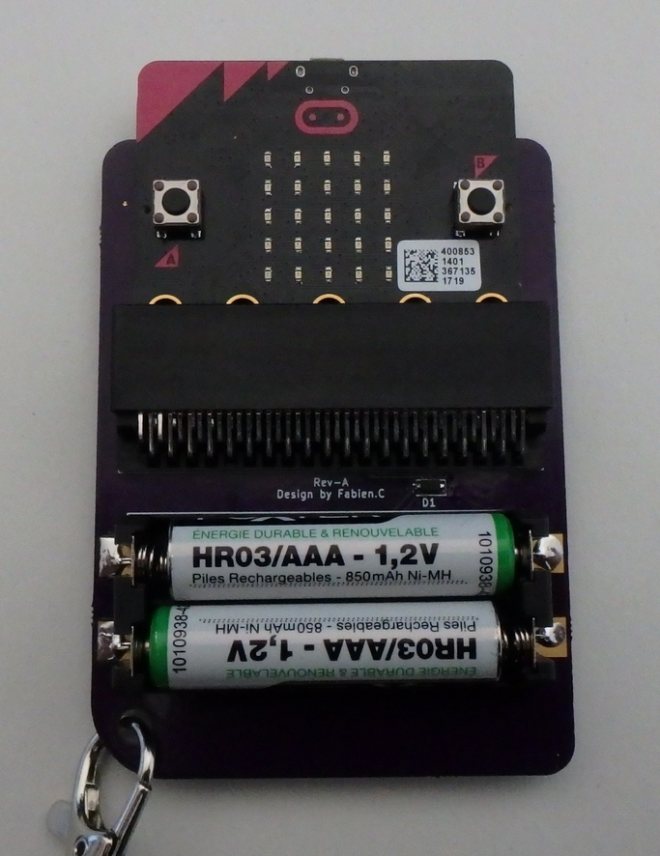
The micro:bit sits in its edge connector on the underside of a handheld PCB above a pair of AAA batteries, while on the other side are an OLED display and the usual set of pushbuttons. It’s a particularly simple board as the micro:bit contains all the circuitry required to support its peripherals.


He’s coded the games using the Arduino IDE with a modified version of the Arduboy2 library that allows him to easily port Arduboy games written for Arduino hardware. It’s a work in progress as there are a few more features to incorporate, but the idea of using micro:bits as cartridges is rather special. There is a video of the console in action, which we’ve placed below the break.

Screenshot from 2018-02-27 18-25-10.png

Microgamer Is A Micro:Bit Handheld Console

World Create Day is the Hackaday Event in Your Neighborhood

Hackaday World Create Day is on March 17th and it’s happening near you. Get together with hackers in your area and create something. Sign up now to host a World Create Day gathering! These are really easy to organize, but we can only do it with your help.

via World Create Day is the Hackaday Event in Your Neighborhood — Hackaday

World Create Day is the Hackaday Event in Your Neighborhood

An Especially Tiny And Perfectly Formed FM Bug

It used to be something of an electronic rite of passage, the construction of an FM bug. Many of us will have taken a single RF transistor and a tiny coil of stiff wire, and with the help of a few passive components made an oscillator somewhere in the FM broadcast band.

via An Especially Tiny And Perfectly Formed FM Bug — Hackaday

An Especially Tiny And Perfectly Formed FM Bug

Friday Hack Chat: Trusting The Autorouter

For this week’s Hack Chat, we’re talking about trusting the autorouter. The autorouter is just a tool, and like any tool, it will do exactly what you tell it. The problem, therefore, is being smart enough to use the autorouter.

Our guest for this week’s Hack Chat is Ben Jordan, Director of Community Tools and Content at Altium. Ben is a Computer Systems engineer, with 25 years experience in board-level hardware and embedded systems design. He picked up a soldering iron at 8, and wrote some assembly at 12. He’s also an expert at using an autorouter successfully.

via Friday Hack Chat: Trusting The Autorouter — Hackaday

Friday Hack Chat: Trusting The Autorouter

Hackaday Dublin Unconference: Grab Your Tickets!

Hackaday comes together in Ireland on April 7th and we want you to be there. Get your free ticket right now for the Hackaday Dublin Unconference!

An Unconference is the best way to put your finger on the pulse of what is happening in the hardware world right now. Everyone who attends should be ready to stand and deliver a seven-minute talk on something that excites them right now — this means you. The easiest thing to do is grab your latest hack off the shelf and talk about that.

Talks may be about a prototype, project, or product currently in progress at your home, work, or university. It could also be an idea, concept, or skill that you’re now exploring. The point is to channel your excitement and pass it on to others in a friendly presentation environment where everyone will cheer as your story unfolds.

Hackaday hosted an excellent Unconference in London back in September to a packed house for dozens of amazing presentations on a huge range of topics. We heard about bicycle turn signals, laser enhancing NES zappers, telepresence robots with IKEA origin stories, tiny-pitch LED matrix design, driving flip-dot displays, not trusting hardware 2-factor, and much more.

All the tickets for that event were scooped up in a few hours, and a huge waitlist followed. Don’t wait to grab your ticket!

via Hackaday Dublin Unconference: Grab Your Tickets!


Hackaday Dublin Unconference: Grab Your Tickets!

Friday Hack Chat: Making A Makerspace

For this week’s Hack chat, we’re going to be talking all about making a makerspace. These are community hubs where people come together and share resources to bring their inventions to life. It’s not as simple as it may seem. You need insurance, you need a building, you need a landlord who’s cool, and there are a thousand and one things that can go wrong. Who best to steer you through the storm of opening a Hackerspace? Who can you solicit advice from?

Our guests for this week’s Hack Chat are Vaibhav Chhabra, a mech E from Boston University. He spent two years working on an eye diagnostic device, is an instructor at MIT REDX health care innovation lab, and is a founder of the incredible Makers Asylum. Eric Michaud is a Hacker, runner, and author, currently working on Rift Recon, Shellcon, and hackerspaces.org. He has written tutorials on Adafruit, and was a founding member of HacDC before he took off to Chicago and started PS:One.

via Friday Hack Chat: Making A Makerspace — Hackaday

1406081518582541781.png


Friday Hack Chat: Making A Makerspace

Win Big Prizes With Repairs You Can Print

 writes in the latest Hackaday Links:

Are you a student? Are you part of a hackerspace? We have a contest going on right now where you can win a fancy new Prusa i3 MK3.

We’re looking for functional repairs of items around your house, office, or garage. Did you repair something with a 3D printer? Then you too can get in on the action!

The Repairs You Can Print contest

2539161516057355433.png

Check out the list of entries:

d


Win Big Prizes With Repairs You Can Print

What’s Coming In KiCad Version 5

 writes on the Hackaday blog about the recent KiCad presentation at FOSDEM:

What’s Coming In KiCad Version 5

Although recent versions of KiCad have made improvements to the way part and footprint libraries are handled, the big upcoming change is that footprint libraries will be installed locally. The Github plugin for library management — a good idea in theory — is no longer the default. Spice simulation is also coming to KiCad. The best demo of the upcoming Spice integration is this relatively old video demonstrating how KiCad turns a schematic into graphs of voltage and current.

The biggest news, however, is the new ability to import Eagle projects. [Wayne] demoed this live on stage, importing an Eagle board and schematic of an Arduino Mega and turning it into a KiCad board and schematic in a matter of seconds. It’s not quite perfect yet, but it’s close and very, very good.

There are, of course, other fancy features that make designing schematics and PCBs easier. Eeschema is getting a better configuration dialog, improved bus and wire dragging, and improved junction handling. Pcbnew is getting rounded rectangle and complex pad shape support, direct export to STEP files, and you’ll soon be able to update the board from the schematic without updating the netlist file. Read that last feature again, slowly. It’s the best news we’ve ever heard.


What’s Coming In KiCad Version 5

Do More with Lockable Ball And Socket Helping Hands

From  on the Hackaday blog:

Printed It: Do More with Lockable Ball And Socket Helping Hands

In one hand you hold the soldering iron, in the other the solder, and in two more hands the parts you’re trying to solder together. Clearly this is a case where helping hands could be useful.

Magnifying glass with helping hands

Luckily helping hands are easy to make, coolant hoses will do the job at under $10. Attach alligator clips to one end, mount them on some sort of base, and you’re done. Alternatively, you can steal the legs from an “octopus” tripod normally used for cell phones. So why would you 3D print them?

One reason is to take advantage of standardized, open source creativity. Anyone can share a model of their design for all to use as is, or to modify for their needs. A case in point is the ball and socket model which I downloaded for a helping hand. I then drew up and printed a magnifying glass holder with a matching socket, made a variation of the ball and socket joint, and came up with a magnetic holder with matching ball. Let’s take  look at what worked well and what didn’t.

Do More with Lockable Ball And Socket Helping Hands