Intro to Python scripting in KiCad

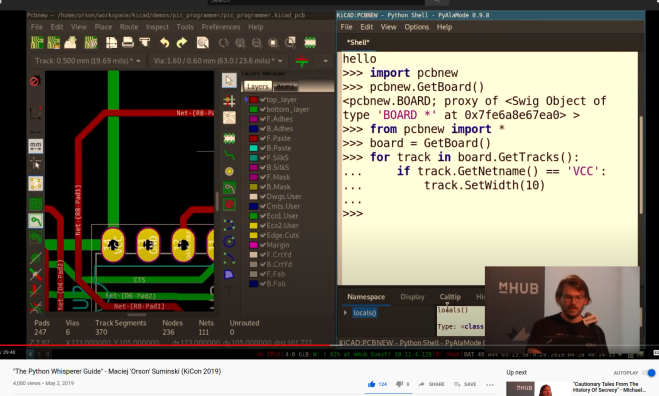
Great introduction to Python scripting in KiCad from Maciej ‘Orson’ Suminski:

“The Python Whisperer Guide”

The Python scripting interface in KiCad is a powerful tool that can relieve you from repetitive and tedious tasks. It is also a great method to address issues that are specific to your workflow and are not likely to be solved in the upstream code. In this talk, I will show you how to start your scripting adventure with KiCad by explaining the principles of python scripting and exploring a few examples. Do not be afraid…pythons are not venomous.

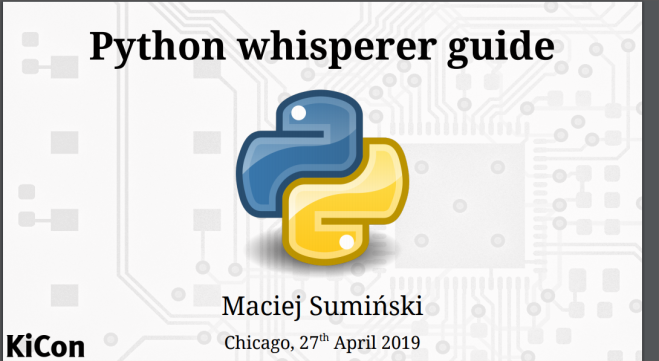
Screenshot from 2020-04-20 16-55-50Slides are available:

Screenshot from 2020-04-24 12-22-27

Intro to Python scripting in KiCad

Join Hardware Happy Hour (3H) on Discord

highres_480539330

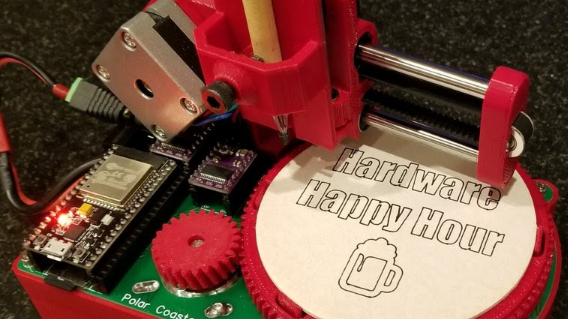
Hardware Happy Hour (3H) is a meetup for engineers, electronics hobbyists, and hardware hackers that takes place in many cities around the world.

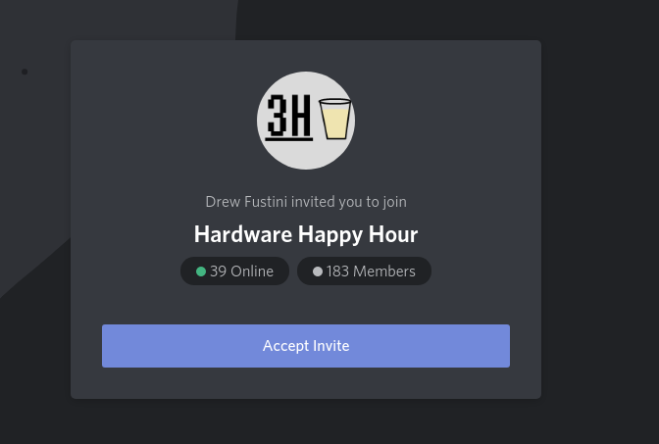
With COVID-19 restrictions on in-person events, 3H organizers have setup a Discord server where we can continue to have virtual 3H meetups!

Screenshot from 2020-04-23 13-33-44

Join Hardware Happy Hour (3H) on Discord

PCB Artwork with Inkscape and KiCad

EUwnVsgXYAAxS9L

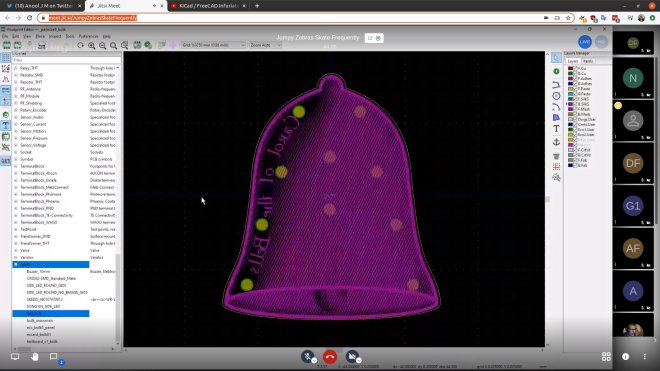
Anool is doing live streams every Saturday on KiCad and this week Bradan Lane joined to show how to use Inkscape to create PCB artwork:

PCB Artwork with Inkscape and KiCad

Join two KiCad livestreams TODAY

Screenshot from 2020-04-01 16-17-56

At 9:00 AM US PDT today, April 1st, KiCad leader developer Seth Hillbrand will be hosting a KiCad Community meetup video conference on Jisti Meet:

Last week’s meetup was nice to see and talk with other KiCad users. Let’s do it again this week.

This week, I’m happy to answer questions and I’ll be working through designing a KiCad version of the Medtronic OpenVentilator project (http://www.medtronic.com/openventilator 5). You may have heard that Medtronic (a multi-billion $ company) bought the company that cancelled the original gov’t contract 2 for low-cost ventilators in 2015 and then this week released a “kind of” open source version 3 of their current (not low-cost) ventilator.

In reality, they released scans of the schematics and some word documents for bring-up procedures. I’m going to see if we can turn the scans into a set of useful KiCad schematics + board files. This still doesn’t get to what’s needed to actually recreate more of these ventilators but it is a needed first step.

If you are curious about recreating designs from incomplete schematics, reverse engineering in KiCad or just want to hang out and chat, please stop by.

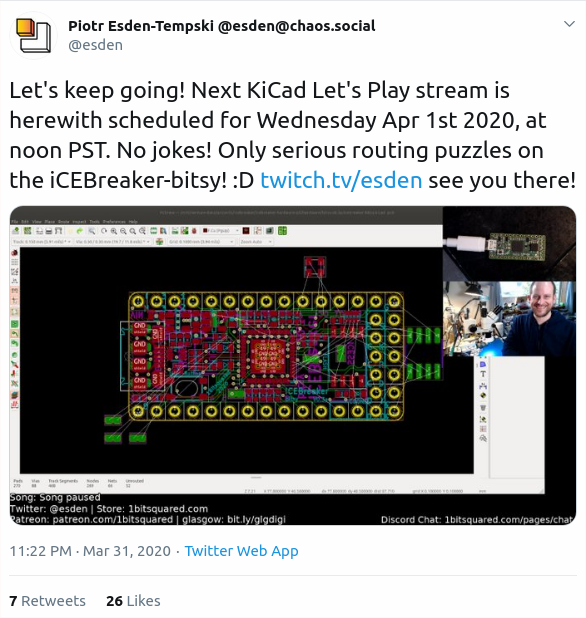
Then at 12:00 PM US PDT, Piotr Esden will livestream KiCad board layout:

Electronics Let’s Play – iCEBreaker-bitsy update/design work Ep. 3

Screenshot from 2020-04-01 16-15-10

Join two KiCad livestreams TODAY

Learn Quantum Computing with virtual Hackaday class

ET92JRpWAAMzW3T

Join artbyphysicistkitty tomorrow for the start of a weekly virtual class:

Introduction to Quantum Computing

I’m starting a virtual class on Hackaday’s Zoom channel every Sunday:

  • 20:30 CET
  • 14:30 US EDT
  • 11:30 US PDT

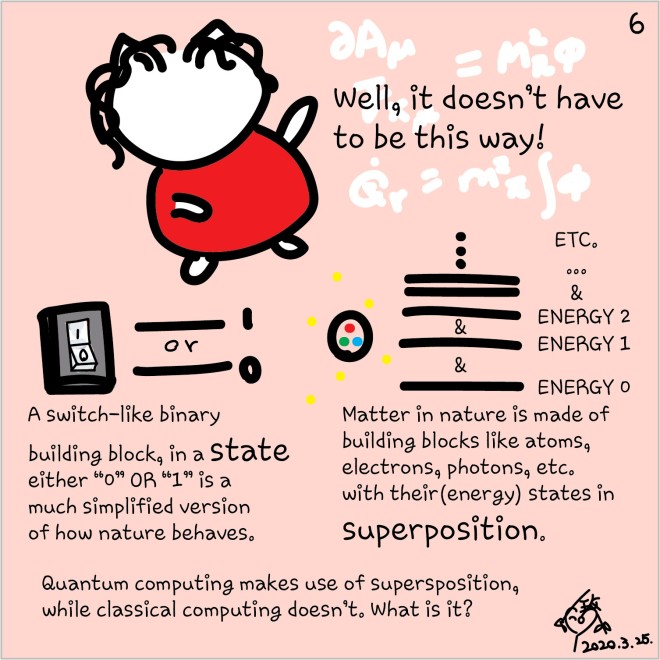
We will discuss a new topic for 30 mins every week. The topic will be based on my comics of the week.

1791301574201961902

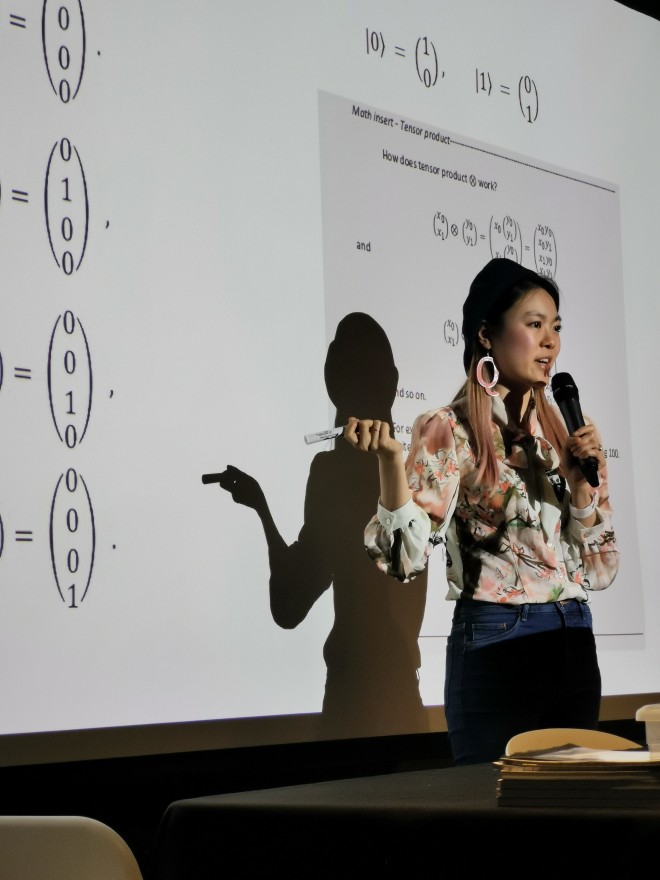
As I’ve been teaching our employees at Microsoft, I’ve built up a series of systematic materials from basic concepts to algorithms to hardware systems, and a tutorial on Q# (Q-sharp) – a domain-specific programming language used for expressing quantum algorithms. Typically we took a few months to go through all the basic concepts. Every class was followed by a few Q# exercises. But it is do-able for a 2-hour workshop, such as the one at Hackaday Supercon.

On November 15, 2019, I gave a workshop on a hands-on introduction to Quantum Computing at Supercon. Here are the slides for everyone.  It might felt like a lot to people who encountered the concepts for the first time. But if they go back to the slides now, they’ll be able to recall and digest at their own pace. The workshop was also on high demand. We didn’t have enough space for more people. So anyone who missed it can take a look at the slides which hopefully can give them directions to study further.

Please feel free to post any questions and discussions in this project page. And any mistakes to correct in the slides. I’ll try to answer them here. Enjoy!

https://twitter.com/KittyArtPhysics/status/1242841934705590274

Learn Quantum Computing with virtual Hackaday class

KiCad and FreeCAD virtual meetup tomorrow (March 28th)

From Anool:

KiCad and FreeCAD virtual meetup tomorrow, Saturday, March 28th

  • 5:00am US Pacific
  • 8:00am US Eastern
  • 5:30pm India
  • 1:00pm CET
  • 8:00pm China
  • 11:00pm Australia

  • This week, I’ll talk about Schematic Library management and @hemalchevli
    will show how to convert STEP model to PCB footprint
  • We’re trying out Jitsi . It works in a Browser without any extensions. On Android Phones (and maybe iPhones), they’ve got an App.
  • VIDEO LINK
    https://meet.jit.si/InfuriatedRhinosEatObnoxiously 1
  • If you’d wish to just watch the livestream, here’s the URL:

https://www.youtube.com/watch?v=migkWNRE384

  • Want to dial in on phone?
    • Australia: +61.8.7150.1136
      Brazil: +55.21.3500.0112
      France: +33.1.84.88.6478
      Germany: +49.89.380.38719
      Japan: +81.3.4510.2372
      Spain: +34.932.205.409
      UK: +44.121.468.3154
      US: +1.512.402.2718
    • Dial meeting ID: ‘3947374070’ to connect!
KiCad and FreeCAD virtual meetup tomorrow (March 28th)

Hackaday: Side-Channel Attacks Hack Chat with Samy Kamkar

Join us on Wednesday, March 25 at noon Pacific for the Side-Channel Attacks Hack Chat with Samy Kamkar!

In the world of computer security, the good news is that a lot of vendors are finally taking security seriously now, with the result that direct attacks are harder to pull off. The bad news is that in a lot of cases, they’re still leaving the side-door wide open. Side-channel attacks come in all sorts of flavors, but they all have something in common: they leak information about the state of a system through an unexpected vector. From monitoring the sounds that the keyboard makes as you type to watching the minute vibrations of a potato chip bag in response to a nearby conversation, side-channel attacks take advantage of these leaks to exfiltrate information.

Side-channel exploits can be the bread and butter of black hat hackers, but understanding them can be useful to those of us who are more interested in protecting systems, or perhaps to inform our reverse engineering efforts. Samy Kamkar knows quite a bit more than a thing or two about side-channel attacks, so much so that he gave a great talk at the 2019 Hackaday Superconference on just that topic. He’ll be dropping by the Hack Chat to “extend and enhance” that talk, and to answer your questions about side-channel exploits, and discuss the reverse engineering potential they offer. Join us and learn more about this fascinating world, where the complexity of systems leads to unintended consequences that could come back to bite you, or perhaps even help you.

join-hack-chatOur Hack Chats are live community events in the Hackaday.io Hack Chat group messaging. This week we’ll be sitting down on Wednesday, March 25 at 12:00 PM Pacific time. If time zones have got you down, we have a handy time zone converter.

Click that speech bubble to the right, and you’ll be taken directly to the Hack Chat group on Hackaday.io. You don’t have to wait until Wednesday; join whenever you want and you can see what the community is talking about

via Side-Channel Attacks Hack Chat with Samy Kamkar — Hackaday

Quote

OSHWA: How We Made the Open Hardware Summit All Virtual in Less Than a Week

From OSHWA president Michael Weinberg:
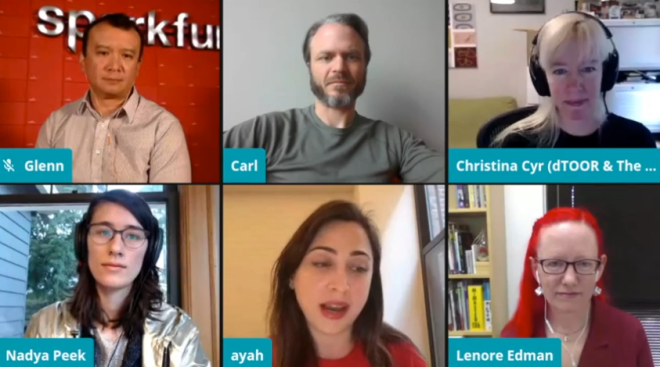
Screen-Shot-2020-03-17-at-3.40.05-PM

How We Made the Open Hardware Summit All Virtual in Less Than a Week

First, thank you again to everyone – speakers, participants, and sponsors – for a fantastic 10th anniversary Open Hardware Summit.  We knew the 10th anniversary Summit would be one for the ages, although we didn’t quite expect it to be because it became the first virtual Summit.

Thanks to the timing of the Summit, the 10th anniversary Summit ended up being many people’s first virtual summit of the Covid-19 era (that includes the organizers).  Unfortunately it looks like it is unlikely to be the last. In the hopes of helping event organizers struggling with the same challenges, this blog post outlines the decisions we made and the steps we took to make it happen.

Quick Context

The Open Hardware Summit is an annual gathering of the open source hardware community held by the Open Source Hardware Association (OSHWA).  This year OSHWA partnered with the Engelberg Center on Innovation Law & Policy at NYU Law to host the event in New York City.  The event usually brings together hundreds of community members and speakers from around the world.  It was scheduled for March 13, 2020.

While the situation has been evolving for some time, as recently as March 5th (8 days before the Summit) we thought that holding a reduced in-person version of the event was the right decision.  By March 8 (5 days before the Summit) that was no longer tenable and we announced that the Summit was going all virtual.  That was the right decision, but what does going all virtual mean?

Priorities

We had two major priorities for the virtual Summit:

  1. Online streaming video of all of the speakers and panels.
  2. A community space for discussions and coming together.

Video

The live stream of the Summit had to be both accessible to our viewers and easy to join for our speakers and panelists.  After considering some options and consulting with experts in our community (huge thank you to Phil Torrone at Adafruit for the guidance), we concluded that a combination of YouTube and StreamYard would be the best option.

YouTube worked for our community because it is easily accessible on a wide range of platforms in most of the world.  That meant that just about everyone would be able to see the Summit from wherever they were.

StreamYard made it easy to manage the backend.  Speakers could join a virtual green room before their talk and our technical testing the day before the Summit made it clear that it was easy for them to share their slide presentations as well.  One of the members of the Summit team was able to easily add and remove people (and their screens) to the live feed, along with stills and slides for introductions, sponsors, and everything else.
Screenshot from 2020-03-20 13-59-37

Community Space

We also looked at a number of options for online discussions.  We decided that a discord server would be the best option for the open source hardware community. Discord allowed us to open the space to anyone who wanted to join, while at the same time giving us moderation control over the discussion (huge thank you for Lenore Edman from Evil Mad Scientist Laboratories for jumping in as a moderator).  Many community members were already comfortable with discord, which was also a bonus.

We also decided to use discord for a version of Q&A for the speakers.  One option would have been to try and integrate video questions from the audience into the live stream. That would have been technically possible with StreamYard (probably…), but it seemed like an unnecessary logistical complication for the organizers.  As an alternative we decided to set up separate discord channels for each of the speakers. That allowed the speakers to end their talk and move to their discord channel for further discussions.

One unexpected and welcome development was that the discord server grew into a larger community hub, with channels devoted to solutions to Covid-19, community announcements, hacking the conference badge, and even virtual conference tips.  We may decide to maintain the server well beyond the Summit as a community space.

It Mostly Worked

We scheduled brief runthroughs with all of the speakers the day before the Summit. Everyone had a chance to get comfortable with the process and work out any last minute problems.  On the day of the Summit we embedded the livestream in the Summit site, along with a link to the discord server for discussion. There were a few audio glitches where speakers had to briefly drop out, but all things considered it went pretty smoothly.

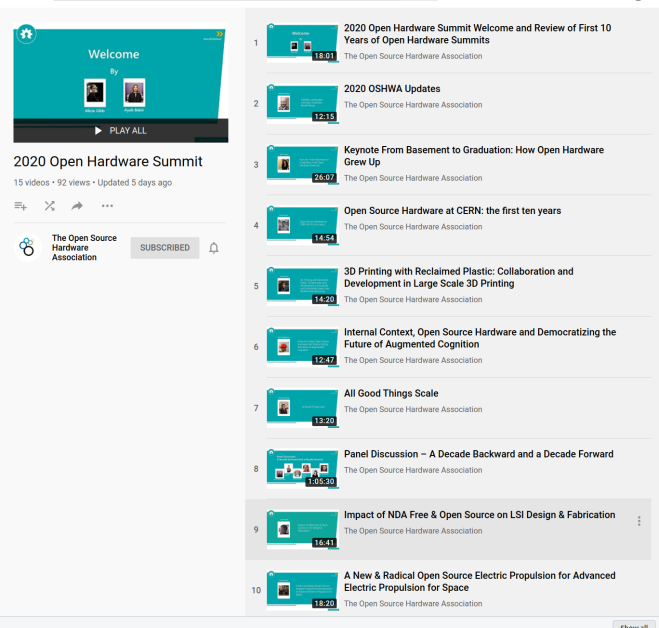
Once the Summit was over the entire livestream of the Summit was posted automatically to OSHWA’s YouTube channel.  Within a day or two we had broken out all of the individual talks into a video playlist and pulled the audio from our panel discussion into a stand alone podcast episode.

To the extent that things worked, one of the big reasons was the nature of the OSHWA community.  Besides being generally great and supportive (no small thing), the open source hardware community already sees itself as a community and is already comfortable with connecting via online tools.  That made it easy for them to enthusiastically watch the live stream and jump into the online discussion. Not all types of events have this starting point, which may suggest that they are not great candidates for this type of virtual structure.

If you are reading this because you are working on your own virtual event, good luck!  We are happy to answer questions if you have them. Email us at [email protected]. StreamYard also has a referral program, so if you drop us a line at [email protected] we can give you a $10 credit if you want it.

OSHWA: How We Made the Open Hardware Summit All Virtual in Less Than a Week

Three Tales of Making It in Electronics Design and Manufacturing

Having found success in different areas, it’s a pleasure to hear from Erika Earl, Paul Beech, and Spencer Owen during a panel discussion at the 2019 Hackaday Superconference. Led by Tindie’s Jasmine Brackett, the panel covers some of the background needed to develop a product and get it into the hands of your customers.

Erika’s origin story begins with an interest in electronics during her teenage years that led to work in recording studios. It seems nobody on staff there was interested in repairing anything. Every company needs a hacker to make sure everything continues to work and she decided to take on the role.

From there Erika found her way into the world of manufacturing and has never looked back. You may remember hearing some of her experiences in her 2016 Hackaday Supercon talk on turning your manufacturing mistakes in a learning experience. During this panel she recounts one particularly painful experience when over-torque on a six-layer PCB damaged traces and led to extensive manual rework; always include a torque-spec!

via Three Tales of Making It in Electronics Design and Manufacturing — Hackaday

Quote