Jon Evans is a longtime developer on the KiCad project and practicing EE at Formlabs. He joins Chris to talk about the future of KiCad, including features that are coming in V6.
I am so excited about @kicad_pcb V6, it's going to be a really important step forward for the program and the community.
Enter one or more of this year’s challenges for the chance to win cash prizes and move on to the finals, where our panel of judges will decide on the grand prize winner! With $25,000 on the line, and numerous other opportunities to win, there’s no reason not to enter!
Ultimately though, the Hackaday Prize isn’t about winning money. It’s about creating impactful change through the kind of hardware innovation only our amazing community can provide.
Trying to solder an oddly shaped art PCB board? This 3D printed visa could help:
A regular vice is great if you want to clamp rectangular objects, but it can fall down a little with more complex shapes. Inspired by an ancient vise [Chris Borge] whipped up his own 3D-printed fractal clamping tool.
The inspiration for this one comes from the [Hand Tool Rescue] video that shows of the clever mechanism. The vice uses a series of interlocking parts that can freely articulate to grip the object of interest via several protruding fingers. In reproducing the design, [Chris] had some issues initially with the joints, but settling on a dovetail similar to that of the original metal vice which got things working nicely.
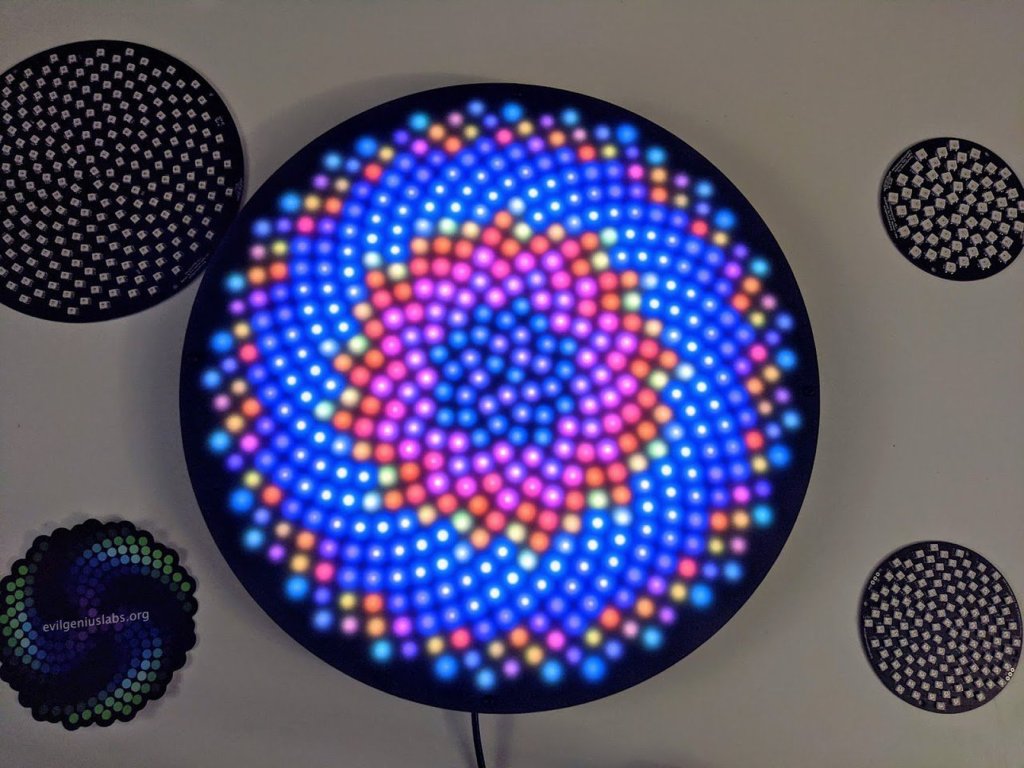
Fibonacci512 is a giant, beautiful 320mm circular disc with 512 RGB LEDs surface mounted in a Fibonacci distribution. Swirling and pulsing like a colorful galaxy, it’s mesmerizing to watch.
It consists of 512 WS2812B-Mini 3535 RGB LEDs, arranged into a circular Fermat’s spiral pattern.
I have created several LED art pieces in Fibonacci patterns. They are all very labor intensive to create, and so are fairly expensive and limited in quantity. I wanted to come up with a Fibonacci layout that was at least slightly easier to create, and therefore more affordable.
I have RGB LEDs in just about every form they come: strips, strings, rings, discs, etc. The LEDs on most discs are arranged in very regular rings. Fibonacci512 is different. The LEDs are arranged in a Fibonacci distribution. The makes the layout very organic and seemingly messy. But with the proper animation, spiral patterns emerge with spectacular results.
Each of the 512 WS2812B-Mini 3535 RGB LEDs has its own decoupling capacitor built in. The top and bottom of the PCB are large 5V and GND planes, to allow for the large amount of current required by the 512 LEDs. The PCB is split into four separate data lines to allow for higher frame rates when driven by a microcontroller that supports the FastLED library’s parallel output, such as ESP8266, ESP32, Teensy, etc. The max theoretical frame rate with four way parallel output is ~260 FPS. Each of the four data lines has a separate four-pin headers provided for 5V, Data In (to the section), Data Out (from the previous section) and GND. The last Data Out pin can be used to connect to even more LEDs. There are also small jumper solder pads that can be bridged to drive the whole panel with a single pin (max ~65 FPS), or two pins (max 130 FPS).
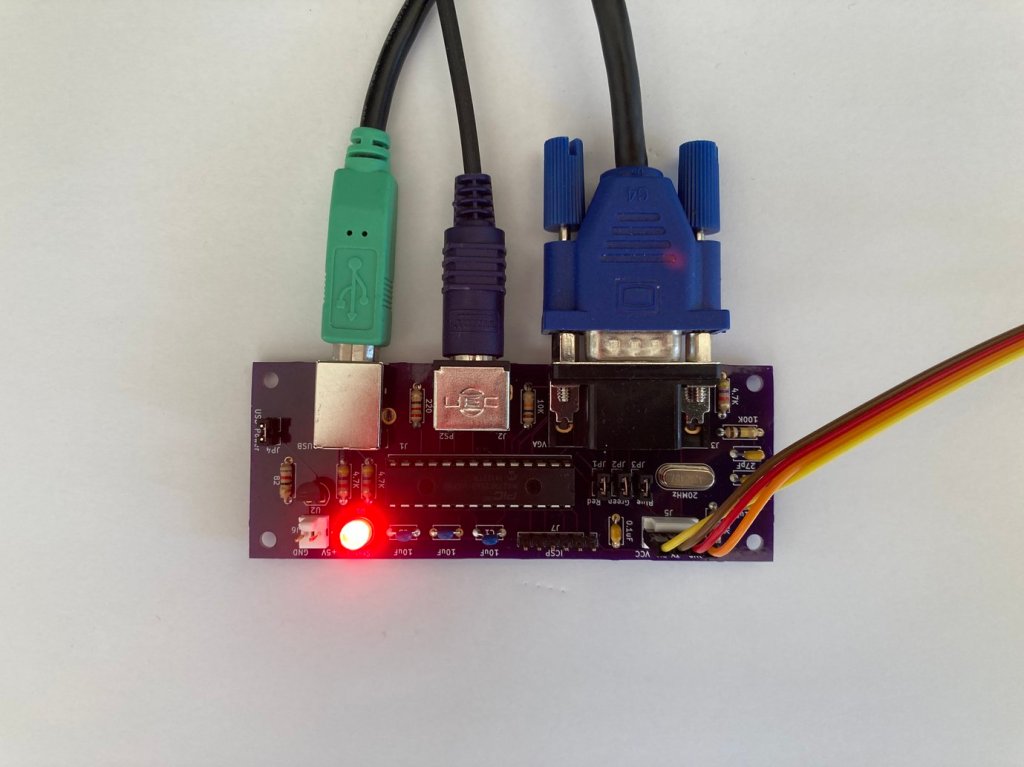
This is VT-100 and XTerm compatible video terminal implemented on the PIC32 microcontroller. It has a serial interface with TTL or RS-232 signal levels, input from a standard PS/2 keyboard, and output to a VGA monitor. There is also a USB interface that supports serial over USB and acts as a USB-to-serial converter.
Great set of talks from Javier Serrano of CERN, Rick O’Conner of OpenHW Group, Calista Redmore of RISC-V International, and more:
One of the most advanced areas in Open Hardware is open chips, a critical dependency for the European Union. Open chips have the potential to be beneficial in terms of their adaptability, speed and potential for increasing digital sovereignty in several sectors, including automotive industry, edge computing, data storage solutions, aerospace, energy or health.
By drawing lessons from Open Source Software, Europe can realise vast value from Open Hardware for its economy and citizens. There is a need for more debate on opportunities and challenges of Open Hardware, its potential for scaling up and supporting more collaborative and open infrastructure underlying all other layers of the digital ecosystem we know.
Take a look at this paper from Javier Serrano, one of the few instances of policy thinking on #OpenHardware – 'Why (and how) public institutions should release more of their hardware designs as Open-Source Hardware'https://t.co/736ddZmW2S
In May 2021 the Open Source Hardware Association (OSHWA) certified a wide variety of hardware as open source. we will have a certified variety collection of Open Source Hardwares, Let’s take a look! (And remember, certification is a free and easy way to show that your hardware complies with the open source hardware definition.)
First, many makers are interested in space and astronomy. The Astrohat is a Raspberry Pi 4 compatible hat for all your astronomy equipment. It comes with six 12V controllable outputs @3A each with current monitoring (2 PWM controllable for dew heaters), a temperature, humidity and pressure sensor port (external module), one adjustable 6-12 V output, and one port for serial communication and power to external device like a GPS. It’s the 5th piece of certified hardware from Greece. You can find the details here.
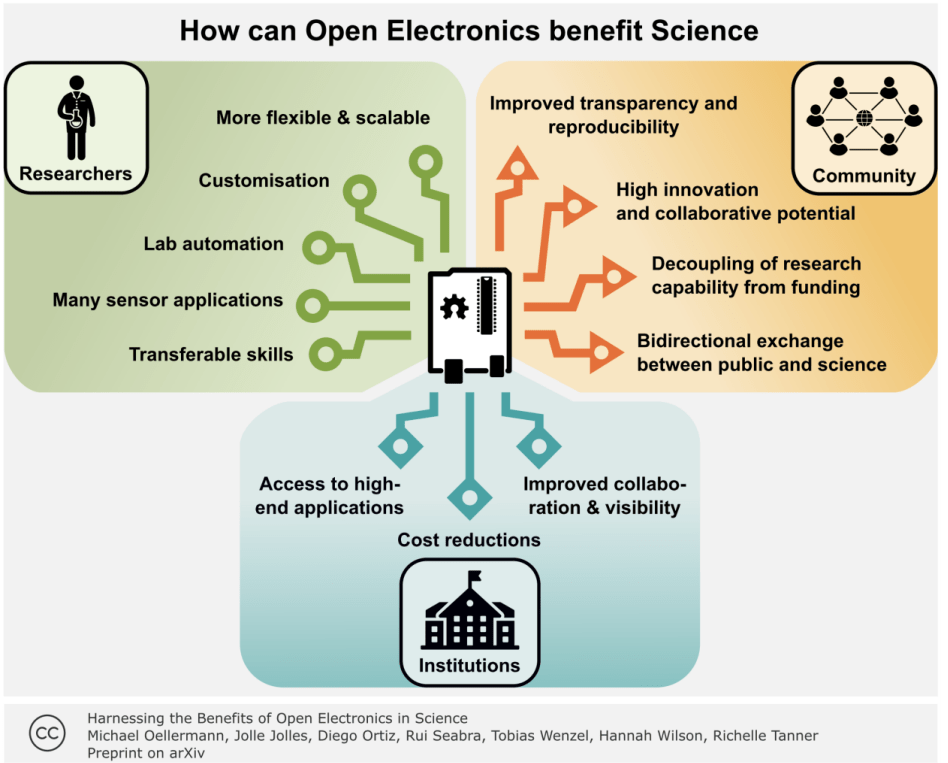
Wonder how Open Electronics can help scientist to make lab life easier, help institutions to reduce costs and aid science to become more reproducible, innovative, and collaborative?
Freely and openly shared low-cost electronic applications, known as open electronics, have sparked a new open-source movement, with much un-tapped potential to advance scientific research. Initially designed to appeal to electronic hobbyists, open electronics have formed a global community of “makers” and inventors and are increasingly used in science and industry. Here, we review the current benefits of open electronics for scientific research and guide academics to enter this emerging field. We discuss how electronic applications, from the experimental to the theoretical sciences, can help (I) individual researchers by increasing the customization, efficiency, and scalability of experiments, while improving data quantity and quality; (II) scientific institutions by improving access and maintenance of high-end technologies, visibility and interdisciplinary collaboration potential; and (III) the scientific community by improving transparency and reproducibility, helping decouple research capacity from funding, increasing innovation, and improving collaboration potential among researchers and the public. Open electronics are powerful tools to increase creativity, democratization, and reproducibility of research and thus offer practical solutions to overcome significant barriers in science.
Wonder how Open Electronics can help scientist to make lab life easier, help institutions to reduce costs and aid science to become more reproducible, innovative, and collaborative?






 OSH Park