The time to enter The Hackaday Prize has ended, but that doesn’t mean we’re done with the world’s greatest hardware competition just yet. Over the past few months, we’ve gotten a sneak peek at over a thousand amazing projects, from Open Hardware to Human Computer Interfaces. This is a contest, though, and to decide the winner,…
Uncategorized
These Twenty Projects Won The Musical Instrument Challenge In The Hackaday Prize
The Hackaday Prize is the greatest hardware competition on the planet. It’s the Academy Awards of Open hardware, and over the past few months we’ve challenged makers and artists to create the Next Big Thing.
via These Twenty Projects Won The Musical Instrument Challenge In The Hackaday Prize — Hackaday
Challenge Your Soldering Skills With Snowy0201
From Bradley Ramsey on the Tindie blog:
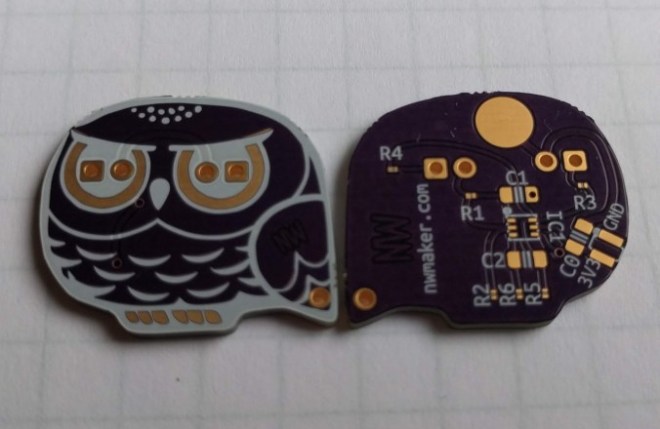
The Snowy Owl is the rebel of owls. They live in the north near arctic regions of the world, and unlike other owls, they are active during the day instead of the night. Owls in general are pretty great, which is why this Snowy Owl version of the Surface Mount Device 0201 soldering challenge kit caught my eye.
For this challenge, the resistors on the back of the owl have been changed to a 0201 packages for an additional level of difficulty. These are cellphone-level miniaturization so it will be a challenge. A dual inverter NL27WZ04 is used to implement the ring oscillator, which drives the blinking LEDs.
Think you’re up to the challenge?
Cool Tools: Deus Ex Autorouter
The first thing you probably asked yourself when learning how to lay out PCBs was “can’t the computer do this?” which inevitably led to the phrase “never trust the autorouter!”. Even if it hooks up a few traces the result will probably be strange to human eyes; not a design you’d want to use.
But what if the autorouter was better? What if it was so far removed from the autorouter you know that it was something else? That’s the technology that JITX provides. JITX is a company that has developed new tools that can translate a coarse textual specification of a board to KiCAD outputs autonomously.
How do you use JITX? At this point the company provides a front end to their tools; you use their website contact form to talk to a human (we assume) about what you want to make and how. But watching their demo videos (see the bottom of this post) gives a hint about how the tooling actually works. In brief; it takes a specification in a domain specific language that describes the components to use, then compiles (synthesizes?) that into KiCAD files that can be sent to fab.
Creating a DIP ATtiny85 Watch with the DS3231
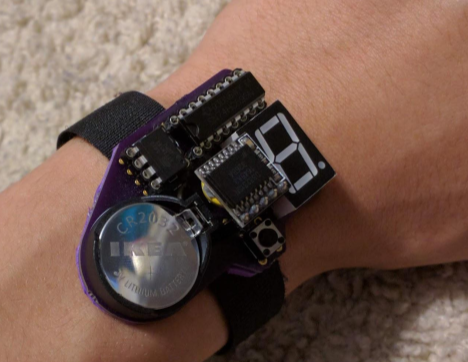
As Douglas Adams explained in The Hitchhiker’s Guide to the Galaxy, digital watches are “pretty neat” to us primitive life forms. Something about the marriage of practicality, and sheer nerdiness gets me oddly excited. Somewhere in my fascination I asked myself, “can I make a digital watch entirely of my design?” I did! And it taught me a lot about pcb fabrication, low power programming, and shift registers.
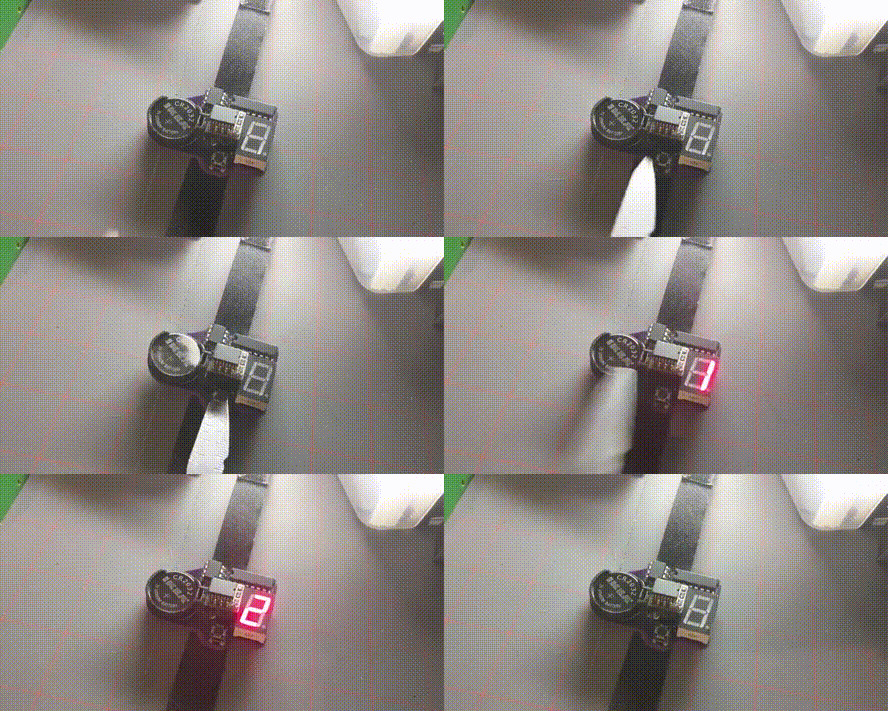
Probably the most important function of a watch is that it keeps time. While you could use your microcontroller to count the seconds and save on parts, there are some major downsides to this. For one, the microcontroller is much worse at keeping time than a dedicated RTC (Real Time Clock) IC, the time would drift significantly with temperature and battery voltage. Another serious problem is that it would require the microcontroller to always be on, keeping track of the time. This would consume much more current than an RTC IC, draining the battery significantly faster. Thus we employ a DS3231 to casually sit in the background, consuming microamps from it’s own back-up battery (which, at the rate of 200µA, would take 12.56 years to drain).

Ken Shirriff Chats About a Whole World of Chip Decapping
Reverse engineering silicon is a dark art, and when you’re just starting off it’s best to stick to the lesser incantations, curses, and hexes. Hackaday caught up with Ken Shirriff at last year’s Supercon for a chat about the chip decapping and reverse engineering scene.
via Ken Shirriff Chats About a Whole World of Chip Decapping — Hackaday
Maker Faire Denver this weekend (Oct. 13-14)
Maker Faire Denver is this weekend, October 13th and 14th:
Maker Faire Denver is entering its second year as the only Feature Maker Faire in the Rocky Mountains and surrounding states! It features awe-inspiring maker creations, hands-on activities for makers of all ages, presentations and competitions. We are also dedicating ourselves to growing our engagement with social impact makers.
Look for our Drew Fustini (@pdp7) in purple!
Micropower Micro Logger
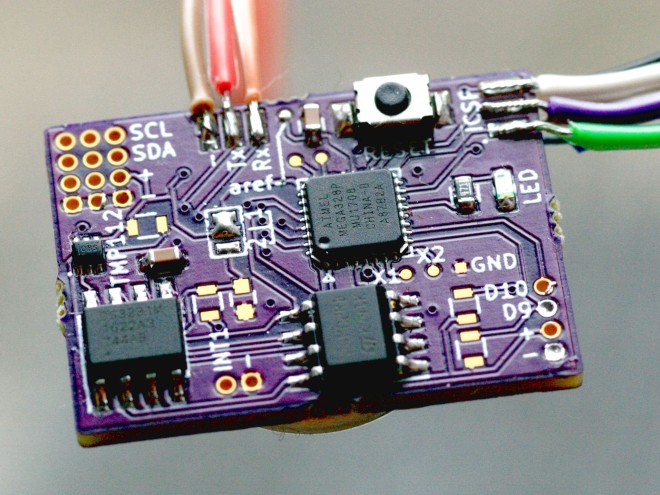
A set-and-forget I2C/digital datalogger from Jan on Hackaday.io
micropower micrologger [mPmL]
This is a logical development from my first and second logger projects. The idea is simple: The logger needs to be small enough to fit inside small spaces, e.g. a bee hive.
With the press off a button it starts/stops logging. The casing can be as simple as shrink tubing!
The 555 and How It Got That Way — Hackaday
There’s a certain minimum set of stuff the typical Hackaday reader is likely to have within arm’s reach any time he or she is in the shop. Soldering station? Probably. Oscilloscope? Maybe. Multimeter? Quite likely. But there’s one thing so basic, something without which countless numbers of projects would be much more difficult to complete,…
Everything Supercon: This. Is. Big.
Come one, come all, this is the megapost about the Hackaday Superconference. Join us in Pasadena on November 2-4 for the hardware conference you cannot miss. Get your ticket quickly as they will sell out! These Are Your People You get excited about cool hardware. We do too. This not the case at most conferences. Come to…