Bring-A-Hack is Back August 5th

Yes, we’re still in a pandemic and yes, these types of events are still happening over videoconference and not in meat space. But you know what? That means that so many more people have the opportunity to show up and show off their hacks! As long as 1 PM PDT is within your personal uptime, that is. Maybe you can make an exception if not?

Here is your link: the summer edition of Bring a Hack with Tindie and Hackaday will take place on Thursday, August 5th at 1:00 PM Pacific Daylight time (that’s 4pm EDT | 9pm BST/CET). Choose your gnarliest hack of late and go register for the event, which will be held on the Crowdcast video chat platform this time around.

The remote Bring-A-Hack held way back in April was packed with awesome people. Now is your chance to join in! You all have awesome projects from the last few months (we’ve seen a lot of them on these very pages), so come show them off to the hacker elite from around the globe. You know the deal: it really doesn’t matter what level your project is on, so don’t worry about that. As long as you’re passionate about it, we’d love to see it and hear all about the problems you had to overcome and yes, even the mistakes you made. You never know what knowledge you might have that can push someone else’s project over the finish line.

Read more on Hackaday…

Bring-A-Hack is Back August 5th

State of Open Hardware 2021

From the Open Source Hardware Assocation:

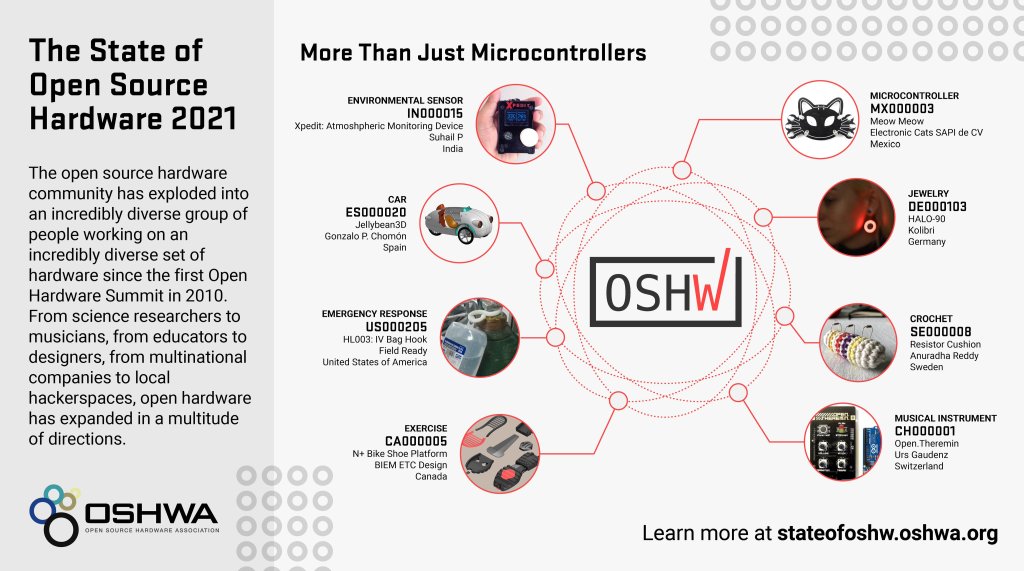
Today OSHWA, in collaboration with the Engelberg Center on Innovation Law & Policy at NYU Law, is excited to launch The 2021 State of Open Source Hardware.  This graphic report builds on data from OSHWA’s Open Hardware Certification Program, the annual Open Hardware Summit, and the annual Open Hardware Community Survey.

The state of open source hardware is strong.  In the eleven years since the first Open Hardware Summit we have seen open hardware grow, with new communities creating new hardware for new uses around the world.  Hundreds of pieces of open source hardware have been certified as compliant with the Open Hardware Definition from countries on every continent except Antarctica. 

A wide range of companies have been built and grown on the foundation of open source hardware.  Dozens of Ada Lovelace Fellows have helped to diversify the open hardware community.  Nonprofit organizations in academia, conservation, science, medical, and more have helped to broaden the impact of open hardware in innumerable ways.

The results of the community survey makes it clear that people come to open hardware for a range of reasons and use open hardware to address a range of needs.  However they start with open hardware, once they start using it they are hooked. Community members study designs, adapt them, and build upon existing designs in order to achieve their goals.  Open hardware is used in teaching, the development of commercial products, and everything in between.

What are you waiting for? Click over, check it out, and let us know what you think.  While the state of open source hardware is strong in 2021, we think it may get even stronger in the future.

State of Open Hardware 2021

Reimagine Supportive Tech for the Newest Hackaday Prize Challenge

Beginning right now, the 2021 Hackaday Prize challenges you to Reimagine Supportive Tech. Quite frankly, this is all about shortcuts to success. Can we make it easier for people to learn about science and technology? Can we break down some barriers that keep people from taking up DIY as a hobby (or way of life)? What can we do to build on the experience and skill of one another?

For instance, to get into building your own electronics, you need a huge dedicated electronics lab, right? Of course that’s nonsense, but we only know that because we’ve already been elbow-deep into soldering stations and vacuum tweezers. To the outsider, this looks like an unclimbable mountain. What if I told you that you could build electrics at any desk, and make it easy to store everything away in between hacking sessions? That sounds like a job for [M.Hehr’s] portable workbench & mini lab project. Here’s a blueprint that can take a beginner from zero to solder smoke while having fun along the way.

Read more on Hackaday…

Reimagine Supportive Tech for the Newest Hackaday Prize Challenge

24-bit SPI ACD breakout board

From Manuvr Breakouts on Tindie:

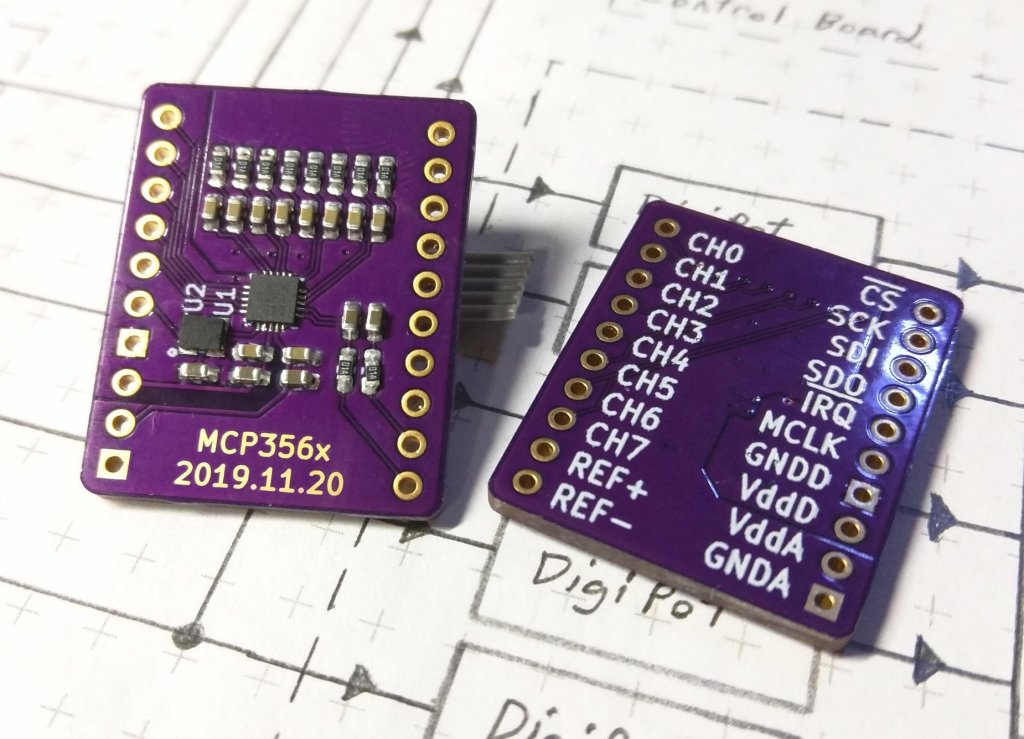
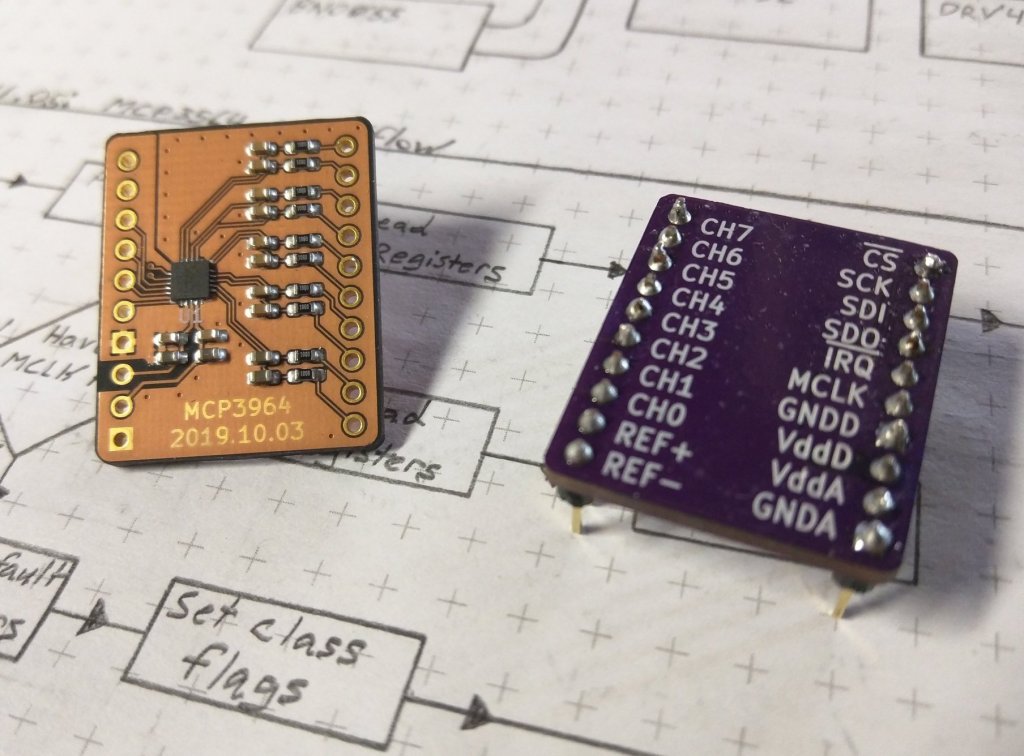
The MCP3564 is a 24-bit sigma-delta ADC with support for up to eight single-ended, or four differential channels. It supports extensive oversampling depths, flexible MUX front-end, circuit burnout detection, adjustable gain, Vref from [0v – 3.6v], and optional internal oscillator.

The board is available with or without high-accuracy external oscillator. If included, the oscillator frequency is fixed at the maximum rate for this part (19.6608 MHz).

Read more…

24-bit SPI ACD breakout board

A Perfect Clock For Any Hacker’s Ohm

Adam Zeloof writes on Hackaday:

The vast majority of us are satisfied with a standard, base ten display for representing time. Fewer of us like to be a bit old-fashioned and use a dial with a couple of hands that indicate the time, modulo twelve. And an even smaller minority, with a true love for the esoteric, are a fan of binary readouts. Well, there’s a new time-telling game in town, and as far as we’re concerned it’s one of the best ones yet: resistor color codes.

The Ohm Clock is, as you may have guessed, a giant model of a resistor that uses its color bands to represent time.  Each of the four bands represents a digit in the standard HH:MM representation of time, and for anybody well-versed in resistor codes this is sure to be a breeze to read. The clock itself was designed by [John Bradnam]. It’s body is 3D printed, with RGB LEDs to brightly illuminate each segment. The whole thing is controlled by an old favorite – an ATtiny, supported by a Real Time Clock (RTC) chip for accurate timekeeping.

Read more on Hackaday…

A Perfect Clock For Any Hacker’s Ohm

EZ Fan2 Tiny Raspberry Pi Fan Controller

Jeremy Cook created this tiny PCB for controlling small cooling fans or other motors:

What is it?

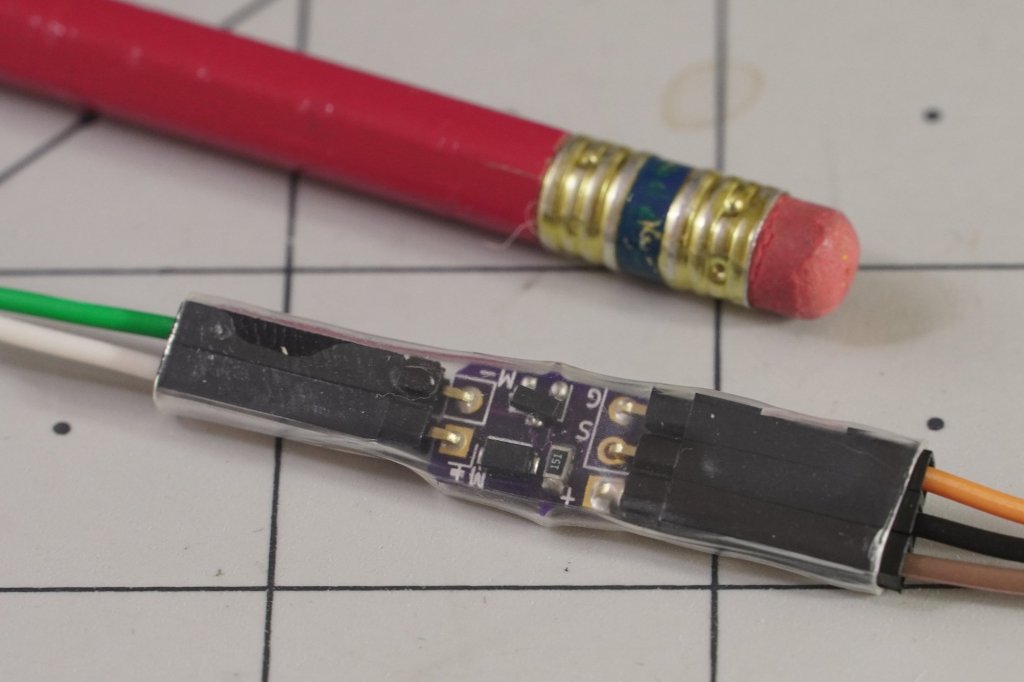
PCB originally designed to control cooling fans on Raspberry Pi boards, but can be used with other small motors or DC loads. Includes a flyback diode to safely dissipate inductive voltage spikes.

Can also work with Arduino and other such dev boards.Why did you make it?

Wanted a way to control cooling fans off of a Raspberry Pi. While some fans have PWM inputs, some do not and cannot normally be controlled. This transistor board works well with the GPIO fan control option in Raspberry Pi OS (which turns it fully on and fully off).

Not a full motor driver (i.e. it only drives in one direction) but can be used with other simple DC motors as well. Includes a resistor and flyback diode.

What makes it special?

It’s very, very small, even compared to a prior THT version. It should therefore be able to fit inside nearly any case. The optional 90º headers are even spec’d out to be low profile.

Boards come fully assembled with or without headers depending on the option selected, and appearance of the boards may vary. Options also available for female-female wires as needed, and/or clear heat shrink.

Read more on Tindie…

EZ Fan2 Tiny Raspberry Pi Fan Controller

Jon Evans talks KiCad V6

KiCad developer Jon Evans joins the Contextual Electronics podcast hosted by Chris Gammell:

CEP014 – Moving to KiCad V6 with Jon Evans

Jon Evans is a longtime developer on the KiCad project and practicing EE at Formlabs. He joins Chris to talk about the future of KiCad, including features that are coming in V6.

Jon Evans talks KiCad V6

Hackaday Prize: deadline on July 19th

The deadline for challenge #2 of the Hackaday Prize is next Monday, July 19th:

Refresh Work-From-Home Life

Enter one or more of this year’s challenges for the chance to win cash prizes and move on to the finals, where our panel of judges will decide on the grand prize winner! With $25,000 on the line, and numerous other opportunities to win, there’s no reason not to enter!

Ultimately though, the Hackaday Prize isn’t about winning money. It’s about creating impactful change through the kind of hardware innovation only our amazing community can provide.

Hackaday Prize: deadline on July 19th

Fractal Vise Holds Odd-Shaped Objects Tight

Trying to solder an oddly shaped art PCB board? This 3D printed visa could help:

A regular vice is great if you want to clamp rectangular objects, but it can fall down a little with more complex shapes. Inspired by an ancient vise [Chris Borge] whipped up his own 3D-printed fractal clamping tool.

The inspiration for this one comes from the [Hand Tool Rescue] video that shows of the clever mechanism. The vice uses a series of interlocking parts that can freely articulate to grip the object of interest via several protruding fingers. In reproducing the design, [Chris] had some issues initially with the joints, but settling on a dovetail similar to that of the original metal vice which got things working nicely.

Read more on Hackaday…

Fractal Vise Holds Odd-Shaped Objects Tight

Fibonacci512 giant LED disc

From Jason Coon of Evil Genius Labs:

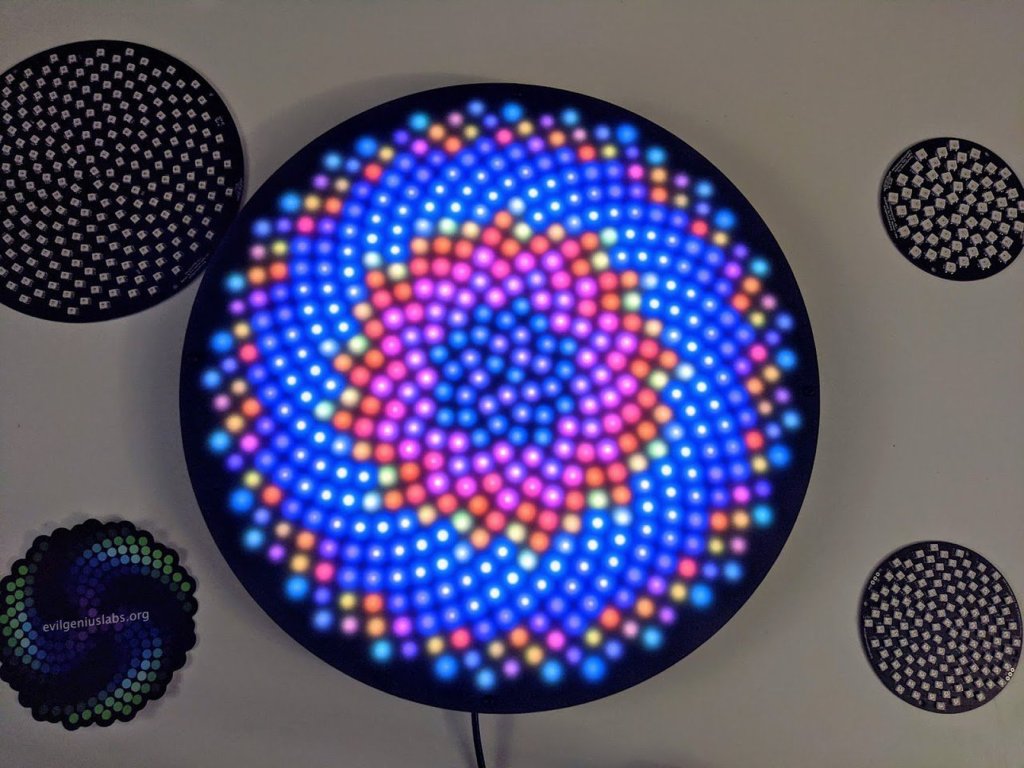
Fibonacci512 is a giant, beautiful 320mm circular disc with 512 RGB LEDs surface mounted in a Fibonacci distribution. Swirling and pulsing like a colorful galaxy, it’s mesmerizing to watch.

It consists of 512 WS2812B-Mini 3535 RGB LEDs, arranged into a circular Fermat’s spiral pattern.

I have created several LED art pieces in Fibonacci patterns. They are all very labor intensive to create, and so are fairly expensive and limited in quantity. I wanted to come up with a Fibonacci layout that was at least slightly easier to create, and therefore more affordable.

I have RGB LEDs in just about every form they come: strips, strings, rings, discs, etc. The LEDs on most discs are arranged in very regular rings. Fibonacci512 is different. The LEDs are arranged in a Fibonacci distribution. The makes the layout very organic and seemingly messy. But with the proper animation, spiral patterns emerge with spectacular results.

Each of the 512 WS2812B-Mini 3535 RGB LEDs has its own decoupling capacitor built in. The top and bottom of the PCB are large 5V and GND planes, to allow for the large amount of current required by the 512 LEDs. The PCB is split into four separate data lines to allow for higher frame rates when driven by a microcontroller that supports the FastLED library’s parallel output, such as ESP8266, ESP32, Teensy, etc. The max theoretical frame rate with four way parallel output is ~260 FPS. Each of the four data lines has a separate four-pin headers provided for 5V, Data In (to the section), Data Out (from the previous section) and GND. The last Data Out pin can be used to connect to even more LEDs. There are also small jumper solder pads that can be bridged to drive the whole panel with a single pin (max ~65 FPS), or two pins (max 130 FPS).

Read more on Tindie…

Fibonacci512 giant LED disc