Friday Hack Chat: Open Hardware For Science

From Brian Benchoff on the Hackaday blog:

Friday Hack Chat: Open Hardware For Science

Scientific equipment is expensive. It can cost hundreds of thousands of dollars to set up a lab. Simply the cost of machines, like data acquisition units or even a simple load cell, can cost hundreds of dollars. This makes research cost prohibitive, and that’s the case even if you do spend a dozen hours a week writing grant proposals. Citizen science is right out, because the cost of the tools to do science is so high.

For this week’s Hack Chat, we’re going to be talking about Open Hardware for science. This is the chat that’s all about Open Source equipment, hardware modular electronics, and Open designs to make the tools that make science.

Our guest for this week’s Hack Chat is [Dr. Alexxai Kravitz]. He has a PhD in Neuroscience from UPenn and completed a postdoc at the Gladstone Institutes in San Fransisco. [Lex]’s research focuses on understanding the reward circuitry in the brain, and his publications use a variety of experiments to examine this, including behavioral testing, in vivo electrophysiology, and optogenetics.

For this Hack Chat, we’re going to about how Open Source has made more science possible. Of note, we’ll be discussing:

  • What Open Source science equipment is being used today
  • The initiatives behind Open Source Hardware for science applications
  • Scientific application that could benefit from Open Hardware

You are, of course, encouraged to add your own questions to the discussion. You can do that by leaving a comment on the Hack Chat Event Page and we’ll put that in the queue for the Hack Chat discussion.
Friday Hack Chat: Open Hardware For Science

Hackaday Belgrade Schedule Announced

Hackaday Belgrade is the best conference focused on hardware creation that you can find anywhere in Europe. Taking place in Belgrade, Serbia on May 26th, the schedule is packed with talks, workshops, and a hacker village that is hackathon, entertainment, and the demoscene rolled into one.

More than just an event, this is about the culture of Hackaday. These are your people, you need to make room in your life to come to Belgrade because you don’t want to miss this!

via Hackaday Belgrade Schedule Announced — Hackaday

Hackaday Belgrade Schedule Announced

Hardware meetup this Thursday in SF

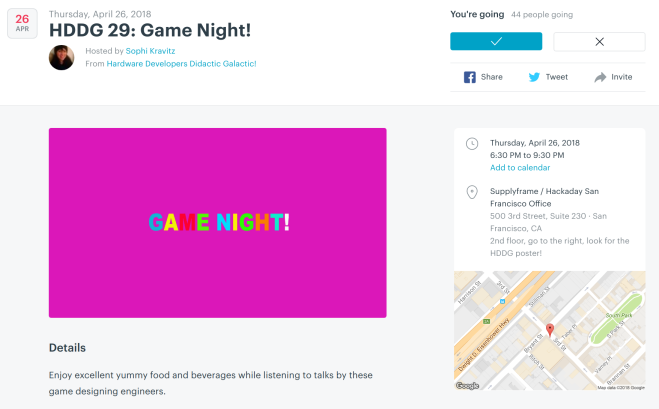
The next  Hardware Developers Didactic Galactic (HDDG) is this Thursday, April 26th, at SupplyFrame’s office in San Francisco:

Screenshot from 2018-04-24 09-24-28

HDDG 29: Game Night!

Enjoy excellent yummy food and beverages while listening to talks by these game designing engineers.

Richard Hogben – Mixed Reality Smartphone Game
Adelle Lin – Multiplayer Games in Public Spaces

HDDG is excited to host Adelle Lin this month. Adelle Lin (http://touchtech.io/ and http://adelleninja.com/) recently moved to San Francisco from New York and is an engineer at Intel. A lover of indie-games, she started building hardware so that she could create games that connect people in space. She has worked on projects shown at Paris Fashion Week, Play NYC, Come Out and Play, PlayTimesSquare, AR World Expo, Burning Man, and Maker Faire.

Developing games for public spaces is challenging and even more so when you introduce hardware components. Adelle will talk through various options to consider through the lens of games that she built for PlayTimesSquare (Symphonic Picnic) and PlayNYC (Star Catcher VR) – networking, hardware specs, interfaces, installation.

We are equally excited to welcome Richard Hogben (https://hackaday.io/rich ). Richard Hogben lives in San Francisco and works as a front end engineer at Supplyframe. His previous projects include a flying Hasselblad medium format film camera. Richard is currently organizing a project on Hackaday.io to build and assemble an Open NSynth Super synthesizer.

At HDDG, Rich will talk about a recent game that he designed and presented at the Hackaday Superconference. The game is called Pinned, and it is a mixed reality smartphone game with Unreal Engine and SteamVR room scale tracking.

After the talks, there will be demos, community announcements, and socializing. If you’d like to give a 2 minute demo/ community announcement, please see the organizers when you arrive to get set up.

A community announcement includes looking for a project partner, a job, offering a project/ job, the announcement of your startup launch, your Crowdfunding pitch, etc

https://www.meetup.com/Hardware-Developers-Didactic-Galactic/events/249704120/

Hardware meetup this Thursday in SF

Simple Mechanism Gives Support for SMT Assembly

 on the Hackaday blog:

pick-and-place-e1523119167760.png

Simple Mechanism Gives Support for SMT Assembly

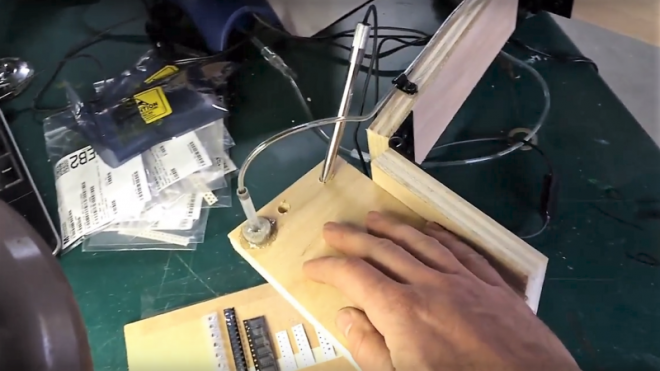
To fight the shakes, you can do one of two things: remove the human, or improve the human. Unable to justify a pick and place robot for the former, [Tom] opted to build a quick hand support for surface-mount work, and the results are impressive considering it’s built entirely of scrap.

It’s just a three-piece arm with standard butt hinges for joints; mounted so the hinge pins are perpendicular to the work surface and fitted with a horizontal hand rest, it constrains movement to a plane above the PCB. A hole in the hand rest for a small vacuum tip allows [Tom] to pick up a part and place it on the board — he reports that the tackiness of the solder paste is enough to remove the SMD from the tip.

Simple Mechanism Gives Support for SMT Assembly

Dublin Knows How to Bring-a-Hack

From  on the Hackaday blog:

Dublin Knows How to Bring-a-Hack

When on the road, we love to stop by a local hackerspace and connect with the hacker community. On Friday, TOG Hackerspace in Dublin, Ireland opened their doors to host a Bring-a-Hack with Hackaday and Tindie.

TOG is a Gaelic word which loosely translates as “to make”. Declan met us for the beer drop and gave us a tour when we returned for the evening event. The building is divided into several different spaces, starting with an entry area that serves as a meeting space, gaming room, and showcase of projects.

Dublin Knows How to Bring-a-Hack

2018 Hackaday Prize: Build Hope. Design the Future

Every year we are inspired by the projects entered into the Hackaday Prize, and we are excited that the 2018 Hackaday Prize season has begun:

This is our global engineering initiative with huge prizes for those hackers, designers, and engineers who want to use their skill and energy to build something that matters. This year, we challenge you to Build Hope. Show the world the amazing ways technology enriches humanity, and that its benefits can be shared by all. There is over $200,000 in cash prizes headed to the most interesting hardware builds of the year. With plenty of room for great ideas, the top 100 entries will each receive a $1,000 cash prize and continue

Have you entered a project into 2018 Hackaday Prize?


2018 Hackaday Prize: Build Hope. Design the Future

The Amazing Hacks Of World Create Day

For this year’s Hackaday Prize, we started an amazing experiment. World Create Day organized hundreds of hackerspaces around the world to come together and Build Hope for the future. This was an experiment to bring community shops and workspaces together to prototype their entries for the Hackaday Prize, and boy was it a success. We had hackerspaces…

via The Amazing Hacks Of World Create Day — Hackaday

The Amazing Hacks Of World Create Day