The Amp Hour podcast: Keyzermas Vacation

Episode #472 – Keyzermas Vacation

Jeff Keyzer of Mightyohm.com joins Chris and Dave to talk about learning 3D CAD, attending a wide range of conferences, long lead time components, and plans for learning in the new year.

Hip hip hooray for Keyzermas Vacation!

  • Jeff has been attending a lot of events in 2019
  • Jeff is no longer at Valve, since February of 2019.
  • He’s been spending his time learning Solidworks and updating his Altium knowledge/license.
The Amp Hour podcast: Keyzermas Vacation

Interview: FieldKit Team the Morning After Winning the 2019 Hackaday Prize

We caught up with Shah Selbe and Jacob Lewallen the morning after their project, FieldKit, won the Hackaday Prize. FieldKit is an open-source field-based research data collection platform. Which is basically a lot of fancy words for saying it’s a system for collecting sensor data in the field without being snagged by the myriad of problems associated with putting electronics in remote locations. It’s a core project of Conservify, a non-profit organization that seeks to empower conservation research.

via Interview: FieldKit Team the Morning After Winning the 2019 Hackaday Prize — Hackaday

Quote

Interview with Matt Berggren of Autodesk on EAGLE and more

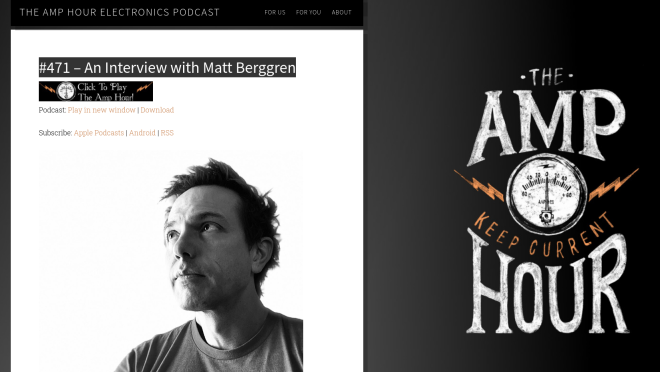
The wonderful electronics podcast The Amp Hour recently interviewed  Matt Berggren of Autodesk about EAGLE and more:

Screenshot from 2019-12-21 13-04-30.png

#471 – An Interview with Matt Berggren


Interview with Matt Berggren of Autodesk on EAGLE and more

Hackaday Supercon badge boots Linux using SDRAM cartridge

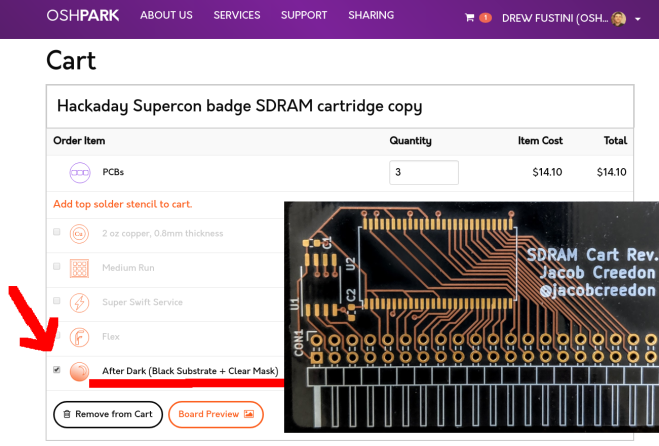
Jacob Creedon designed an a cartridge board that adds 32MB of SDRAM to the Hackaday Supercon badgeMichael Welling just assembled a version of the PCB made with the OSH Park “After Dark” black FR-4 service:

The addition of SDRAM provides enough memory to boot Linux on a RISC-V soft-core in the ECP5 FPGA on the badge.  Here’s a screenshot of Linux running:

Read more about “Team Linux on Badge” in this Hackaday post:

Badge-hacking-2019-13-Linux-on-badge-team.jpg

And finally, receiving the biggest applause was Linux-on-Badge: this team used all the badge hacking tricks in the book. The hardware component was a 32 MiB SDRAM cartridge by [Jacob Creedon]. The default badge SOC FPGA bitstream was entirely replaced in order to support a minimalist Linux. Much of the development was done on [Michael Welling]’s computer, guided by the precedence of a LiteX project putting Linux on the Radiona ULX3S. This is a true success story of Supercon collaboration as the team (including [Drew Fustini], [Tim Ansell], [Sean Cross], and many others) came together and worked late into nights, drawing from the massive body of collective expertise of the community.

Watch the demo during the Badge Hacking ceremony (jump to 17m 35s):

Resources:

ad-sdram
Note: click the “After Dark” checkbox if you want clear solder mask on black substrate

UPDATE:

Demo of Linux-on-LiteX booting on the badge:

Wondering what LiteX is?

LiteX is a FPGA design/SoC builder that can be used to build cores, create SoCs and full FPGA designs

Hackaday Supercon badge boots Linux using SDRAM cartridge

Open Source Hardware column in Hackspace Magazine

I wrote about Open Source Hardware and the Open Hardware Summit 2020 in the December issue of HackSpace magazine.  If you don’t subscribe to the print edition, then you can download the free PDF.

This October, people all over the world celebrated Open Source Hardware Month with meet-ups, talks and workshops. The month kicked off with events at RAIT in Vienna (Austria) and SparkFun in Colorado (USA), followed by gatherings in Poland, Panama, Thailand, Japan, Ghana and more!

In total, there were 40 events in 14 different countries across five continents, showing us that the world of Open Source Hardware is expanding rapidly. But while many people in the maker community will have used some kind of Open Source Hardware technology — such as an Arduino — there is some confusion about what the term actually means.

Open Source Hardware column in Hackspace Magazine

Hardware Happy Hour announced for Omaha (USA)

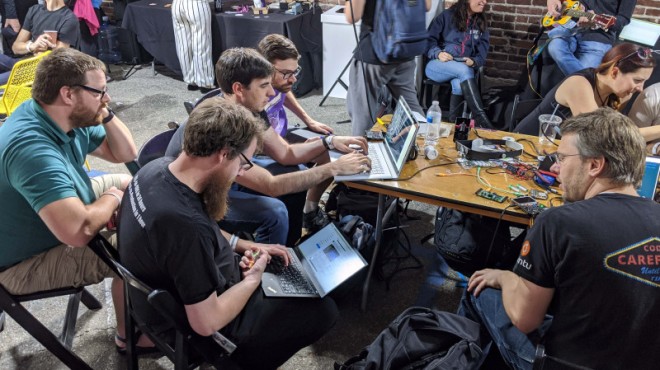
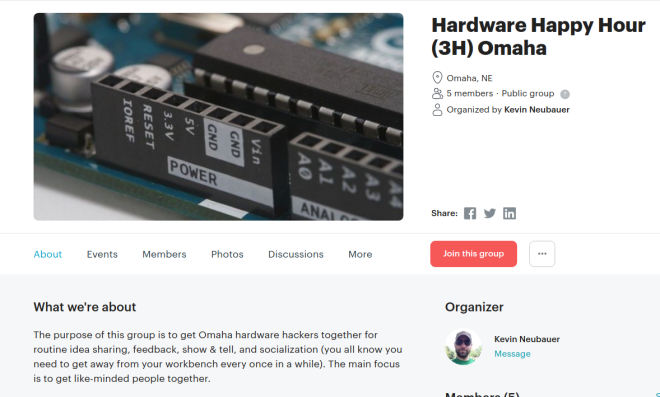
Kevin Neubauer recently created CircuitBrains and wants to meet up with other electronics hobbyists in Omaha (in the USA):

Screenshot from 2019-12-18 03-34-55.png

https://www.meetup.com/3H-Omaha/

highres_480539330

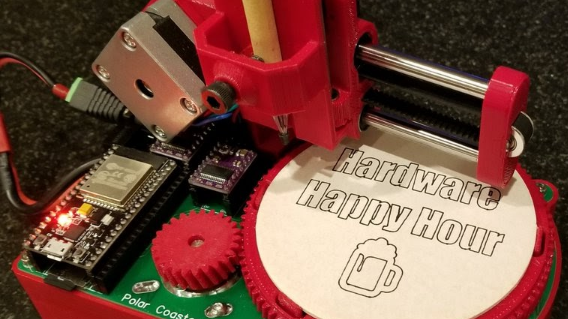
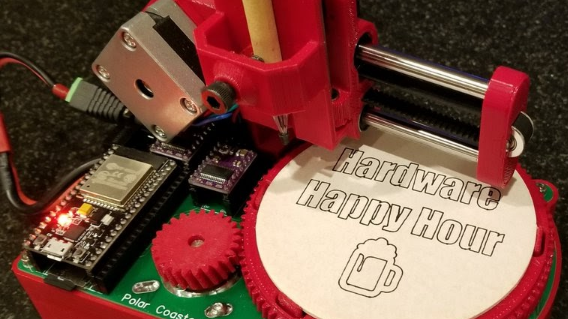
Did you know there are Hardware Happy Hours in many cities?

https://www.meetup.com/Seattle-Hardware-Happy-Hour-3H/

https://www.meetup.com/3HBerlin/

https://www.meetup.com/Hardware-Happy-Hour-3H-Chicago/

https://www.meetup.com/hardwarehappyhoursf/

https://www.meetup.com/Hardware-Happy-Hour-3H-Phoenix/

Chris Gammell tries to keep a list of all the 3H meetups, so feel free to ask on Twitter.

Hardware Happy Hour announced for Omaha (USA)

Weird World of Microwaves Hack Chat

Join us on Wednesday, December 18 at noon Pacific for the Weird World of Microwaves Hack Chat with Shahriar Shahramian! We’ve been following him on The Signal Path for years and are excited to pick his brain on what is often considered one of the dark arts of electronics.

No matter how much you learn about electronics, there always seems to be another door to open. You think you know a thing or two once you learn about basic circuits, and then you discover RF circuits. Things start to get a little strange there, and stranger still as the wavelengths decrease and you start getting into the microwave bands. That’s where you see feed lines become waveguides, PCB traces act as components, and antennas that look more like musical instruments.

via Weird World of Microwaves Hack Chat — Hackaday

Quote

CircuitPython in a small factor with CircuitBrains Deluxe

CB-Deluxe-Front
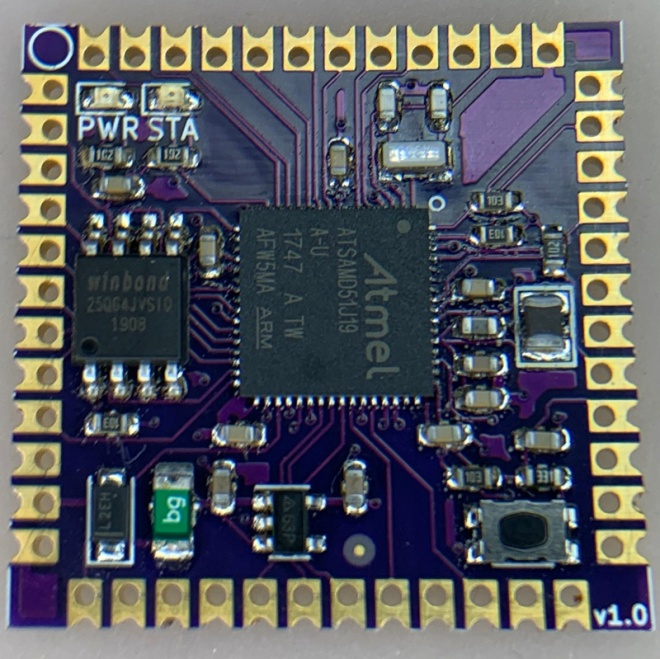
Kevin Neubauer has designed a System-on-Module (SoM) to make it easy to embed Circuit Python in project:

CircuitBrains Deluxe

I love Adafruit’s CircuitPython product line. The ability to just plug your board into USB, make code changes, and see them take effect in real-time is amazing. However, when it comes to finishing up a CircuitPython project, I felt limited in choice for a small form-factor, streamlined board. I always ended up creating my own boards. The overhead in doing this was huge though. You have to make sure your design has proper power, decoupling, and clock. Then you source all of the parts. After that you lay out the PCB and have it fabricated. When the PCB and parts arrive, you have to deal with finicky small-pitch surface mount assembly. Finally, you need to download the sources for the UF2 bootloader and CircuitPython and define your board, compile, and flash. This makes what should be a small project pretty time consuming and tedious!

https://twitter.com/kevinneubauer/status/1204808844293095424

Goals:

  1. Reduce barriers to entry for custom CircuitPython-based boards & badges
  2. Package CircuitPython into a small form-factor module that will add minimal dimensions to a parent project

Specs:

  1. Dimensions: 29 x 29 x 3.5 millimeters / 1.15 x 1.15 x 0.15 inches
  2. Atmel ATSAMD51J19A Microcontroller (32-bit ARM Cortex M4)
    • 120 MHz
    • 192 KB SRAM
    • 512 KB Flash
  3. 8 MB SPI Flash
  4. Onboard 3.3V LDO Regulator
  5. Power and Status LEDs
  6. Breakouts for SPI and I2C
  7. Breakouts for 14 Analog and 19 Digital Inputs/Outputs

Links: https://github.com/neubauek/CircuitBrains

CircuitPython in a small factor with CircuitBrains Deluxe

Time lapse build of Retro CPC Dongle

So the next build of the CPC2 is done. I recorded the process with a time-lapse camera because it’s hard to make a 7 hour build entertaining. Each second of video is 30 seconds of assembly time, so this 7-hour build ended up at 7m19s of timelapse, after cutting out the cursing and head-scratching. See if you can spot my hands start to shake at the 2-hour mark of trying to precisely place the sub-millimetre components and enjoy.

via Retro CPC Dongle – Part 41 — Intelligent Toasters

Quote