Software Defined Everything with Mike Ossmann and Kate Temkin


Software defined radio has become a staple of the RF tinkerer, but it’s likely that very few of us have ever taken their software defined toolchain outside the bounds of radio. It’s an area explored by Mike Ossmann and Kate Temkin in their newly published Supercon talk as they use GNU Radio to do some things that you might find unexpected.

For most people, a software defined radio is a device. An RTL-SDR dongle perhaps, or the HackRF that a popular multi-tool for working in the radio frequency realm. But as they explain, the SDR hardware can be considered merely as the analogue front end, being just the minimal analogue circuitry coupled with a digitiser. The real software-defined part comes — as you might expect — in the software

Kate and Mike introduce GNU Radio Companion — the graphical UI for GNU Radio — as their tool of choice and praise it’s use as a general purpose digital signal processing system whether or not that includes radio. Taking their own Great Scott Gadgets GreatFET One USB hackers toolkit peripheral as an input device they demonstrate this by analysing the output from a light sensor. Instantly they can analyse the mains frequency in a frequency-domain plot, and the pulse frequency of the LEDs. But their bag of tricks goes much deeper, exploring multiple “atypical use cases” that unlock a whole new world through creative digital signal processing (DSP).

via Software Defined Everything with Mike Ossmann and Kate Temkin — Hackaday
Quote

Chat about Open-Source Neuroscience Hardware today on Hackaday

Join us on Wednesday, February 19 at noon Pacific for the Open-Source Neuroscience Hardware Hack Chat with Dr. Alexxai Kravitz and Dr. Mark Laubach!

There was a time when our planet still held mysteries, and pith-helmeted or fur-wrapped explorers could sally forth and boldly explore strange places for what they were convinced was the first time. But with every mountain climbed, every depth plunged, and every desert crossed, fewer and fewer places remained to be explored, until today there’s really nothing left to discover.

Unless, of course, you look inward to the most wonderfully complex structure ever found: the brain. In humans, the 86 billion neurons contained within our skulls make trillions of connections with each other, weaving the unfathomably intricate pattern of electrochemical circuits that make you, you. Wonders abound there, and anyone seeing something new in the space between our ears really is laying eyes on it for the first time.

But the brain is a difficult place to explore, and specialized tools are needed to learn its secrets. Lex Kravitz, from Washington University, and Mark Laubach, from American University, are neuroscientists who’ve learned that sometimes you have to invent the tools of the trade on the fly. While exploring topics as wide-ranging as obesity, addiction, executive control, and decision making, they’ve come up with everything from simple jigs for brain sectioning to full feeding systems for rodent cages. They incorporate microcontrollers, IoT, and tons of 3D-printing to build what they need to get the job done, and they share these designs on OpenBehavior, a collaborative space for the open-source neuroscience community.

Join us for the Open-Source Neuroscience Hardware Hack Chat this week where we’ll discuss the exploration of the real final frontier, and find out what it takes to invent the tools before you get to use them.

Our Hack Chats are live community events in the Hackaday.io Hack Chat group messaging. This week we’ll be sitting down on Wednesday, February 19 at 12:00 PM Pacific time. If time zones have got you down, we have a handy time zone converter.

via Open-Source Neuroscience Hardware Hack Chat — Hackaday

Quote

Hardware Happy Hour (3H) Berlin on Feb. 20th

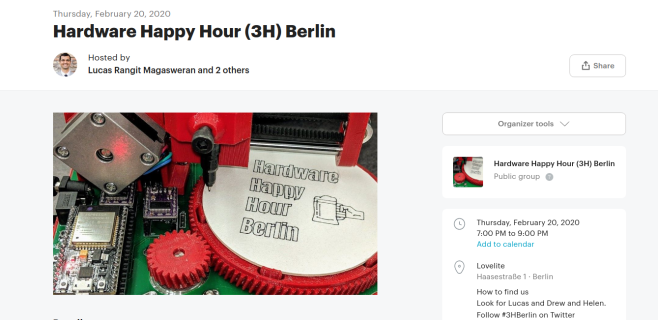
If you are near Berlin next Thursday, February 20th, then check out this social gathering of electronics enthusiasts:Screenshot from 2020-02-15 18-03-12

Hardware Happy Hour (3H) Berlin

We will be returning to the Lovelite bar this time.

Please bring your latest project with you! Anything you’re working on, electrical, mechanical or software works! We want to see the stuff that you’re interested in!

Lovelite will open at 6pm and we will officially start at 7pm.

https://www.meetup.com/3HBerlin/events/268451851/

Follow Drew Fustini (@pdp7) for updates!


Hardware Happy Hour (3H) Berlin on Feb. 20th

International Hackerspaces Open Day 2020 in March

Every last Saturday of March there is International Open Hackerspace Day!

Screenshot from 2020-02-07 14-21-59

What could you do?

  • make a press release and spread this around your (local) newspapers, websites etc. (include nice hires pic with people on it)
  • explain the word ‘hacker’ and maker (some people have still a negative / criminal interpretation of hackers)
  • show people around your space and explain what a hackerspace is.
  • give an workshop eg soldering, programming, arduino
  • give a ‘lecture’ about privacy, IoT (and lack of security), open source software.
  • any more ideas? Add them here.

Participating spaces are:

Netherlands:

Brazil

Bulgaria

Check hackerspaces.org see to more as they are added!

International Hackerspaces Open Day 2020 in March

Build a Cracklebox in Berlin

“Your skin is a circuit”

Build a Cracklebox with Nicolas Collins on Feb. 17th at Common Ground in Berlin:
Screenshot from 2020-02-06 12-49-44

Back in December, I visited Nicolas Collins at the School of the Art Institute in Chicago and got to see one of the latest creations that he is using in class. The beautiful traces wind their way into the classic LM386 audio amp for an expressive overdriven effect:

https://twitter.com/oshpark/status/1206711384223997958

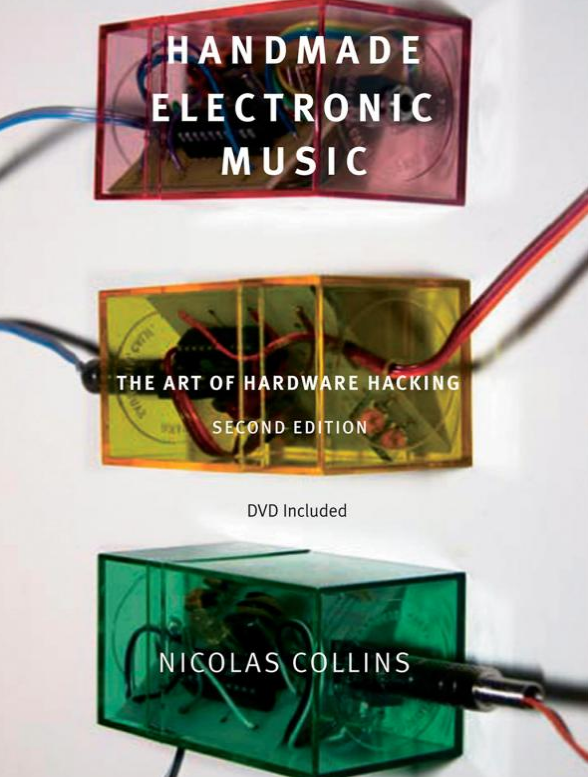
Nicolas Collins is well known for having written Handmade Electronic Music: The Art of Hardware Hacking:

Screenshot from 2020-01-15 11-38-09.png

provides a long-needed, practical, and engaging introduction to the craft of making – as well as creatively cannibalizing – electronic circuits for artistic purposes. With a sense of adventure and no prior knowledge, the reader can subvert the intentions designed into devices such as radios and toys to discover a new sonic world. At a time when computers dominate music production, this book offers a rare glimpse into the core technology of early live electronic music, as well as more recent developments at the hands of emerging artists. In addition to advice on hacking found electronics, the reader learns how to make contact microphones, pickups for electromagnetic fields, oscillators, distortion boxes, and unusual signal processors cheaply and quickly.


Build a Cracklebox in Berlin

KiCon 2020 announced

Screenshot from 2020-02-03 03-19-22

After a successful first year of KiCon in 2019 in Chicago, it will change venues to CERN, a major contributor to the KiCad project!

KiCon 2020: A KiCad conference at CERN, September 11th-13th, 2020

More details soon!  If you’re interested in being involved, the following email addresses can be used to contact the right people about this event:

KiCon 2020 announced

Teardown 2020: hardware hacking con in Portland this June

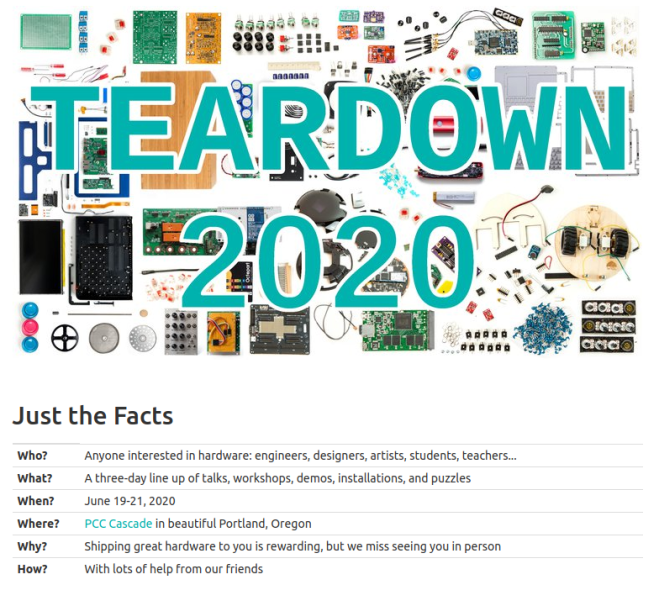
Teardown 2020, the hardware hacking conference organized by Crowd Supply, will be June 19-21 at PCC Cascade in beautiful Portland, Oregon!

Screenshot from 2020-01-25 11-04-12

Teardown 2020

Teardown is about the practice of hardware: prototyping, manufacturing, testing, disassembling, and circumventing, all while having fun. Leave the marketing glitz and talk of venture capital at the door and come prepared to learn and teach.

Helen Leigh wrote a great Hackaday post about what happened at Teardown 2019!

Teardown 2020: hardware hacking con in Portland this June