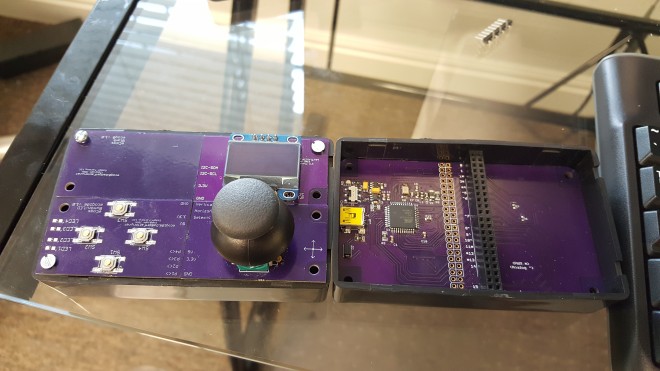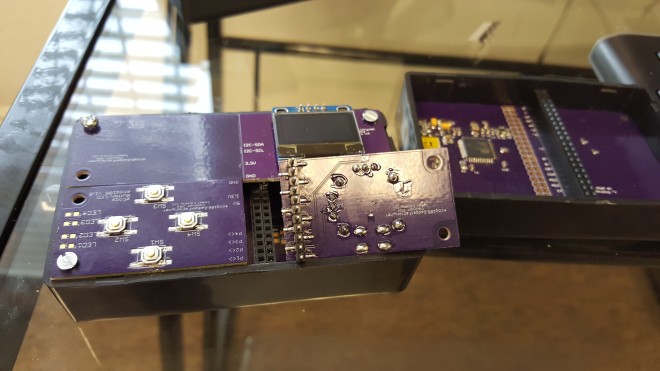
Abstract. For a while now the Pilogger needs a small remote display. The logging station is neither particularly compact nor elegant, therefore I made some tests about a battery powered status display. I tried solutions which I never used mainly by curiosity but also in order to continue to learn something. Especially the Wifi chip ESP8266 and a […]
Uncategorized
Hackaday Prize Entry: Open Sip And Puff

Hackaday highlights Jason Webb’s impressive assistive technology project:
Hackaday Prize Entry: Open Sip And Puff
A sip-and-puff device is an assistive technology used by people who cannot use their hands. Being a quasi-medical device, you can imagine this technology is extremely expensive, incapable of being modified, and basically a black box that can’t do anything except what it was designed for.
Sega Genesis Chiptune Synthesizer
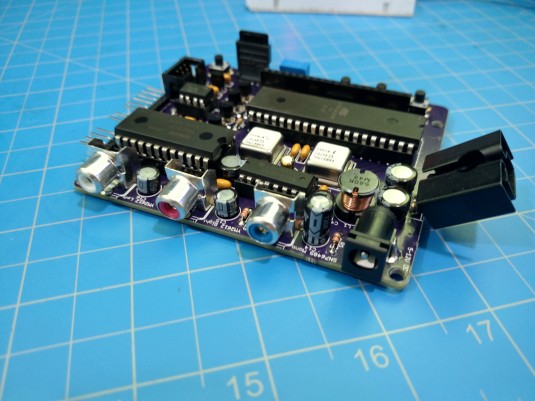
Jarek Lupinski created this board that uses the actual Sega Genesis sound chips to play chiptune files:
Sega Genesis Native Hardware Chiptune Synthesizer
The VGM file format stores instructions for sound chips, and VGM files for many popular games can be found online. An Atmega1284p microcontroller will read these VGM files from an SD card and translate them into signals to send to the onboard YM2612 and SN76489 chips. These chips were used by the original Sega Genesis hardware to make the sound effects and music in Genesis games.
Hackerbot Labs autonomous boat
Hackerboat
An autonomous boat of unusual size
Hackerboat Progress
Since the last update, we’ve gotten in the water one more time (in late July) and we’ve made some substantial design changes. First off, here’s a video of my talk at Toorcamp that Alex was kind enough to put together
Teensy E-Paper shield
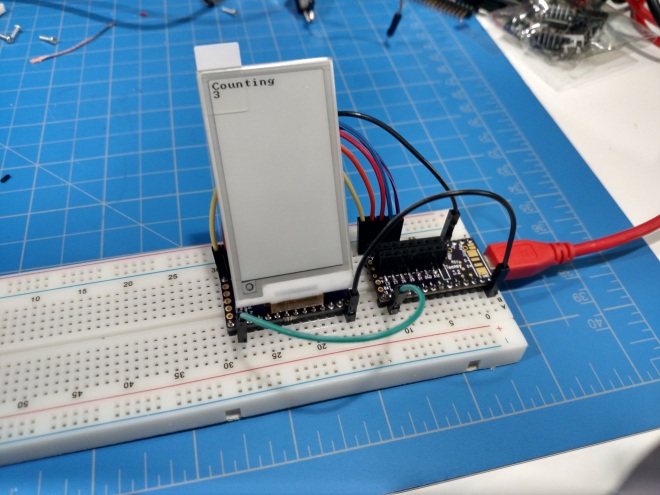
Jarek Lupinski created a Teensy 3.x shield for e-paper displays:
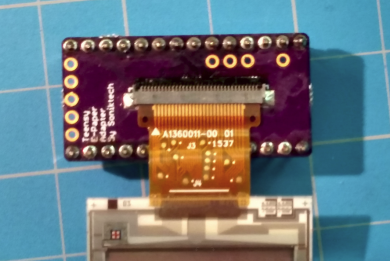
Teensy E-Paper Adapter Board
E-Paper is not a simple display to drive. With manual temperature compensation, onboard power regulation requiring external capacitors, and setting up a step-up circuit, there are many factors to consider when working with this display, with the large benefit of not requiring any power to maintain its image once written.
I have created the simplest possible circuit necessary to drive the Pervasive Displays E2215CS062 , available from your favorite distributor. Certain parts from the reference design were substituted with US-available equivalents with assistance from the Pervasive Displays engineering team.
Books You Should Read: The Soul of A New Machine
We wholeheartedly agree with Hackaday!
If there was one book that describes what it means to be in the trenches of a cutting edge design, that book is The Soul Of a New Machine. Tracy Kidder’s Pulitzer prize-winning book has been an inspiration to thousands over the years. Soul is the story of the creation of the Data General Eclipse…
via Books You Should Read: The Soul of A New Machine — Hackaday
DIY Vector Network Analyzer
What to do when a piece of test equipment is too expensive? Henrik Forstén decided to design and build his own:
Cheap homemade 30 MHz – 6 GHz vector network analyzer
Vector network analyzer (VNA) are used to measure scattering parameters of high frequency circuits
Since I can’t afford even a used VNA I decided to make one myself with a budget of 200€, tenth of what they cost used and about 1/100 of what they cost new
The design files and source code are available on GitHub:
Let’s Make Life A Little Better — Hackaday
Chances are you’ve spent a lot of time trying to think of the next great project to hit your workbench. We’ve all built up a set of tools, honed our skills, and set aside some time to toil away in the workshop. This is all for naught without a really great project idea. The best…
Hackaday: Infrared Targeting On a Small Scale
Sometimes, a person has a reason to track a target. A popular way to do this these days is with a camera, a computer, and software to analyze the video. But, that lends itself more to automated systems, like sentries. What if you want to be able to target something by “painting” it with a…
via Infrared Targeting On a Small Scale — Hackaday
GadgetBox: “No more shield stacking!”
Jack Gassett wants to enable rapid prototyping of new projects:
GadgetBox
GadgetBox is an IoT project built around a case that allows you to connect 4 eCogs (think mini Shields) without stacking or sharing pins!