To place a satellite in orbit satisfactorily it is necessary not only to hitch a ride on a rocket, but also to put it in the right orbit for its task, and once it is there, to keep it there. With billions of dollars or roubles of investment over six decades of engineering behind them the national space agencies and commercial satellite builders solved these problems long since, but replicating those successes for open source microsatellites still represents a significant engineering challenge. One person working in this field is [Michael Bretti], who is doing sterling work with a shoestring budget on open source electric thrusters for the smallest of satellites, and he needs your help in crowdfunding a piece of equipment.
Beware suspiciously cheap eBay vacuum pumps!
As part of his testing he has a vacuum chamber, and when he places a thruster inside it he has to create a space-grade vacuum . This is no easy task, and to achieve it he has two pumps. The first of these, a roughing pump, is a clapped-out example that has clearly reached the end of its days, and it is this that he needs your help to replace. His GoFundMe page has a modest target of only $4,200 which should be well within the capabilities of our community in reaching, and in supporting it you will help the much wider small satellite community produce craft that will keep giving us interesting things from space for years to come.
In this event, Tim Ansell will outline the collaboration and the goals of the project. He will get into the technical details of the PDK and outline the roadmap of the project.
In the beginning, there was hot glue. Plus some tape, and a not inconsiderable amount of Bondo. In general, building custom portable game consoles a decade or so in the past was just a bit…messier than it is today. But with all the incredible tools and techniques the individual hardware hacker now has at their disposal, modern examples are pushing the boundaries of DIY.
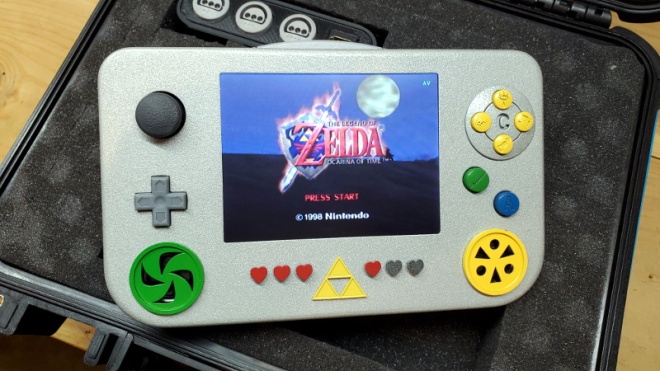
This Zelda: Ocarina of Time themed portable N64 by [Chris Downing] is a perfect example. While the device is using a legitimate N64 motherboard, nearly every other component has been designed and manufactured specifically for this application. The case has been FDM 3D printed on a Prusa i3, the highly-detailed buttons were printed in resin on a Form 3, and several support PCBs and interface components made the leap from digital designs to physical objects thanks to the services of OSH Park.
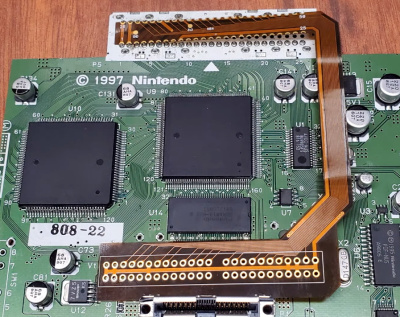
A custom made FFC to relocate the cartridge port.
Today, those details are becoming increasingly commonplace in the projects we see. But that’s sort of the point. In the video after the break, [Chris] breaks down the evolution of his portable consoles from hacked and glued together monstrosities (we mean that in the nicest way possible) to the sleek and professional examples like his latest N64 commission. But this isn’t a story of one maker’s personal journey through the ranks, it’s about the sort of techniques that have become available to the individual over the last decade.
Case in point, custom flexible flat cables (FFC). As [Chris] explains, when you wanted to relocate the cartridge slot on a portable console in the past, it usually involved tedious point-to-point wiring. Now, with the low-volume production capabilities offered by companies like OSH Park, you can have your own flexible cables made that are neater, faster to install, and far more reliable.
Projects like this one, along with other incredible creations from leaders in the community such as [GMan] are changing our perceptions of what a dedicated individual is capable of. There’s no way to be sure what the state-of-the-art will look like in another 5 or 10 years, but we’re certainly excited to find out.
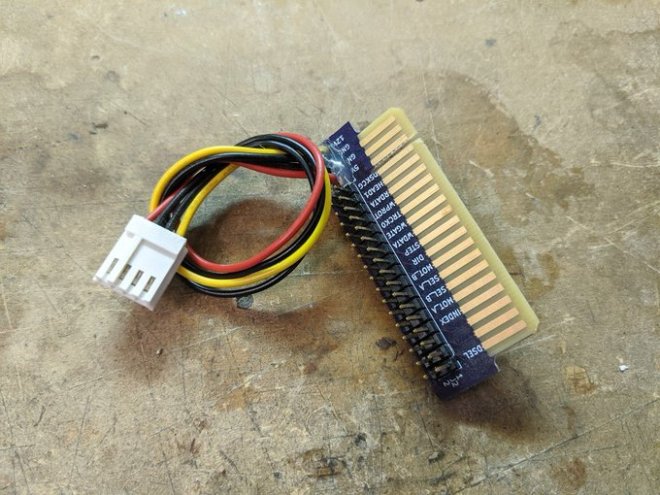
This PS/2 floppy adapter is designed to allow standard PC floppy drives to be used in IBM PS/2 systems that have 40-pin edge connectors for their floppy drive interfaces. Compatible models include
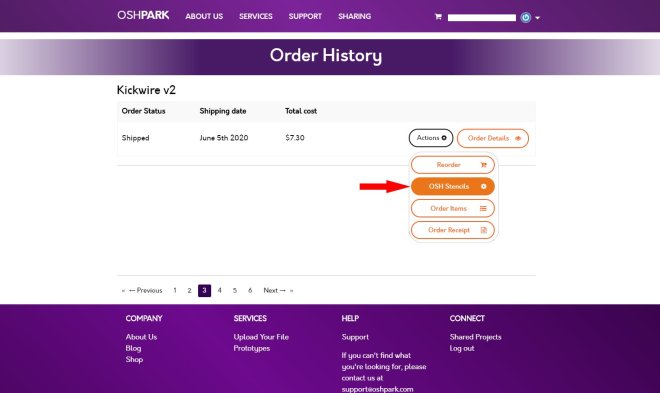
Back in 2019, we added ability to order a stencil for your board design from OSH Stencils:
You've asked for it for years and it's finally here! @oshpark now has a direct link after checkout to submit your design to our site for a stencil! We're working together to streamline your maker needs. Be sure to include your paste layer when ordering boards to use this feature! pic.twitter.com/05oreSVgvR
Now we are excited to have extended that capability to your order history page:
Pleased to share that @oshpark has expanded their features and you can now send stencils directly to us from your Order History on any Paid/Completed order. In case you forget at the end of checkout, you can now go back and send it from your history 🙂 pic.twitter.com/1iPQqxAAAi
To be a child in the 1970s and 1980s was to be of the first generations to benefit from electronic technologies in your toys. As those lucky kids battled blocky 8-bit digital foes, the adults used to fret that it would rot their brains. Kids didn’t play outside nearly as much as generations past, because modern toys were seducing them to the small screen. Truth be told, when you could battle aliens with a virtual weapon that was in your imagination HUGE, how do you compete with that.
How those ’80s kids must have envied their younger siblings then when in 1990 one of the best toys ever was launched, a stored-pressure water gun which we know as the Super Soaker. Made of plastic, and not requiring batteries, it far outperformed all squirt guns that had come before it, rapidly becoming the hit toy of every sweltering summer day. The Super Soaker line of water pistols and guns redefined how much fun kids could have while getting each other drenched. No longer were the best water pistols the electric models which cost a fortune in batteries that your parents would surely refuse to replace — these did it better.
You likely know all about the Super Soaker, but you might not know it was invented by an aerospace engineer named Lonnie Johnson whose career included working on stealth technology and numerous projects with NASA.
Preliminary note: this article is co-authored with Carlos Serrano. Javier is with CERN, the European Laboratory for Particle Physics in Geneva, Switzerland. Carlos is with LBNL, the Lawrence Berkeley National Laboratory in Berkeley, CA, USA. Both CERN and LBNL have public statements on their mission, which includes the maximisation of positive impact of their developments on society. The means employed for reaching those goals differ, of course, as a function of the circumstances of each development and, to a lesser extent, are also subject to opinion. This article presents the personal opinions of the authors, hoping to foster productive discussion, and is in no way intended to represent an official communication from either LBNL or CERN. A pdf version is available in the Open Hardware Repository, with a few extra footnotes in places where more detail might be welcome by some but could otherwise interfere with the reading flow in Medium.
Solder is the conductive metal glue that one uses to stick components together. If you get the component and the PCB hot enough, and melt a little solder in the joint, it will stay put and conduct reliably. But it’s far from simple.
There are many different solder alloys, and even the tip of the soldering iron itself is a multi-material masterpiece. In this article, we’ll take a look at the metallurgy behind soldering, and you’ll see why soldering tip maintenance, and regular replacement, is a good idea. Naturally, we’ll also touch upon the role that lead plays in solder alloys, and what the effect is of replacing it with other metals when going lead-free. What are you soldering with?
Intermetallic Compounds
Soldering, and its higher temperature cousin, brazing, are one of essentially two ways create metal-to-metal bonds, and they allow the use of low-temperature techniques that still create relatively stable bonds between two metal surfaces. Soldering is also an interesting chapter in the field of metallurgy, on account of it being based around so-called intermetallic compounds (IMCs).
Welding stands in contrast to soldering, where high temperatures melt the metal on both sides of the pieces that are being joined, permanently fusing them. Welding is a high-strength, high-reliability way of joining metal pieces, but is unfortunately wholly unsuited for delicate electronics where excess heat can damage parts and the goal is more to ‘glue’ electrically conducting elements together than to melt them together.
This also leads us to the reason why soldering and IMCs are such a source of trouble, to the point where IMCs are referred to as ‘evil’. IMCs are essentially bits of the two metal surfaces on either side dissolved into the solder, causing enough of a joining that each side of the joint is more or less stably fused with the solder. Unfortunately such an IMC is a far cry from the stable solid metal of a welding joint, and as a result can be brittle depending on exactly which metals were involved in the solder alloy.
But the IMCs formed in soldering are strong enough, and their formation is at the root of why every solder alloy uses tin. Tin has the property that it is very good at letting other metals dissolve into it. In fact, it’s possible to solder with pure tin, although as we’ll see below, most solder is improved by adding other metals into the mix.











 OSH Park