CERN updates its Open Hardware Licence

Version 2.0 of the CERN Open Hardware Licence has been released, introducing three variants meant to cater to different collaborative models:
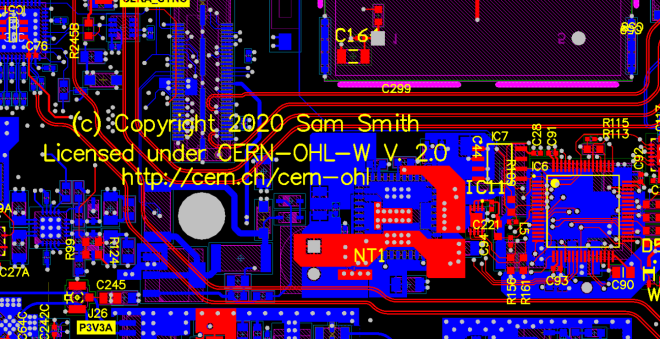
cern-ohl-circuit-sam-smith

CERN updates its Open Hardware Licence

Nine years after publishing the first version of the CERN Open Hardware Licence (CERN-OHL) – which governs the use, copying, modification and distribution of hardware designs and the manufacture and distribution of any resulting products – CERN has now released version 2.0 of the licence. The latest version uses simpler terminology, introduces three variants of the licence, and broadens its range to include designs that go from artistic to mechanical to electronic, as well as adapting the licence to cases such as application-specific integrated circuits (ASICs) and field-programmable gate arrays (FPGAs). It can even be used to license software.

“The CERN-OHL is to hardware what the free and open-source licences are to software,” explains Myriam Ayass, legal adviser for the CERN Knowledge Transfer group and one of the authors of the CERN-OHL. “It defines the conditions under which a licensee will be able to use or modify the licensed material. It shares the same principles as free software or open-source software: anyone should be able to see the source – the design documentation in the case of hardware – study it, modify it and share it.” ‘Source’ includes schematic diagrams, designs, circuit or circuit-board layouts, mechanical drawings, flow charts and descriptive texts, as well as other explanatory material.

“Open hardware gives designers and users the freedom to share hardware designs, modify them, manufacture products based on the design files and commercialise those products. This freedom enables collaboration among engineers, scientists, researchers, hobbyists and companies without the risk of vendor lock-in or other issues present in proprietary development,” explains Javier Serrano, an engineer in the Beams Department at CERN and the founder of the Open Hardware Repository (OHR).

Version 2.0 of the CERN-OHL introduces three variants of the licence – strongly reciprocal, weakly reciprocal and permissive – which aim to address specific constraints caused by different collaboration models currently used in open-hardware projects. The first two variants mean that if any product is made using an open hardware design, the design of that product, including any improvements or modifications, should be made available under the same licence as that of the original product. Permissive licences do not impose this condition.

Andrew Katz, a lawyer and “open” specialist from Moorcrofts LLP, who has also been involved in the drafting process, said he believes the new drafts adopt best practices from the world of open-source software, while adapting to the specific and uniquely complex challenges presented by open hardware. “We’re particularly excited by the enthusiastic response we’ve had to the drafts from members of communities in all sectors of open hardware, and we’ve been very grateful for their valuable comments and input.”

CERN will soon submit the CERN-OHL for endorsement by the Open Source Initiative (OSI) and the Free Software Foundation (FSF).

CERN updates its Open Hardware Licence

How to join the virtual Open Hardware Summit tomorrow

Screenshot from 2020-03-12 10-15-35

Due to the COVID-19 virus, the Open Hardware Summit has been moved from NYC to cyberspace!

2020.oshwa.org


How to join the virtual Open Hardware Summit tomorrow

ChickTech Turtle Robot Workshop 2020

From Ken Olsen of the Makers Box:

P1090235

ChickTech Turtle Robot Workshop 2020

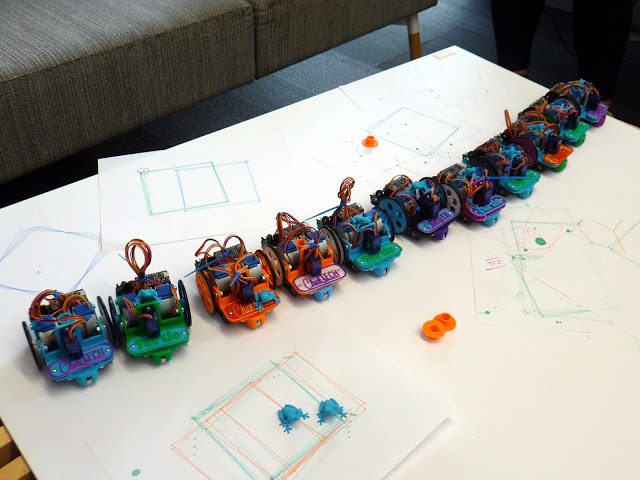
It is hard for me to believe that it has been seven years since my first ChichTech.org workshop, and five years since I started with the Turtle Robot workshop.  The Open Source Turtle Robot I designed specifically for this workshop has gotten better and better.  My workshops leader skills have gotten better and better.  And this workshop was the best so far.  It was designed to introduce high school age girls to engineering, mainly electrical, mechanical, and firmware.  I tell them that engineering is all about problem solving.  The trick is figuring out which problems you like solving!

The high-light of these events is when the parents and siblings come in for a “tech show” and you get to hear the girls explain how they built and programmed the robot.  It is an amazing feat to accomplish in just a few hours.  I predict great success for these girls in what ever they decide to pursue in their lives!

ChickTech Turtle Robot Workshop 2020

Debugging PCBs with Augmented Reality

Screenshot from 2020-03-10 11-51-32

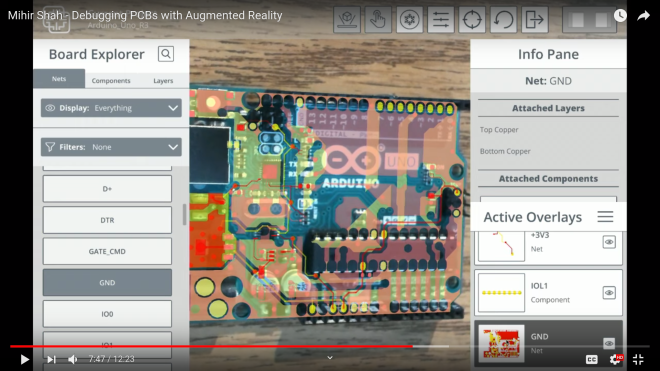
The idea of InspectAR is to use augmented reality to help work with and debug electronics. It’s a powerful suite of tools that enable the live overlay of graphics on a video feed of a circuit board, enabling the user to quickly and effectively trace signals, identify components, and get an idea of what’s what. Usable with a smartphone or a webcam, the aim is to improve collaboration and communication between engineers by giving everyone a tool that can easily show them what’s going on, without requiring everyone involved to run a fully-fledged and expensive electronics design package.

The Supercon talk served to demonstrate some of the capabilities of InspectAR with an Arduino Uno. With a few clicks, different pins and signals can be highlighted on the board as Mihir twirls it between his fingers. Using ground as an example, Mihir first highlights the entire signal. This looks a little messy, with the large ground plane making it difficult to see exactly what’s going on. Using an example of needing a point to attach to for an oscilloscope probe, [Mihir] instead switches to pad-only mode, clearly revealing places where the user can find the signal on bare pads on the PCB. This kind of attention to detail shows the strong usability ethos behind the development of InspectAR, and we can already imagine finding it invaluable when working with unfamiliar boards. There’s also the possibility to highlight different components and display metadata — which should make finding assembly errors a cinch. It could also be useful for quickly bringing up datasheets on relevant chips where necessary.

via Debugging PCBs with Augmented Reality — Hackaday

Quote

Take the Plunge into PCB Design

Jeremy S Cook writes about the experience of designing their first PCB:

Take the Plunge into PCB Design

While I’ve been experimenting with circuits for years, decades even, my projects tend to be filled with a rat’s nest of wires. These snake about with the constant possibility of disconnection or other problems. They are a pain both to assemble and troubleshoot. Breadboards and perfboards are one possible solution, but I don’t particularly enjoy working with them, and they also tend to be quite messy in my case.

5e5d2faf1ebb2-IMAGE+1 (1)

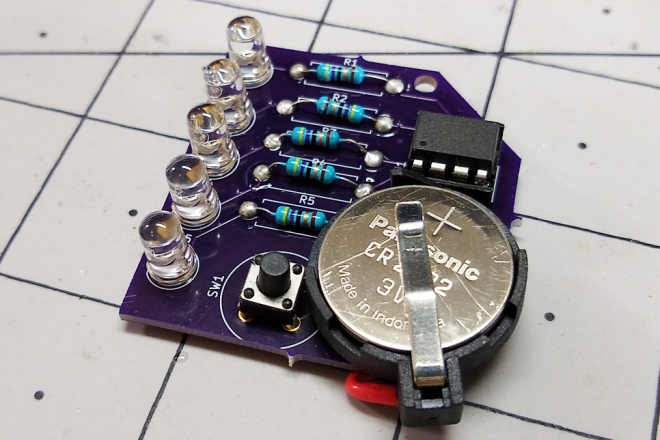
A final possibility is the printed circuit board, with precise connections from point-to-point made by a machine. This seems like a great solution, but to someone who has never made one, it also seems like a black art—something pursued by people much more competent than myself.

5e5d304956e90-IMAGE+3

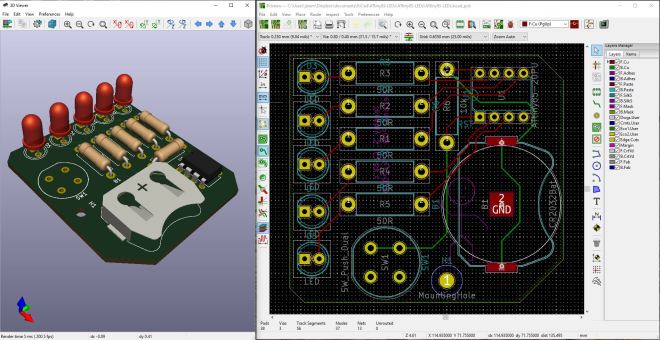
As someone that has recently designed two PCBs in the open-source KiCAD EDA platform, I know that this is not the case whatsoever. There is certainly a video tutorial out there somewhere to walk you through the process, this is what I recently used. I found these text instructions to be quite good, and going through it probably helped me remember things better.

Take the Plunge into PCB Design

Watch Linux Boot On Your Hackaday Superconference Badge

Last year’s Hackaday Superconference badge was an electronic tour de force, packing an ECP5 FPGA shoehorned into a Game Boy-like form factor and shipping with a RISC-V core installed that together gave an almost infinite badge hacking potential. It did not however run Linux, and that’s something [Greg Davill] has addressed, as he’s not only running Linux on his badge, but also a framebuffer that allows him to use the badge screen as the Linux terminal screen. Finally you can watch Linux boot on your Superconference badge itself, rather than over its serial port.

He’s achieved this by changing essentially everything: from the new VexRiscv CPU core, to new video drivers and a VGA terminal courtesy of Frank Buss, now part of the LiteVideo project. It’s not quite a fully fledged Linux powerhouse yet, but you can find it in a GitHub repository should you have a mind to try it yourself. Paging back through his Twitter feed reveals the effort he’s put into this work over the last few months, and shows that it’s been no easy task.

For those keeping score at home, this is an open hardware design, running an open CPU core, with community-designed open-source peripherals, compiled by an open-source toolchain, running an open-source operating system. And it’s simply a fantastic demo for the badge, showing off how flexible the entire system is. One of the best parts of writing for Hackaday is that our community is capable of a huge breadth of amazing pieces of work, and this is an exemplar of that energy. We can’t wait to see what Greg and any other readers tempted to try it will come up with.

If you’d like to refresh your memory over the 2019 Supercon badge, here’s our write-up at the time.

via Watch Linux Boot On Your Hackaday Superconference Badge — Hackaday

Quote

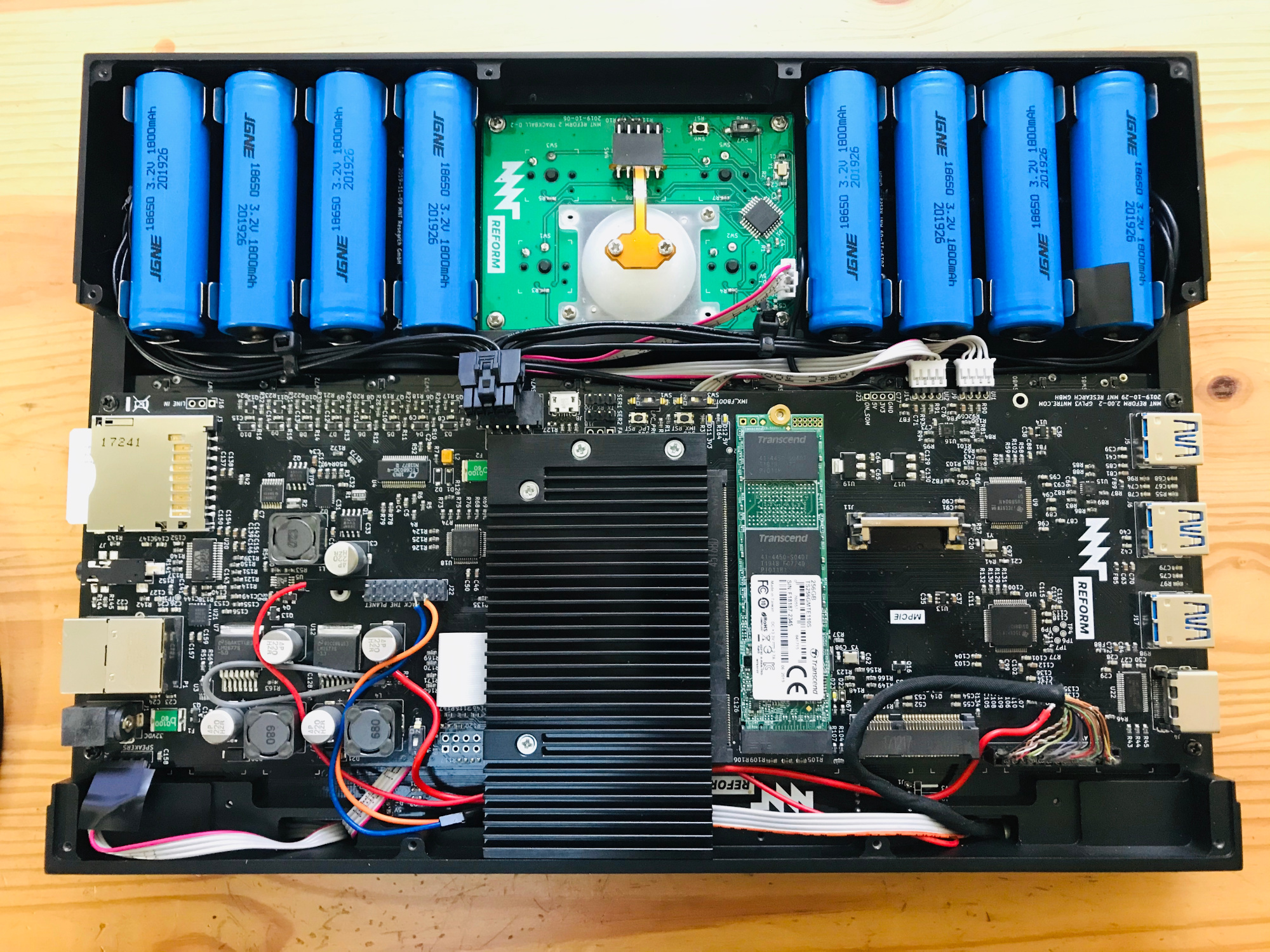
Open Laptop Soon to be Open For Business

How better to work on Open Source projects than to use a Libre computing device? But that’s a hard goal to accomplish. If you’re using a desktop computer, Libre software is easily achievable, though keeping your entire software stack free of closed source binary blobs might require a little extra work. But if you want a laptop, your options are few indeed. Lucky for us, there may be another device in the mix soon, because [Lukas Hartmann] has just about finalized the MNT Reform.

Since we started eagerly watching the Reform a couple years ago the hardware world has kept turning, and the Reform has improved accordingly. The i.MX6 series CPU is looking a little peaky now that it’s approaching end of life, and the device has switched to a considerably more capable – but no less free – i.MX8M paired with 4 GB of DDR4 on a SODIMM-shaped System-On-Module. This particular SOM is notable because the manufacturer freely provides the module schematics, making it easy to upgrade or replace in the future. The screen has been bumped up to a 12.5″ 1080p panel and steps have been taken to make sure it can be driven without blobs in the graphics pipeline.

via Open Laptop Soon to be Open For Business — Hackaday

Quote

The Newbie’s Guide To JTAG

This JTAG primer will get you up to snuff on snarfing, and help you build your reverse engineering skills.

Whatever your motivation for diving into reverse engineering devices with microcontrollers, JTAG skills are a must, and [Sergio Prado]’s guide will get you going. He starts with a description and brief history of the Joint Test Action Group interface, from its humble beginnings as a PCB testing standard to the de facto standard for testing, debugging, and flashing firmware onto devices. He covers how to locate the JTAG pads – even when they’ve been purposely obfuscated – including the use of brute-force tools like the JTAGulator. Once you’ve got a connection, his tutorial helps you find the firmware in flash memory and snarf it up to a file for inspection, modification, or whatever else you have planned.

via The Newbie’s Guide To JTAG — Hackaday

Quote

ToorCamp call for papers

IMG_20200224_111054

Call For Papers ReleasedWe’re now accepting talk submissions for ToorCamp! You have until April 20th to submit your talk to be considered by our esteemed review panel. We’re looking forward to seeing what you all have been working on!

ToorCamp, the American hacker camp, first “launched” at the Titan-1 Missile Silo in Washington State in 2009. The second and third ToorCamp happened in 2012 and 2014 on the beautiful Washington Coast. For the past 2 events (2016 and 2018) and upcoming 2020 are now at the Doe Bay Resort on Orcas Island, WA and are looking for groups to participate. Show off your crazy projects you’ve been working on, bring some ideas you want to hack on with the other technology experts that will be showing up, organize a campsite with all of your friends and show how awesome your group is, or just see what all the other groups are up to. It’s up to you! Either way, we’d like to show that the US can throw down as much as the European hacker camps (CCC CampHAR, etc) so this is your invitation to come!

ToorCamp call for papers