

The Hackaday writing crew goes to great lengths to cover all that is interesting to engineers and engineering enthusiasts. We find ourselves stretched a bit thin and it’s time to ask for help. 161 more words
The Hackaday writing crew goes to great lengths to cover all that is interesting to engineers and engineering enthusiasts. We find ourselves stretched a bit thin and it’s time to ask for help. 161 more words

For my current project I searched for a good boost power converter which is able to deliver continuous 400mA power for various sensors. There are an endless number of good boost converters around, but not many can be hand soldered to a board. I would really like to see some with SO packages. It seems […]

Love them or hate them, Nixies are here to stay. Their enduring appeal is due in no small part to the fact that they’re hardly plug-and-play; generating the high-voltage needed to drive the retro displays is part of their charm. But most Nixie power supplies seem to want 9 volts or more on the input side, which can make integrating them into the typical USB-powered microcontroller project difficult.
Fixing that problem is the idea behind [Mark Smith]’s 5-volt Nixie power supply. The overall goal is simple: 5 volts in, 170 volts out at 20 mA. But [Mark] paid special care to minimize the EMI output of the boost converter through careful design, and he managed to pack everything into a compact 14-cm² PCB. He subjected his initial design to a lot of careful experimentation to verify that he had met his design goals, and then embarked on a little tweaking mission in KiCad to trim the PCB’s footprint down by 27%. The three separate blog posts are well worth a read by anyone interested in learning about electronics design.
Now that [Mark] has his Nixie power supply, what will become of it? We can’t say for sure, but it’ll be a clock. It’s always a clock. Unless it’s a power meter or a speedometer.
via Nicely Engineered Boost Converter Powers Nixies from USB Charger — Hackaday

We miss the days when everything had daughterboards. Now, Arduinos have shields and Raspberry Pis have hats. The BeagleBone has capes. Whatever. However, regardless of the name, the open source… 239 more words
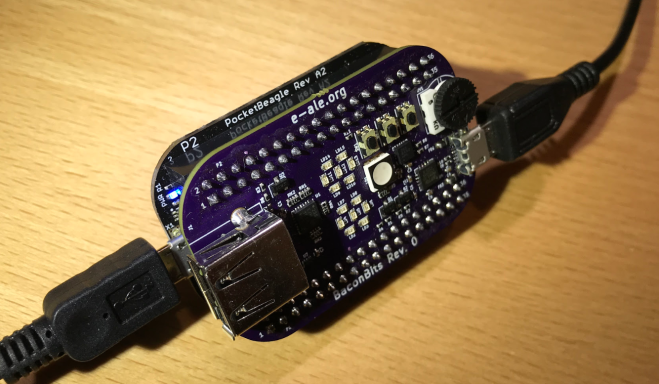
Embedded Apprentice Linux Engineer (E-ALE) is a series of 9 seminars over 3 days at existing Embedded Linux conferences:
Are you an Embedded Engineer who is transitioning to using Linux? Attend seminars on how to start with using Linux for Embedded Applications. The Embedded Apprentice Linux Engineer program provides a place at existing Embedded conferences where you can get your questions answered.
Embedded Apprentice Linux Engineer Hands on Workshops at SCALE 16x in Pasadena from Thursday, March 8th to Saturday, March 10th:

Embedded Apprentice Linux Engineer track at The Linux Foundation’sEmbedded Linux Conference in Portlandfrom Monday, March 12 to Wednesday, March 14

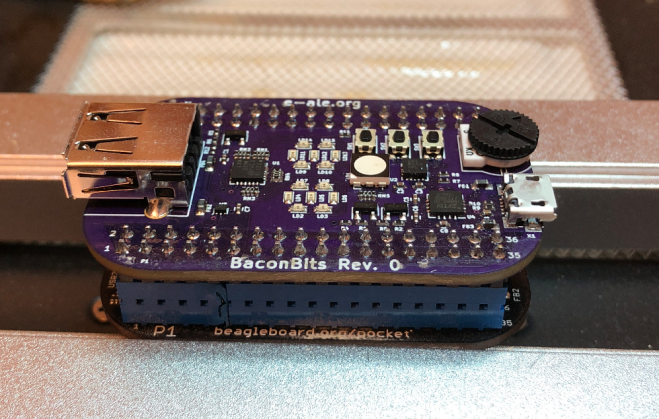

Do you like Open Source? Join Hackaday and Tindie at the largest community-run Open Source conference in North America. We’ll be at the Southern California Linux Expo next week, and we want to see you there.
What’s happening at SCALE this year? Amateur radio license exams, a PGP signing party, Bad Voltage Live and The Spazmatics, and a ton of great talks. Hackaday and Tindie will be at SCALE Friday through Sunday, showing off the coolest parts of Hackaday, Hackaday.io, and our lovable robotic dog, Tindie.
We’ll be handing out t-shirts and stickers, and we’ll be giving tours of the SupplyFrame Design Lab located just two blocks away from the convention center. The Design Lab is a crown jewel of our corporate overlord’s emphasis on Open Hardware, and if you want to see where the magic happens, this is your chance. We’ll be running tours of the Lab on Friday, so find the Hackaday and Tindie crew in the expo area around 3:40 PM.
via Join Hackaday And Tindie At The Southern California Linux Expo

Everyone needs a helping hand in the shop once in a while, and most of us have gone the traditional route and bought one of those little doohickies with the cast iron base and adjustable arms terminated in alligator clips.
via Coolant Hoses Retasked to Lend a Helping Hand — Hackaday
BeagleWire by Michael Welling is a fully open ICE40 FPGA BeagleBone cape:
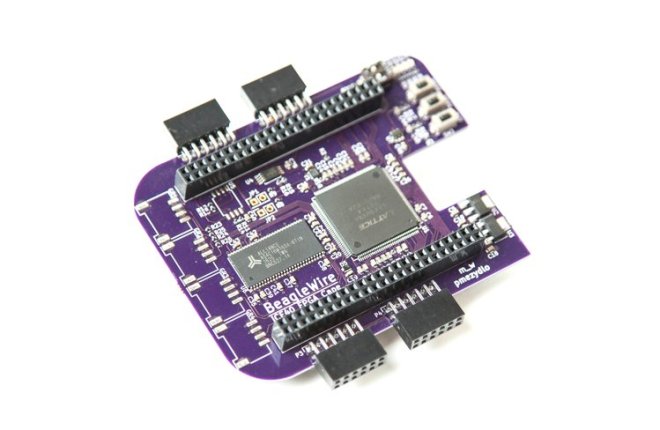
BeagleWire is a completely open source FPGA development board. Unlike most other FPGA dev boards, the BeagleWire’s hardware, software, and FPGA toolchain are completely open source. The BeagleWire is a Beaglebone compatible cape leveraging the Lattice iCE40HX FPGA.
BeagleWire can be easily expanded by adding additional external modules for example, modules for high speed data acquisition, software defined radio, and advanced control applications. Using well-known connectors like Pmod and Grove makes it possible to connect various interesting external modules widely available in stores. Owing to this, prototyping new imaginative digital designs is easier.
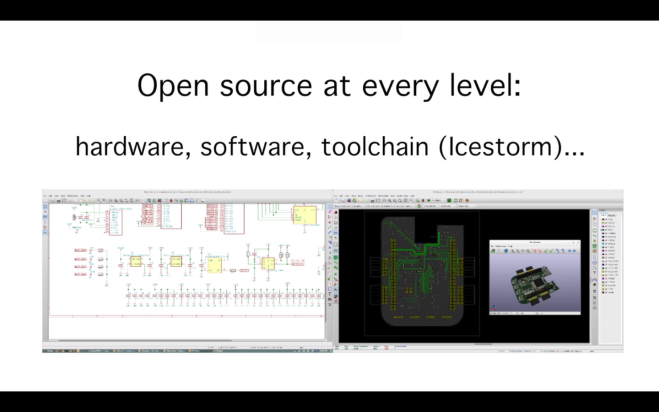

Hardware and software are certainly different beasts. Software is really just information, and the storing, modification, duplication, and transmission of information is essentially free. Hardware is expensive, or so we think, because it’s made out of physical stuff which is costly to ship or copy. So when we talk about open-source software (OSS) or open-source hardware (OSHW), we’re talking about different things — OSS is itself the end product, while OSHW is just the information to fabricate the end product, or have it fabricated [..]
What would it take to get you to build someone else’s OSHW project, improve on it, and contribute back? That’s a question worth a thoughtful deep dive.
UPDATE:
If you missed our Hack Chat yesterday, then check out the transcript.
Also, please feel free to ask any additional questions on the Hackaday.io event page. If you include “@oshpark” then we will get a notification and reply.

Please join us tomorrow on Hackaday.io for a Hack Chat with Dan Shaedel and Drew Fustini:
For this week’s Hack Chat, we’re going to be talking about everything PCB. How do you do castellated holes? How do you mill slots and square or otherwise non-round holes? Internal cutouts? Stop mask expansion? Artwork? Panelization? Why purple? More POGs!
Our guests for this chat will be [Dan Sheadel] and [Drew Fustini] of OSH Park, and they’re going to be there answering all your questions. [Dan] has been around OSH Park from the beginning and enjoys designing tiny useless robots and mentoring students building better ones. [Drew] is an Open Source hardware developer, firmware designer, a BeagleBoard board member, and is usually found at hardware meetups wearing purple.
Our Hack Chats are live community events on the Hackaday.io Hack Chat group messaging. This Hack Chat is going down Friday, March 2nd at noon, Pacific time. Want to know what time this is happening in your neck of the woods? Have a countdown timer!

 OSH Park