Building a DIY Pick and Place with Stephen Hawes

From the new Contextual Electronics podcast hosted by Chris Gammell:

CEP002-CoverArt-Banner-880x360

CEP002 – Building a DIY Pick and Place with Stephen Hawes

Today we’re talking with, Stephen Hawes, an electronics engineer and maker who is building his own Pick and Place machine and sharing about the process on YouTube

Building a DIY Pick and Place with Stephen Hawes

Atomized Annoy-O-Tron with Flex PCB

Been working on a tiny version of the Annoy-o-tron ThinkGeek’s prank device.

My design is based on Geppetto Electronics version from tindie… https://www.tindie.com/products/nsayer/annoy-o-tron-tiny/

My version is just over 0.25in round.. so tiny! Even found a tiny piezo to go with it and 3d printed a holder for 2 watch batteries and PCB.

via Atomized Annoy-O-Tron — AtomSoftTech

This slideshow requires JavaScript.

Quote

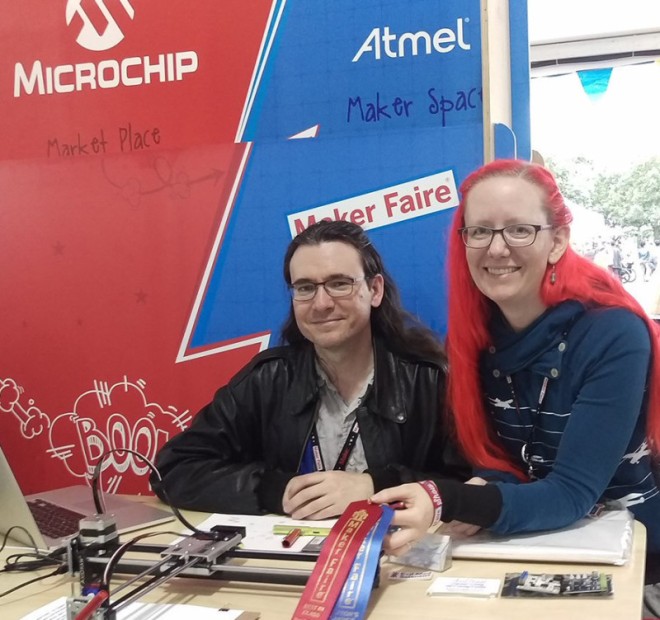
Meet the maker: Evil Mad Scientist

We are happy to see Hackspace Magazine feature some of our favorite people, Windell and Lenore from Evil Mad Scientist:

Lenore___Windell

Meet the maker: Evil Mad Scientist

“We started Evil Mad Scientist accidentally. We did not mean to start a business. We went to the very first Maker Faire with our project and people said ‘Ooh, how d’you do that? I want to do that!’ So, we started making kits to make it feasible for other people to do projects like ours. Every time we would do a kit, we would bring money back into the next round of the kits. It grew very gradually, and now it’s our full-time job. It’s been a slow-going, organic, interesting journey.

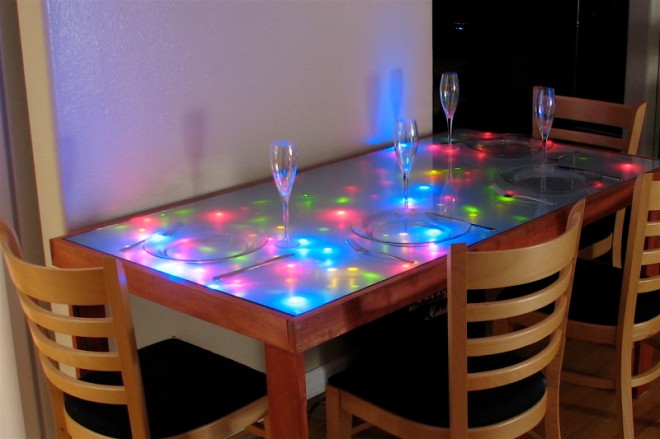
“That first project was our interactive LED dining table. It had 400 LEDs and a connected series of nodes that had a light sensor on them. When something would change over that sensor, it would change which LEDs were on and how bright they were. For example, when you pass the salt, or move the napkin, or pick up a drink, a sensor would send a message to its neighbour node – I’ve changed, do you want to change? That would trigger a ripple of changes throughout the table.

1__2_

FINDING YOUR COMMUNITY

“We sell components, we sell kits, and we sell plotters. The components tend to be purchased by educators. LEDs for classroom use, pager motors for making art bots.

“They get used, for instance, by model train enthusiasts who want to make their trains more realistic and who want to put LEDs into their trains, but who find it hard to shop for LEDs at a traditional electronics store because there isn’t information, or someone to contact about how to do that. Well, I have a really good article about what resistor you should use with your LED if you’re using an AA battery, for example (hsmag.cc/MFcmTe). We have niche cases like that where it’s a hobby that’s not necessarily electronics-related, but somebody wants to do something with LEDs or electronic components.

“This is one of the beautiful things about open-source hardware – when you document your hardware well, people can use it for other things. Scientists are always looking for solutions to problems that you and I don’t know exist. They’re looking at very narrow problems in fields that we would never think about our thing being used there.

LED_dining_table

Meet the maker: Evil Mad Scientist

Applied Ion Systems: open source space propulsion

This slideshow requires JavaScript.

Michael Bretti of Applied Ion Systems describes open source space propulsion at the 2020 Open Hardware Summit:

Applied Ion Systems is creating open source electric propulsion systems

Applied Ion Systems initially started out of a personal hobbyist effort to share projects involving plasma systems, particle beams, and and high vacuum projects.   Later, as I began to expand my efforts and meet awesome makers around the world, I began focusing my efforts on open source electric propulsion for small satellites, such as PocketQubes and CubeSats.

Eventually, this effort evolved into the world’s first and only open-source home-based electric propulsion program, working on cutting edge plasma and ion thrusters for small satellites on a hobbyist level budget.

My main objective was to provide intensive engineering resources, data, and system designs for the community to help lower the barriers of entry into the field, and allow enthusiasts to follow along the journey of creating and testing these advanced systems, with the ultimate goal of developing low-cost, easy-to-use, fully integrated space-qualified thrusters.

Applied Ion Systems: open source space propulsion

Official Arduboy Upgrade Module Nears Competition

We’ve been big fans of the Arduboy since [Kevin Bates] showed off the first prototype back in 2014. It’s a fantastic platform for making and playing simple games, but there’s certainly room for improvement. One of the most obvious usability issues has always been that the hardware can only hold one game at a time. But thanks to the development of an official add-on, the Arduboy will soon have enough onboard storage to hold hundreds of games

Even the rear silkscreen was a community effort.

The upgrade takes the form of a small flexible PCB that gets soldered to existing test points on the Arduboy. Equipped with a W25Q128 flash chip, the retrofit board provides an additional 16 MB of flash storage to the handheld’s ATmega32u4 microcontroller; enough to hold essentially every game and program ever written for the platform at once.

Of course, wiring an SPI flash chip to the handheld’s MCU is only half the battle. The system also needs to have its bootloader replaced with one that’s aware of this expanded storage. To that end, the upgrade board also contains an ATtiny85 that’s there to handle this process without the need for an external programmer. While this is a luxury the average Hackaday reader could probably do without, it’s a smart move for an upgrade intended for a wider audience.

The upgrade board is currently available for pre-order, but those who know their way around a soldering iron and a USBasp can upgrade their own hardware right now by following along with the technical discussion between [Kevin] and the community in the “Project Falcon” forum.

via Official Arduboy Upgrade Module Nears Competition — Hackaday

Quote

Hackaday Remoticon: Our 2020 Conference is Packed with Workshops and We’re Calling for Proposals

We’re proud to announce the Hackaday Remoticon, taking place everywhere November 6th – 8th, 2020. It’s a weekend packed with workshops about hardware creation, held virtually for all to enjoy.

But we can’t do it without you. We need you to host a workshop on that skill, technique, or special know-how that you acquired through hard work over too many hours to count. Send in your workshop proposal now!

What is a remoticon?

The Hackaday Remoticon achieves something that we just couldn’t do at the Hackaday Superconference: host more workshops that involve more people. Anyone who’s been to Supercon over the past six years can tell you it’s space-limited and, although we do our best to host a handful of workshops each day, those available seats are always in high demand.

We’re sad that we can’t get together in person for Supercon this year, but now we have an opportunity to host more workshops, engaging more live instructors and participants because they will be held virtually. This also means that we can make recordings of them available so that more people can learn from the experience. This is something that we tried way back during the first Supercon with Mike Ossmann’s RF Circuit Design workshop and 140,000 people have watched that video. (By the way, that link is worth clicking just to see Joe Kim’s excellent art.)

Now I’m not saying that your workshop will have a view count into six digits. What I am saying is that you have skills worth sharing, and people are hungry to learn. Since traveling to massive conferences is on pause for a while, spinning up a way to share your experience with others is a superb use of your time.

We need you to submit a workshop proposal! This can take any shape that makes sense for your topic, but here’s the gist of how this might work. Each accepted workshop makes a list of necessary materials and where to get them so that participants can order ahead of time and follow along. Live workshops will be held via video conference, with periods of instruction, work time, and recap that lets participants ask questions and show results as they go.

SUBMIT YOUR WORKSHOP NOW!

Wait, wait, wait. Before you click away to the next awesome Hackaday article, don’t assume you have nothing to teach. In fact, do the opposite. Assume you have rare and specialized knowledge on something (because you do!) and seek that out. Then unleash your mind to form a workshop idea around it. Hackaday is filled with weird, wild, and interesting projects, and we always want to see more of them. Share the wealth so that more people begin to walk the path of the hardware hacker

via Hackaday Remoticon: Our 2020 Conference is Packed with Workshops and We’re Calling for Proposals — Hackaday

Quote

DIN SPEC 3105: industry specification published for Open Source Hardware

The German standards body DIN now has a specification for Open Source Hardware documentation:

GitLab: Open Hardware Standards

Open Source Hardware: Technical Documentation Requirements

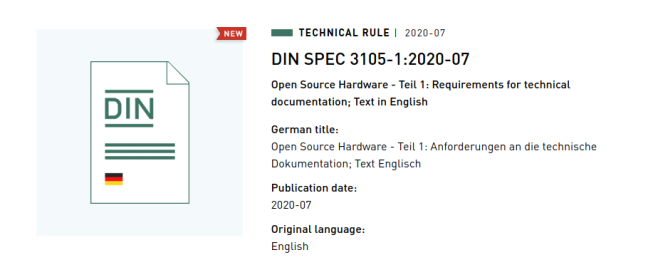
The published specification is available from DIN:

Screenshot from 2020-08-03 09-00-11

Jérémy Bonvoisin wrote on Twitter:

The icing on the cake: this is the first standard to be published by DIN under cc license and to adopt an open and community based process for any of the new version to come! It’s both a progress for open source hardware AND for standardisation processes as such!

More information is available in this paper by Jérémy BonvoisinJenny MolloyMartin Haeuer, and Tobias Wenzel:

Standardisation of practices in Open Source Hardware

Standardisation is an important component in the maturation of any field of technology. It contributes to the formation of a recognisable identity and enables interactions with a wider community. This article reviews past and current standardisation initiatives in the field of Open Source Hardware (OSH). While early initiatives focused on aspects such as licencing, intellectual property and documentation formats, recent efforts extend to ways for users to exercise their rights under open licences and to keep OSH projects discoverable and accessible online. We specifically introduce two standards that are currently being released and call for early users and contributors, the DIN SPEC 3105 and the Open Know How Manifest Specification. Finally, we reflect on challenges around standardisation in the community and relevant areas for future development such as an open tool chain, modularity and hardware specific interface standards.

DIN SPEC 3105: industry specification published for Open Source Hardware

Stepper Motor FeatherWing

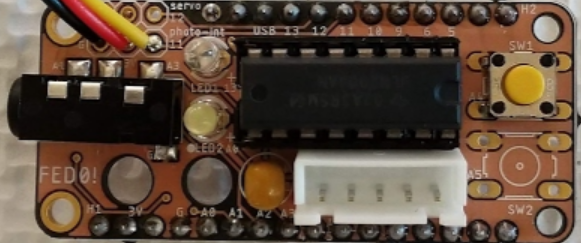
Lex Kravitz has designed a simple board containing the ULN2003 stepper motor driver in a Feather form factor:

Screenshot from 2020-08-02 11-31-59

Feather ULN2003 Stepper Wing

This Feather Wing was made to be hand assembled with through-hole components, which I find easier to put together in small runs.  In the future I may make a version with SMD components as well for professional manufacture.  I made this to control 5V 28BYJ-48 steppers that are easily available for ~$2-3 each.  Often they come with a ULN2003 driver board, if you are thrifty you can grab the chip off the board and move it to this board saving ~50 cents per board.

This board contains:

1) Two 3-pin headers (GND, PWR, and SIG).  These can be used to control a servo or additional sensor.

2) A 3.5mm TRRS port for external control

3) Two LEDs tied to digital pins

4) The ULN2003 motor driver

5) Two small buttons for user control

Stepper Motor FeatherWing

2020: Everything is Virtual

It’s like the dystopian future arrived out of the blue. From one year to the next we went from holing up in overly air-conditioned hotel ballrooms and actually meeting our fellow meatbags in the flesh, to huddling in our pods and staring at the screens. I’m looking for the taps to hook me in to the Matrix at this point.

But if you haven’t yet received your flying car or your daily Soma ration, you can still take comfort in one thing: all of the hacker conferences are streaming live, as if it were some fantastic cyber-future! In fact, as we type this, someone is telling you how to print your way to free drinks on USAir flights as part of HOPE’s offering, but the talks will continue for the next few days. (Go straight to live stream one.)

If retrocomputing is more your thing, Saturday marks the start of the virtual Vintage Computer Festival West of which Hackaday is a proud sponsor. (Here’s the schedule.)

And next weekend is DEF CON in Safe Mode with Networking. While we can totally imagine how the talks and demo sessions will work, the Villages, informal talks and hack-togethers based on a common theme, will be a real test of distributed conferencing.

via 2020: Everything is Virtual — Hackaday

Quote

QRP-Labs Filter Adapter for NanoVNA

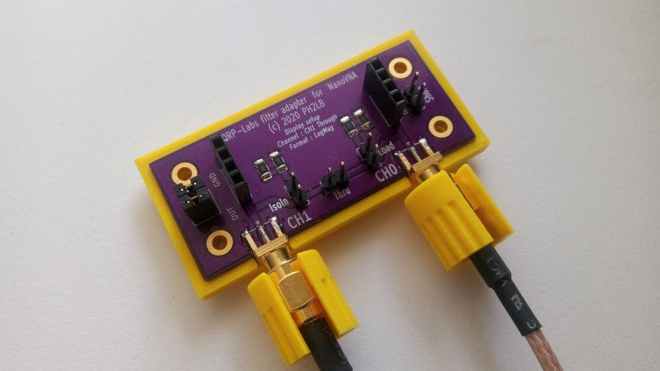
Cabe Atwell writes on Hackster about a RF filter adapter was made using some spare parts and lowpass and bandpass filter kits:
nanovna_qrplabs_20_FEE8nQ8TSv

QRP-Labs Filter Adapter for NanoVNA

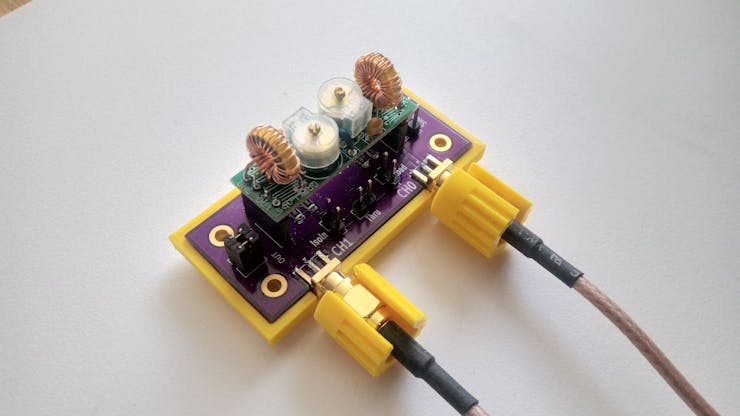
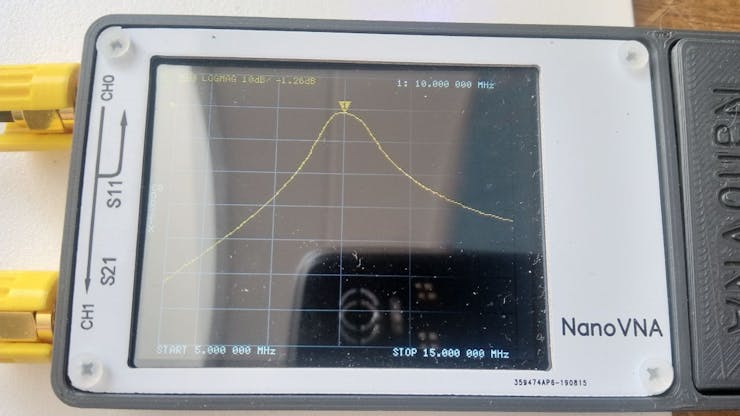
Check out Lex Bolkesteijn’s new project constructing a QRP-Labs filter adapter for NanoVNA with some spare parts and lowpass and bandpass filter kits. The NanoVNA is a tiny handheld Vector Network Analyzer (VNA), which accomplishes both high-performance and portability. Besides working as a vector network analyzer and antenna analyzer, this build utilizes it as a filter tuner.

A current work in progress, last updated in mid-June, it was developed using a double-sided PCB, two SMA chassis, and a header cut in two to form a filter holder that enabled the use of the NanoVNA to test and tune the filters as required. The filter kits themselves include the double-sided PCD along with silkscreen, solder mask, and through-hole plating, as well as the capacitors. Both are the same size, and so require no adjustments to the filter holder.

Although the filter has four pins, five holes are drilled in the PCB base of the filter holder using a perforated PCB for spacing. The fifth hole allows for a via to connect the top and bottom layers. With some soldering, the via, SMA chassis parts, and headers are connected to the base. In a few steps that, everything is set up to connect the filter to the NanoVNA.

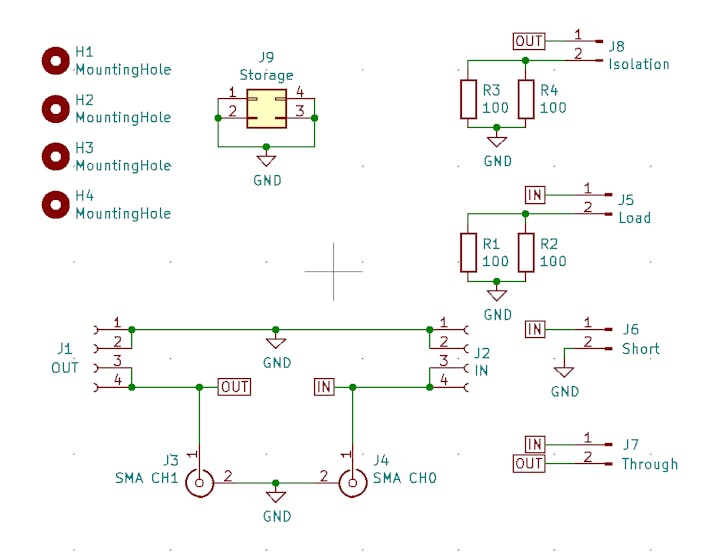
The NanoVNA should be calibrated before use, and in the documented project, this was done with an experimental calibration tool. When calibrating as close as possible to the adaptor, it’s not possible to use the calibration standards. The calibration tool was made with another PCD, with holes drilled for vias and two 100 Ohm SMD 1206 resistors.

A design, complete with CAD files for the casing, is also included for those who are unable to mill PCBs by hand. This uses a 3D-printed casing and custom-ordered PCBs to serve as the adapter. Simplifying the manual work required in the design, even more, the most recent custom PCB ordered includes built-in calibration options. The 3D-printed base looks spiffier than the hand-milled PCBs and requires no additional PCB for calibration.

For anyone interested, the bill of materials, CAD files, and a step-by-step with images are freely available on Bolkesteijn’s blog.

QRP-Labs Filter Adapter for NanoVNA