PoE Powers Christmas Lights, But Opens Up So Much More

Addressable LEDs are a staple of homemade Christmas decorations in our community, as is microprocessor control of those LEDs. So at first sight [Glen Akins]’ LED decorated Christmas tree looks pretty enough, but isn’t particularly unusual. But after reading his write-up you’ll discover there’s far more to the project than meets the eye, and learn a lot about the technologies behind it that has relevance far beyond a festive light show.

The decoration is powered exclusively from power-over-Ethernet, with a PIC microcontroller translating Art-Net DMX-over-Ethernet packets into commands for the LED string. The control board is designed from the ground up and includes all the PoE circuitry, and the write-up  gives a very thorough introduction to this power source that takes the reader way beyond regarding PoE as simply another off-the-shelf black box. Along the way we see all his code, as well as learn a few interesting tidbits such as the use of a pre-programmed EEPROM containing a unique MAC address.

So if your house has CAT5 wiring and you want an extra dimension to your festive splendour, you’ve officially got a whole year to build your own version. He’s featured here before, with his buzzer to break the Caps Lock habit.

via PoE Powers Christmas Lights, But Opens Up So Much More — Hackaday

Quote

Hackaday Superconference: An Analog Engineer Dives Into RF

Those of us who work with electronics will usually come to the art through a particular avenue that we master while imbibing what we need from those around it. For example, an interest in audio circuitry may branch into DSP and microcontrollers as projects become more complex. Some realms though retain an aura of impossibility, a reputation as a Dark Art, and chief among them for many people is radio frequency (RF). Radio circuitry is often surprisingly simple, yet that simplicity conceals a wealth of complexity because the medium does not behave in the orderly manner of a relatively static analogue voltage or a set of low-frequency logic levels.

Chris Gammell is a familiar face to many Hackaday readers for his mastery of much electronic trickery, so it comes as something of a surprise to find that RF has been one of the gaps in his knowledge. In his talk at the Hackaday Superconference he took us through his journey into RF work, and the result is a must-watch for anyone with a curiosity about radio circuitry who didn’t know where to start.

via Hackaday Superconference: An Analog Engineer Dives Into RF — Hackaday

Quote

Bunnie at 36C3: Open Source is Insufficient to Solve Trust Problems in Hardware

On his talk this year at the 36C3, [bunnie] showed a detailed insight of several attack vectors we could face during manufacturing. Skipping the obvious ones like adding or substituting components, he’s focusing on highly ambitious and hard to detect modifications inside an IC’s package with wirebonded or through-silicon via (TSV) implants, down to modifying the netlist or mask of the integrated circuit itself. And these aren’t any theoretical or “what if” scenarios, but actual possible options — of course, some of them come with a certain price tag, but in the end, with the right motivation, money is only a detail.

Sure, none of this is particularly feasible or even much of interest at all for a blinking LED project, but considering how more and more open source hardware projects emerge to replace fully proprietary components, especially with a major focus on privacy, a lack of trust in the hardware involved along the way is surely worrying to say the least. At this point, there is no perfect solution in sight, but FPGAs might just be the next best thing, and the next part of the talk is presenting the Betrusted prototype that [bunnie] is working on together with [xobs] and [Tom Marble]. That alone makes the talk worth watching, in our view.

via 36C3: Open Source is Insufficient to Solve Trust Problems in Hardware — Hackaday
Quote

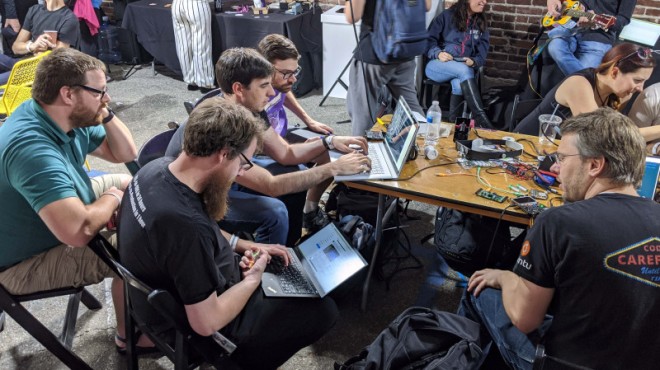
Hackaday at the 36th Chaos Communication Congress (36c3)

Drew (@pdp7) is at the Chaos Communication Congress (36c3) and so is the Hackaday community:

ccc-34c3-featured.jpg

It’s that time of year again here in Germany. The mulled wine flows all night long at the Christmas markets, the Krampus runs wild in the streets, and hackers are perched frantically behind their keyboards and soldering irons, trying to get their last minute projects “finished” for the 36th annual Chaos Communication Congress (36C3) in Leipzig.

We’ll have an assembly for all fans and friends of the Jolly Wrencher, so if you’re coming to Congress, you can come join us or at least stop by and say hi. [Elliot] and [Sven] and a number of Hackaday.io luminaries will be on hand. (Ask us about secret stickers and an as-yet unannounced upcoming Hackaday conference.)

Even if you’re not able to make it, you should keep your eyes on Hackaday from the 27th to the 30th, because we’ll be reporting on the best of Congress. But you don’t have to take our word for it: the Chaos Computer Club makes all of the talks available on livestream during the event, many with simultaneous translation, and final edited versions often appearing just a few hours afterwards.

We’ve looked through the schedule, and it’s going to be a hum-dinger! Gather ’round the glowing box with your friends at your own local hackerspace, or call in sick from work and make yourself some popcorn. This is must-see nerd TV.

Whether you’ve been naughty or nice, swing by our assembly if you’re going to be in Leipzig for the last few days of 2019. See you there!

via Hackaday is Going to the 36th Chaos Communication Congress — Hackaday

Quote

KiCad teardop plugin and flexible PCBs

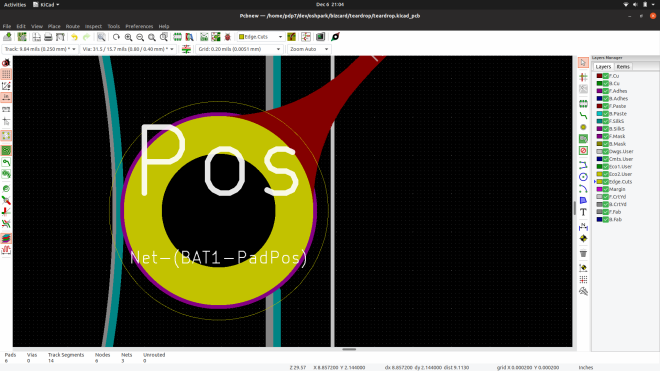
Screenshot from 2019-12-06 21-04-05

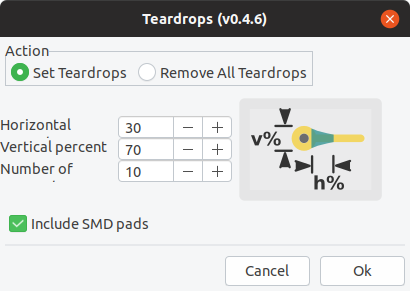
Thanks to Anool posting on Hackaday about KiCad plugins.  I decided to try out the Teardrop plugin by NilujePerchut:

Screenshot from 2019-12-11 14-51-09

KiCad Teardrop Plugin

This action plugin adds and deletes teardrops to a PCB.

This implementation uses zones instead of arcs. This allows to comply with DRC rules by simply rebuild all zones. You can also modify their shape by simply modifying the zone outline (like any other zone). Teardrops created with this script use a specific priority (0x4242) to be recognized as teardrops.

Here is the result of my first experiment to use the Teardrop plugin on a flexible PCB to reduce the mechanical stress of flexing the trace:

The board is available as an OSH Park shared project and the KiCad design files are on GitHub.

The author of the plugin was very responsive to GitHub issues and I was able to get better results on my next flex design which is currently being manufactured:

My flex “business card” will fold over a coin cell battery to light a 0603 LED.

Curious how the plugin works?  It creates zones next to the vias and pads.  Here are the two teardrop zones that connect traces to a via:

Warning: you need create a schematic and generate a netlist before starting the PCB layout.  Otherwise the the zones the plugin creates won’t be filled:

You also need to be careful that there is not copper on the same layer too close to the zone.  For example, the text was too close to the teardrop zone on this via, so I moved the text down and the zone now fills correctly:

An open GitHub issue is that the teardrop zone does not align perfectly for SMD pads that are not circles (like rectangles, squares, rounded rectangles).  The work around I used was to move the zone after it is filled to align with my SMD pad:

I hope you have fun with this plugin and leave a comment if you use it your own design!

UPDATE: I joined Adafruit Show-n-Tell to talk about flex PCBs and the teardrop plugin at 10 min 51 sec mark

KiCad teardop plugin and flexible PCBs

Hackaday Supercon badge boots Linux using SDRAM cartridge

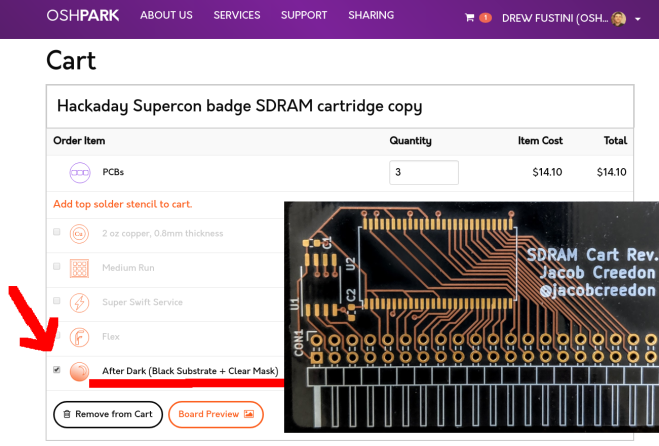
Jacob Creedon designed an a cartridge board that adds 32MB of SDRAM to the Hackaday Supercon badgeMichael Welling just assembled a version of the PCB made with the OSH Park “After Dark” black FR-4 service:

The addition of SDRAM provides enough memory to boot Linux on a RISC-V soft-core in the ECP5 FPGA on the badge.  Here’s a screenshot of Linux running:

Read more about “Team Linux on Badge” in this Hackaday post:

Badge-hacking-2019-13-Linux-on-badge-team.jpg

And finally, receiving the biggest applause was Linux-on-Badge: this team used all the badge hacking tricks in the book. The hardware component was a 32 MiB SDRAM cartridge by [Jacob Creedon]. The default badge SOC FPGA bitstream was entirely replaced in order to support a minimalist Linux. Much of the development was done on [Michael Welling]’s computer, guided by the precedence of a LiteX project putting Linux on the Radiona ULX3S. This is a true success story of Supercon collaboration as the team (including [Drew Fustini], [Tim Ansell], [Sean Cross], and many others) came together and worked late into nights, drawing from the massive body of collective expertise of the community.

Watch the demo during the Badge Hacking ceremony (jump to 17m 35s):

Resources:

ad-sdram
Note: click the “After Dark” checkbox if you want clear solder mask on black substrate

UPDATE:

Demo of Linux-on-LiteX booting on the badge:

Wondering what LiteX is?

LiteX is a FPGA design/SoC builder that can be used to build cores, create SoCs and full FPGA designs

Hackaday Supercon badge boots Linux using SDRAM cartridge

Weird World of Microwaves Hack Chat

Join us on Wednesday, December 18 at noon Pacific for the Weird World of Microwaves Hack Chat with Shahriar Shahramian! We’ve been following him on The Signal Path for years and are excited to pick his brain on what is often considered one of the dark arts of electronics.

No matter how much you learn about electronics, there always seems to be another door to open. You think you know a thing or two once you learn about basic circuits, and then you discover RF circuits. Things start to get a little strange there, and stranger still as the wavelengths decrease and you start getting into the microwave bands. That’s where you see feed lines become waveguides, PCB traces act as components, and antennas that look more like musical instruments.

via Weird World of Microwaves Hack Chat — Hackaday

Quote

Applied Ion Systems: Open-Source Satellite Propulsion

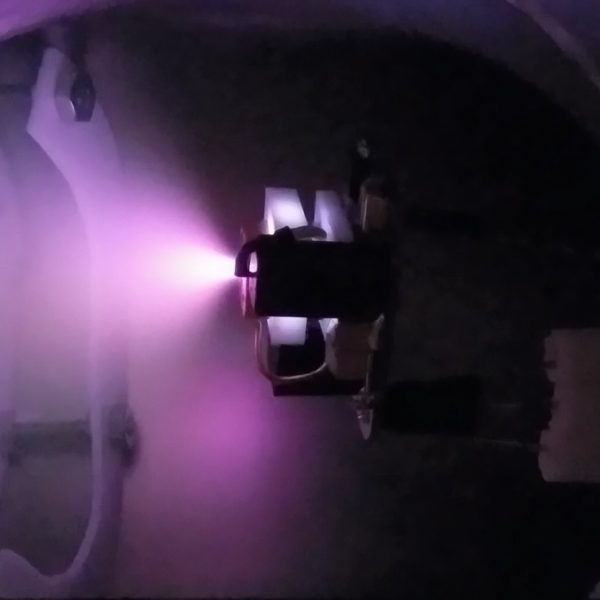
AIS-gPPT3-1C-T-Integrated-Propulsion-Module-Ignition-Plume-09-06-2019-600x600

Applied Ion Systems is leading development in the world’s first and only open-source home-based advanced electric propulsion program!

The Hackaday hackchat this week covered this exciting project:

ELXBkAwWoAAHKE5

Michael Bretti is on the leading edge of the trend toward making satellites more DIY friendly. He formed Applied Ion Systems to address one of the main problems nano-satellites face: propulsion. He is currently working on a range of open-source plasma thrusters that can help keep nano-satellites on station and in orbit longer, and someday you’ll be able to buy them off the shelf like any other component.

In this week’s Hack Chat, we’ll discuss the design of plasma thrusters, the details of Michael’s latest testing, and the challenges of creating something that needs to work in space.

Follow them on Twitter for more exciting news!

Applied Ion Systems: Open-Source Satellite Propulsion

New Hackaday Contest: Tell Time!

Clocks. You love ’em, we certainly love ’em. So you hardly need a reason to take on a new clock build, but it makes it much sweeter when you know there’s a horde of people waiting to fawn over your creation. Hackaday’s Tell Time Contest is a celebration of interesting timepieces. Show off a clever way to mark the passage of time and gain the adoration of your peers, and maybe even score a prize!

The Rotating Moon Clock is an interesting take on a timepiece

From now until January 24th, you can enter your Hackaday.io project by using the “Submit project to…” menu on the left sidebar of your project page. There is only one main constraint: it needs to somehow represent time. Microseconds or millennia, minutes until the next bus arrival or centuries until Pluto completes its next orbit, we don’t care as long as you find it interesting.

Document your timepiece with pictures, a description, and all of the technical details. Three outstanding entries will each receive a $100 cash prize, based on craftsmanship, function, and creativity.

Tick-tock… don’t delay. Time’s slipping away to have your quirky clock immortalized on Hackaday.

via New Contest: Tell Time — Hackaday

Quote

Hackaday Supercon: introduction to the state of the art in open-source FPGAs

Hackaday writes about an interesting talk from the recent Supercon:

David Williams Is “FPGA-Curious” — Hackaday

If you hadn’t noticed, we had a bit of an FPGA theme running at this year’s Superconference. Why? Because the open-source FPGA toolchain is ripening, and because many of the problems that hackers (and academics) are tackling these days have become complex enough to warrant using them. A case in point: David Williams is a university professor who just wanted to build a quadruped robotics project. Each leg has a complex set of motors, motor drivers, sensors, and other feedback mechanisms. Centralizing all of this data put real strains on the robot’s network, and with so many devices the microcontrollers were running out of GPIOs. This lead him to become, in his words, “FPGA-curious”.

If you’re looking for a gentle introduction to the state of the art in open-source FPGAs, this is your talk. David covers everything, from a bird’s eye view of hardware description languages, through the entire Yosys-based open-source toolchain, and even through to embedding soft-CPUs into the FPGA fabric. And that’s just the first 18 minutes. (Slides for your enjoyment, and you can watch the talk embedded below the break.)

Screenshot from 2019-12-06 16-22-42

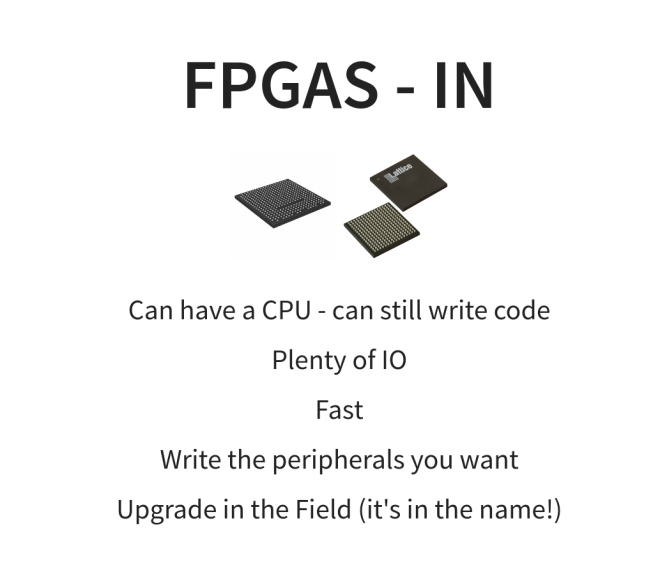
The second half of the talk is more about his personal experience and advice based on the last year or so of his experience going from FPGA newbie to master of his own robot. He highlights the versatility of a soft-CPU in an FPGA versus a pre-baked microcontroller solution. With the microcontroller you get all of the peripherals built into the silicon, but with the FPGA you get to write your own peripherals. Want a 10-wire SPI-like bus? Just code it up. Your peripherals are as simple or complex as you need them to be.

On the hardware side, David touts the PMOD standard (a man after our own heart!) and points out the large ecology of PMOD-compatible devices out there. Going for a plug-in solution also means that your engineering job is reduced to building a carrier board that can seat the FPGA brainboard of your choosing and interface it with a bunch of PMODs. It’s hard to get much simpler than that.


Quote