A 3D-Printed Bowl Feeder for Tiny SMD Parts

[Andrzej Laczewski] has something big in mind for small parts, specifically SMD resistors and capacitors. He’s not talking much about that project, but from the prototype 3D-printed bowl feeder he built as part of it, we can guess that it’s going to be a pretty cool automation project.

Bowl feeders are common devices in industrial automation, used to take a big pile of parts like nuts and bolts and present them to a process one at a time, often with some sort of orientation step so that all the parts are the right way around. They accomplish this with a vibratory action through two axes, which [Andrzej] accomplishes with the 3D-printed ABS link arms supporting the bowl.

via A 3D-Printed Bowl Feeder for Tiny SMD Parts — Hackaday

Quote

Monoprice Mini Converted to Pick and Place (Kinda)

Would you believe that you can take a cheap 3D printer and easily convert it into a full function pick and place machine to help assemble your PCBs? No? Well good, because you can’t. A real pick and place needs all kinds of sensors and logic to identify parts, rotate them, make sure everything is aligned, etc, etc. There’s no way you could just bolt all that onto a cheap 3D printer, and let’s not even talk about the lack of closed loop control.

But if you have a very specific use case, namely a PCB that only has a relatively large single part that doesn’t need to be rotated, [Connor Nishijima] might have a solution for you. He bought a $150 USD Monoprice Mini, and with the addition of a few printed parts, was able to build a machine that drastically cuts down the time it takes for him to build his LED boards. Best of all the modification doesn’t involve any permanent changes to the printer, he can just pop off the vacuum attachment when he wants to print something.

via Monoprice Mini Converted to Pick and Place (Kinda)

Quote

Belgrade Badge Hacks

We’re still coming off the Hackaday Belgrade conference right now. If you were there, you know it was the greatest hardware conference ever. If you weren’t there, you missed out. Sorry. (Make sure you get in on the Hackaday Superconference in November.)

One of the many highlights of the Belgrade conference was, of course, the badge. The 2018 Hackaday Belgrade Badge is a masterpiece of hardware with a 55-key keyboard, RGB TFT LED, speaker, and a BASIC interpreter.

This badge is a masterpiece of electronic design by Voja Antonic. Just to take one small example from the design, check out the placement of the buttons. Think the slightly rotated buttons that make up the keyboard is only a stylistic choice? It’s not; by carefully rotating each button, the legs of each switch can fit in between each other. It’s brilliant.

via Belgrade Badge Hacks — Hackaday

Quote

Emotional Hazards That Lurk Far From The Uncanny Valley

From  on the Hackaday blog:

Emotional Hazards That Lurk Far From The Uncanny Valley

A web search for “Uncanny Valley” will retrieve a lot of information about that discomfort we feel when an artificial creation is eerily lifelike. The syndrome tells us a lot about both human psychology and design challenges ahead. What about the opposite, when machines are clearly machines? Are we all clear? It turns out the answer is “No” as [Christine Sunu] explained at a Hackaday Los Angeles meetup.


When we build a robot, we know what’s inside the enclosure. But people who don’t know tend to extrapolate too much based only on the simple behavior they could see. As [Christine] says, people “anthropomorphize at the drop of the hat” projecting emotions onto machines and feeling emotions in return. This happens even when machines are deliberately designed to be utilitarian. iRobot was surprised how many Roomba owners gave their robot vacuum names and treated them as family members. A similar eruption of human empathy occurred with Boston Dynamics video footage demonstrating their robot staying upright despite being pushed around.

Quote

Hot Camera Contest: Build A Battery Powered Thermal Camera

Here’s a challenge for all you hardware hackers out there. Peter Jansen has opened up the Hot Camera Contest on Hackaday.io to use a thermal imaging camera in a battery-powered project.

The challenge here is simple. Use a Flir Lepton thermal imaging camera module in a battery-powered configuration. There’s a catch, though: this is a project to use the Lepton in radiometric mode, where the camera spits out an actual temperature value for each pixel. Yes, this is a documented feature in the Flir Lepton module, but so far very few people are using it, and no one has done it with a small, battery-powered device.

The rules for this challenge are to use the Flir Lepton 2.5 in radiometric mode using either the Raspberry Pi Zero W or ESP32. Any software in this challenge must spit out absolute temperature values in a text format, and there must be a demonstration of putting the Flir Lepton into low-power mode. There are two challenges here, one for the Raspi and one for the ESP32; and winner will be named for each.

via Hot Camera Contest: Build A Battery Powered Thermal Camera — Hackaday

963711531424781533.jpg

Quote

HDDG 32: Stimulating Communication Through Titillating Wearables

Bradley Ramsey recaps HDDG from last week:

1_yHc1e_wIGfjhgE8MbM3pzQ.jpeg

HDDG 32: Stimulating Communication Through Titillating Wearables

Sarah Petkus takes the stage to discuss her ongoing project, which measures and indicates human arousal using stylish wearables

1_A-lxKrlNREmuEAJLR2Kx6g

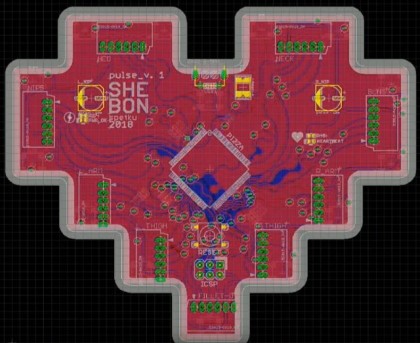
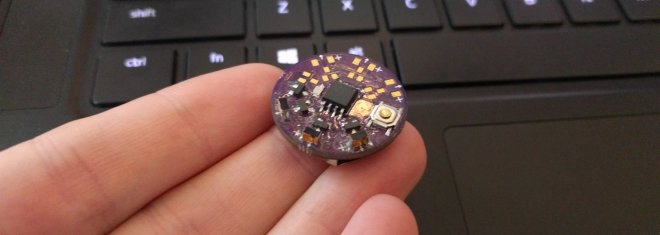
Sarah’s talk entitled SHE BON: Using Body-data to communicate the intimate and the unseen, discusses her work on a unique new project aimed at encouraging communication around human sexuality. Sarah is a kinetic artist, roboticist, and was recently called a transhumanist, which fits really well once you’ve seen her presentation.

The term refers to an intellectual movement that seeks to elevate the human condition both mentally and physically through the use of technology. Sarah’s talk begins with her origins, which were rooted in feelings of powerlessness.

So, she did what any maker would do: she built a robot army. With the help of her colleague, she built an army of 100 delta robots that you control with physical gestures.

HDDG 32: Stimulating Communication Through Titillating Wearables

ERRF 18: The Start of Something Great

From  on the Hackaday blog:

ERRF 18: The Start of Something Great

For years, the undisputed king of desktop 3D printing conferences has been the Midwest RepRap Festival (MRRF). Hosted in the tropical paradise that is Goshen, Indiana, MRRF has been running largely unopposed for the top spot since its inception. There are other conferences focused on the industrial and professional end of the 3D printing spectrum, and of course you’d find a Prusa or two popping up at more or less any hacker con; but MRRF is focused on exploring what the individual is capable of once they can manifest physical objects from molten plastic.

But on June 23rd, 2018, MRRF finally got some proper competition. As the name might indicate, the East Coast RepRap Festival (ERRF) is an event very much inspired by its Hoosier State predecessor. Held in Bel Air, Maryland, hackers on the right side of the United States for the first time had the opportunity to attended a true 3D printing festival without having to get on a plane. Not to say it was a neighborhood block party; people from all over the country, and indeed the globe, descended on the APG Federal Credit Union Arena for the two-day celebration of everything plastic.

This inaugural ERRF was, to put it mildly, a massive success. A couple of Hackaday Field Agents were in attendance, and we definitely came away impressed with the event considering it was the first attempt. We saw evidence that the RepRap dream of printable printers is still going strong, a gaggle of new printers and products that will be prying at your wallet this year, and an American-made hotend that challenges traditional wisdom. Of course we also saw a huge number of 3D printing fanatics who were eager to show off their latest creations.

We have no doubt that ERRF will return again next year, but until then, you’ll have to settle for the following collection of selected highlights from this year’s show.

We’re no strangers to the work [David Shorey] has been doing with 3D printing on fabric, but it’s always awesome to see up close. The concept here is actually quite simple: pause the print after a few layers, pull a piece of tulle (the kind of thing bridal veils are made of) tight over the bed, and then let the print finish. The fabric is caught between the layers of the print, and as long as you aren’t too rough with it, will hold together quite nicely.

[David] wasn’t the only person to have this idea, but he certainly seems to be on the forefront of perfecting it. Perhaps the most interesting element of this technique is that essentially anyone with a 3D printer and a nearby fabric store can try their hand at it.

 

Quote

Micro TV-B-Gone

From Nicholas Junker on Hackaday.io

6009271515082893441.jpg

Micro TV-B-Gone

The Micro TV-B-Gone is based off of Adafruit’s original TV-B-Gone kit, except made to be as small as possible, using an LIR-2032 coin cell.


I based this project off of the Adafruit TV-B-Gone kit. I wanted to start getting into using surface mount components on my projects, and seeing as the TV-B-Gone was my first foray into soldering, I figured that it would be a great project to work on.

The device takes a rechargeable LIR-2032 battery, and is activated pressing the single button on top. It will run through all TV power codes, and then go into a low power mode, waiting for the next button press. The battery will last around 40 full cycles, before being reduced down to 3.5 volts.

Micro TV-B-Gone

Sarah Petkus: Using Body-data to communicate the intimate and the unseen

Awesome talk by Sarah Petkus for HDDG last night at Supplyframe in SF:

Using Body-data to communicate the intimate and the unseen

Sarah Petkus is a kinetic artist, roboticist, and transhumanist from Las Vegas, who designs electronic and mechanical devices which encourage reflection regarding the human relationship with technology.

Their talk will be about a series of wearable augments built to facilitate in sensing, tracking, and indicating one’s level of excitement (or arousal)! Each of the wearables uses a variety of sensors as input to influence quirky electronic and mechanical devices of my design as output. The goal in doing so is not only to create a stellar suit of electronic armor (or amour), but also to help facilitate a dialogue about sex and intimacy amongst my peers that is relatable, honest, healthy, and fun.

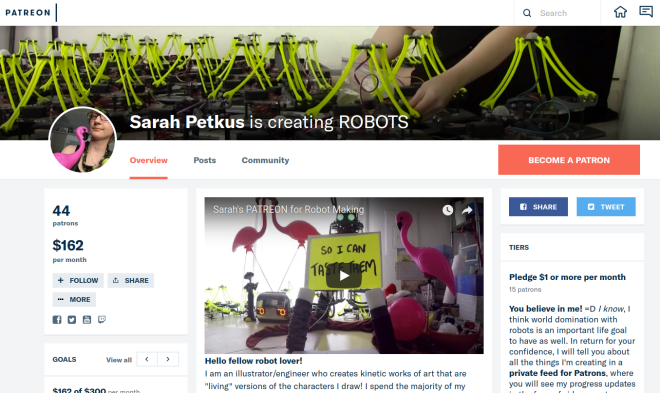
Follow Sarah and her projects on Patreon:Screenshot from 2018-07-13 13-00-51.pngSarah Petkus is creating ROBOTS

Sarah Petkus: Using Body-data to communicate the intimate and the unseen