OnChip Open-V Arduino Compatibility

OnChip has posted a Crowd Supply update on their plans for Arduino compatibility:
arduino-open-v_jpg_project-body.jpg

Open-V Arduino Compatibility

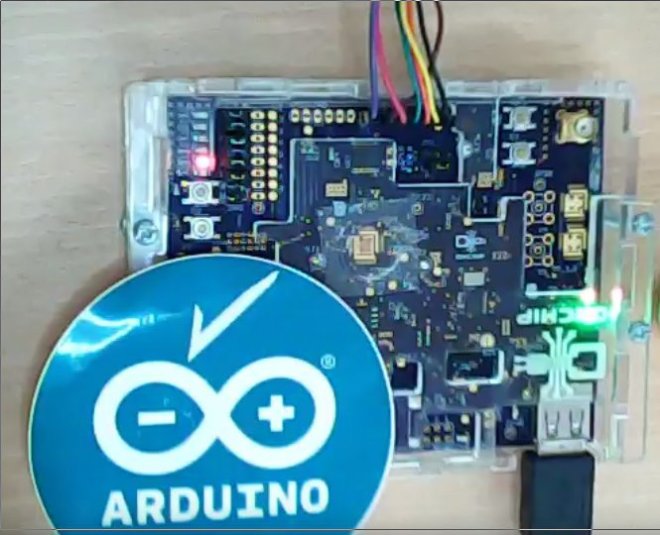
Arduino compatibility can mean a lot of things to a lot of different people, so we’ll try to be as concrete and specific as possible. For the Open-V, Arduino development tools, and interoperating on a hardware level with existing Arduino shields.

wire-bonds-zoomed_jpg_project-body.jpg

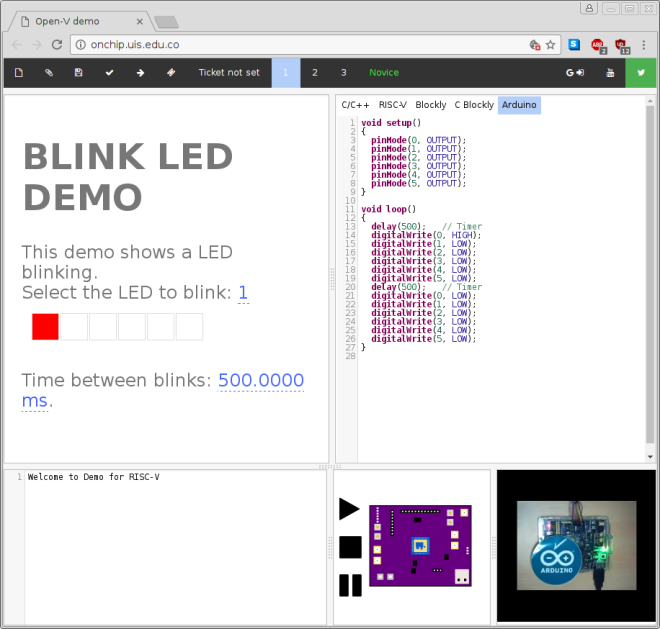
We’ve updated our live, web-streamed demos to include an Arduino mode in addition to the assembler and C modes we already have. You might also notice the relatively new Blockly modes and a refined layout of the demo page. Go write some code and see the results live streamed!
Screenshot at 2017-02-12 20-18-49.png

OnChip Open-V Arduino Compatibility

$3 Tinusaur board on IndieGoGo

Neven Boyanov has launched a new Tinusaur campaign on IndieGoGo:

Learn, Teach and Make with the Tinusaur

Small microcontroller board that could run Arduino and help you learn, teach others and make things

uvloj5csuhcx0ri4yn5c

The Tinusaur is powered by the Atmel ATtiny85 microcontroller.

We want to bring the cost down to $3 for the basic “lite” boards
and allow more people to be able to get them.

$3 Tinusaur board on IndieGoGo

Learn, Teach and Make with the Tinusaur

Last week we’ve launched our Indiegogo crowdfunding campaign and, as of a few minutes ago, we’ve reached 1/3-rd of our goal already. In case you’re not familiar what the Tinusaur project is about … A small board with a tiny chip on it that comes as an assembly kit – a small package with parts and you […]

via Indiegogo Campaign is Almost Halfway Through — The Tinusaur

Learn, Teach and Make with the Tinusaur

Cypress FX2LP High-Speed USB Controller

Yin Zhong designed this dev board for Cypress FX2LP™ microcontroller:

750471485341005936-1

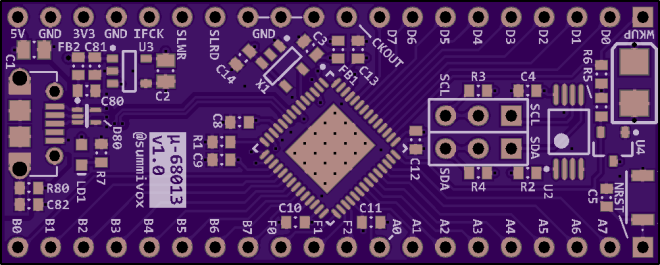
μ-68013: a High Speed USB2.0 MCU breakout

Cypress’s FX2LP (CY7C6801x) is one of the smallest footprint MCUs that offer a high-speed USB (480 Mbit/s) device peripheral with built-in PHY (many others lack the PHY!). It contains a 8051 core for bookkeeping and setting up data streams through its hardware multiplexed parallel FIFO interface to/from an external processor, be it MCU, DSP, or FPGA/CPLD.

This is a breadboard-friendly minimal system PCB for CY7C68013 in QFN56 package. It integrates 3.3 V power supply, core clock, reset circuit/button, and I2C EEPROM (the MCU does not have built-in flash). It breaks out all IO pins through 2 rows x 20 pins 0.1″ pitch headers with 0.7″ row spacing.

summivox has shared the board on OSH Park:

20170112-0057 CY7C68013-v1.0.zip

3ff564ec93a66d415384b740fe7db92f.png Order from OSH Park

Cypress FX2LP High-Speed USB Controller

ATtiny45 motion sensing night light

DanR has shared this motion sensing night light board:

52a565338ea97ef07276d81c9bc9584c

ATtiny45 motion sensing night light V1.2 D

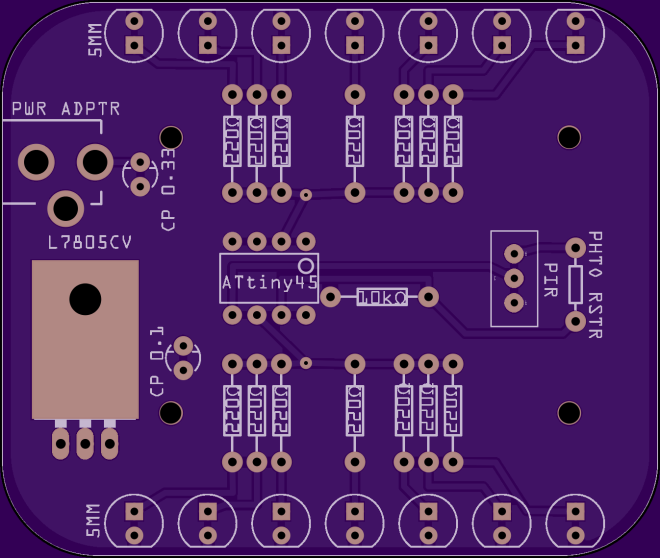
This light is powered by an ATtiny45/85 which powers on the 14 LED lights when motion is sensed and it is in a dark room. The light sensor on the board will not allow the lights to come on if it is in a reasonably lit room.

It is fitted with a barrel plug for power, this model specifically with an L7805CV voltage regulator.

Order from OSH Park

ATtiny45 motion sensing night light

GlowSaber

Carlos Vadillo and Bx Dawes created the GlowSaber project to help kids in Alameda learn about physics, engineering and programming:

screenshot-from-2016-12-23-21-27-09

Building the GlowSaber main board

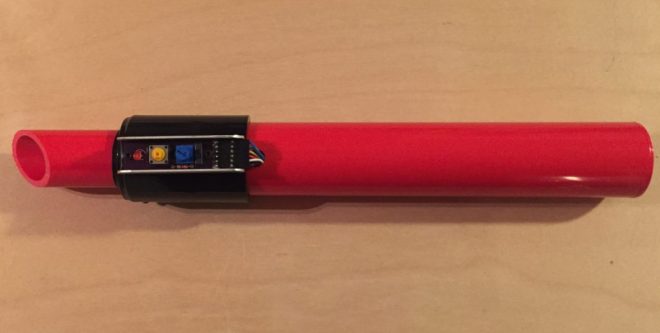
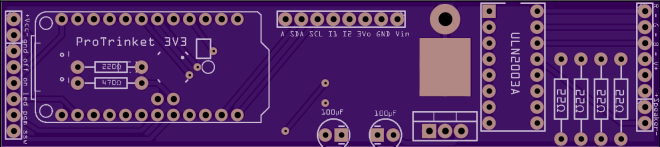
All the logic, sound and light effects of the GlowSaber are performed by a small microprocessor board. In this tutorial I will explain, step by step how to put together the main board of a GlowSaber.

DSC_0695-2016-09-11_17-41-42-864-1024x680.jpg

Building the GlowSaber handle

One premise that I had while designing the GlowSaber was that I should be able to build all of it with tools that I already have. That limited the materials I could choose to those that I could cut, drill and glue with just the basic tools:

228-1024x518

GlowSaber RGB LED assembly

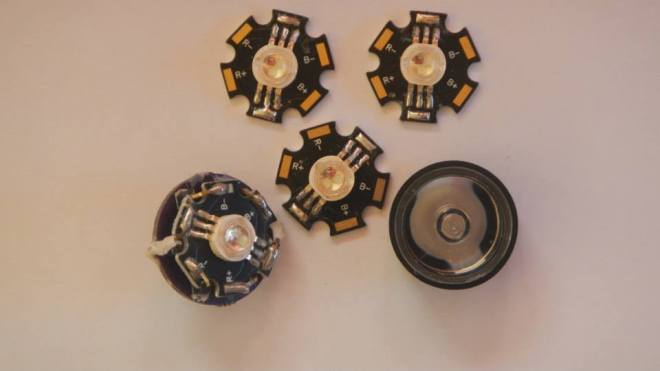
The GlowSaber uses a Vollong 3 watts RGB LED. It is very bright and more than enough to light the length of the blade. When designing the GlowSaber I found that I needed a way to connect the LED to the main PCB and I designed a LED break out

11068412_1603898416534244_4239972562777874584_n.jpg

How to use a potentiometer to change the behavior

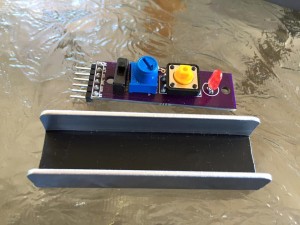
The GlowSaber has a switch assembly, that controls the on/off functions. It also has a LED to show that the GlowSaber is ready to start, and finally has a small 1 kΩ potentiometer. The following is a schematic of the switch assembly:

11999092_1652403508350401_7697716071713430521_n-300x225

cvadillo has shared the board on OSH Park:

GlowSaber

Untitled.png
Order from OSH Park

GlowSaber

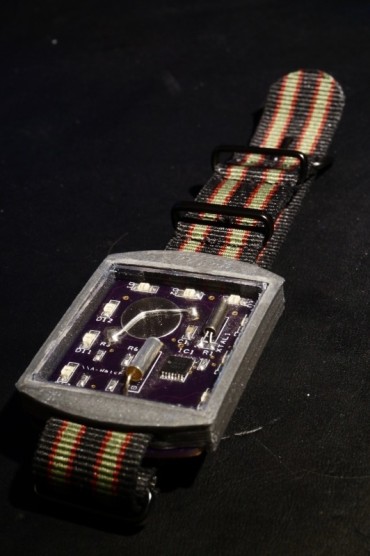
Tilt activated LED watch

askoog89 saw a major flaw with many LED watches – you have to press a button to see the time:

114881412191895394.jpg

A Watch

I tried fix that problem by using a tilt switch to active the LED showing the time when tilt your arm to look at the watch

The watch uses the low power MSP430G2211 MCU from Texas instruments to control the LED and mesure the time with the help of a 32kHz watch cristal. The MCU sleeps most of the time only waking up ones a second to count up the time and check if the tilt switch is active.  To show the time the watch uses 12 charlieplexed orange LEDs.

Tilt activated LED watch

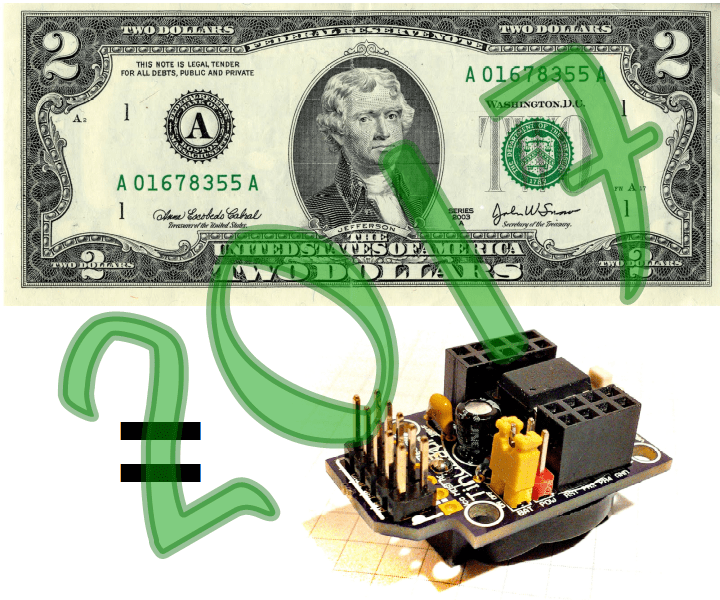
Moving forward with the Tinusaur Project in 2017

2016 has been a great year! Over 20 workshops, lectures, seminars, courses. One Indiegogo campaign. Hundreds of people started using the Tinusaur platform. So, what’s next? Our Q1 goal: Launch new Indiegogo campaign in February to produce 1000 Tinusaur kits and bring the cost down to $2 per basic kit. This will make our boards […]

via Moving forward with the Tinusaur Project in 2017 — The Tinusaur

Moving forward with the Tinusaur Project in 2017

Acrylic Solenoid Engine

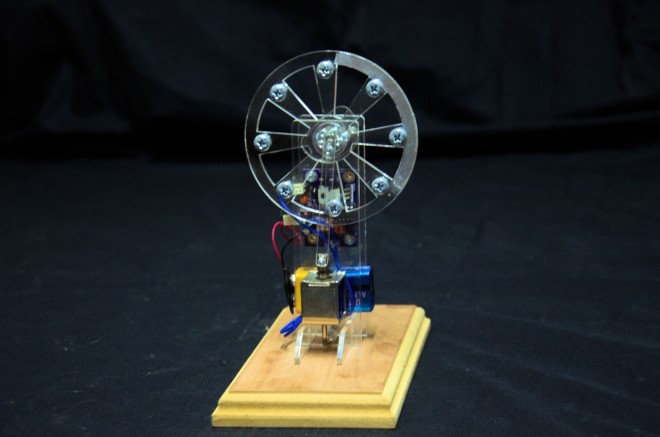
Extreme Electronics designed this easy-to-build solenoid engine:

996401481888712703

I’ve always loved solenoid engines. The first one I built was many,many years ago out of Mechano. Many others have followed since, But they always ran badly and only for a short while as the accuracy of the construction medium was poor. I am not a metal worker, making a “proper” engine out of cast pieces is out of my (and many other peoples) capabilities.

With modern laser cutting it is easy to make accurate components, it is relatively cheap and fairly quick.

So the Acrylic Solenoid Engine came into being

2592791481888508539

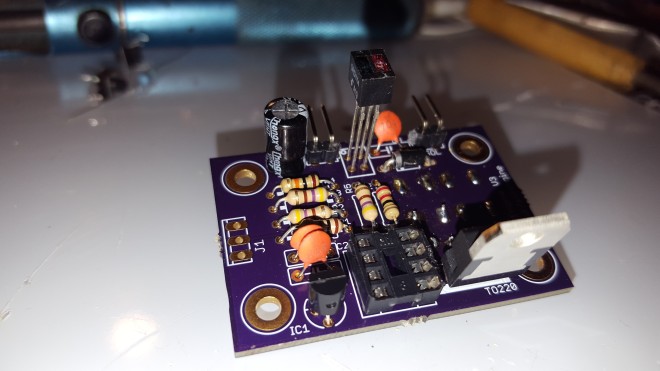
The initial driver is using a small PIC 12F675 and and an IR detector to give me pulse timing information from the solenoid. I went the IR sensor route rather than a mechanical switch so there was no rubbing parts that could wear as acrylic is rather soft. To get a good timing signal aluminum foil is placed on one side of the flywheel to give a good reflection back to the IR emitter receiver pair on the PCB.

Acrylic Solenoid Engine

GPS Clock by Nick Sayer

Nick Sayer created this simple desk clock that gets time from GPS:

397901481448251464.jpg

GPS Clock

GPS is best known as a ubiquitous, accurate positioning system (obvious from the name), but the way it actually works requires distributing hyper-accurate time information. This makes it possible (and, actually, pretty easy) to make a clock that you never have to set as long as it gets good GPS reception.

Yes, this is way overkill… but GPS is getting so cheap that you might as well.

The source code is available on GitHub:

images11 nsayer/GPS_clock


Nick has hacked together a tenth digit for the clock:

screenshot-from-2016-12-16-13-15-11

Here is a video of the GPS clock in slow motion:


GPS Clock by Nick Sayer