Open Source Hardware in industry – meet DIN SPEC 3105

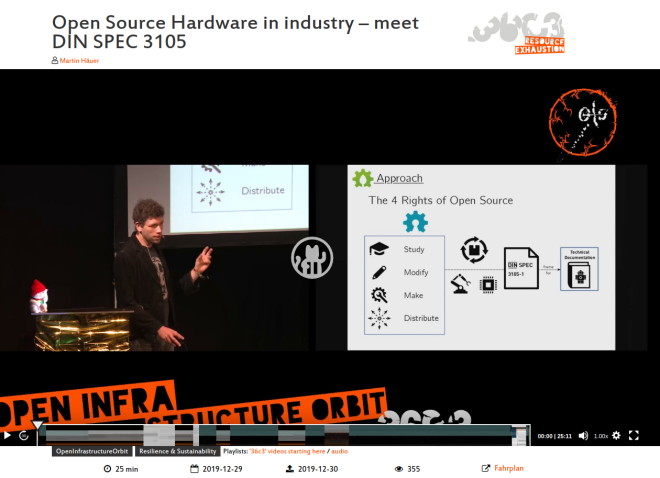
Martin Häuer of Open Source Ecology Germany gave a talk at 36c3 about a recent effort to create a standard for Open Source Hardware with DIN (the German Institute for Standardization):
Screenshot from 2020-01-11 11-20-39

Open Source Hardware in industry – meet DIN SPEC 3105

Compared to software, the open source approach is relatively new to most actors in the field of (mechanical) hardware.

Plus Open Source Hardware faces some special issues. A yet missing definition of its “source code” is one of them (+ patent law, liability, engineers that do not know how to work with git, costly prototyping…)

DIN SPEC 3105 will be/is the first official standard for Open Source Hardware and also the first official standard ever published under a free license (CC-BY-SA 4.0; that was a lot of lobby work 😉 ). It defines the technology-specific “source” of Open Source Hardware and aims to build a bridge between research institutes, public authority, industry and the worldwide open source community.

Here is a PDF of the slides: OSH Standardisation-36c3

Screenshot from 2020-01-11 11-23-34To look into the standards themselves:

Additional information is hosted on GitLab:

Technology-specific Documentation Criteria (TsDC) specify the requirements for the technical documentation of Open Source Hardware (OSH). A TsDC is created (yet manually) by OSH projects/developers and is a subset of the TsDC database (TsDC-DB) provided in this repository. The concept of a TsDC was initially mentioned in DIN SPEC 3105-1 (since v0.3) and probably will be mainly used in this context.

Learn more about Open Source Ecology Germany on their website:

Screenshot from 2020-01-11 11-31-00

Enable a sustainable way of life and the emergence of an open source economy through self-created and freely available means of production .
Open Source Hardware in industry – meet DIN SPEC 3105

Penguino Feather SAMR34 LoRa Dev-Board

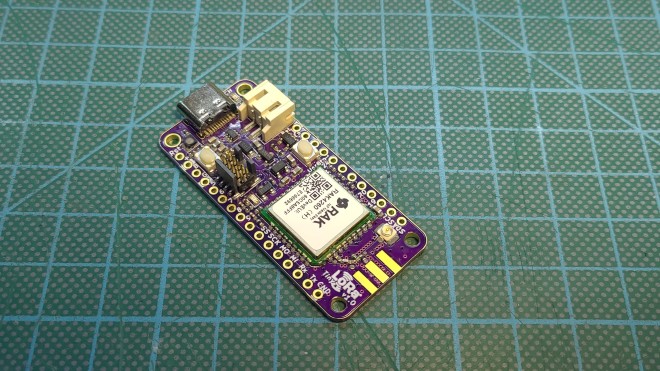
Orkhan AmirAslan on Hackaday.io has created a RAK4260 based, Feather styled LoRa dev-board:

811081576236264418

Penguino Feather SAMR34 LoRa Dev-Board

This is a SAMR34 based LoRa dev-board with all the necessary components for fast prototyping. It’s a successor of my previous Penguino RF module and Feather breakout design ( https://www.tindie.com/products/16985/ )The new design uses the RAK4260 module from @RAKWireless and improves on some aspects, such as USB Type-C, RGB LED, user button, battery protection & voltage supervision, and optional flash & per-provisioned secure element IC pads.

Background:

About a year ago, after I first saw SAMR34 System in Package (SiP) in 2018 Electronica I couldn’t find a module for it and I took up the challenge for myself to build one myself. Then sharing first renders with the Twitterverse it gathered quite a bit of interest and I started selling couple over at my Tindie store. At the time I named the project TinyLoRa but for legal reasons I had to change it to Penguino.

Specs:

  • ATSAMR34J18 LoRA System-in-Package (SiP) based RAK4260
  • ARM Cortex M0+ MCU & SX1276 LoRa Radio
  • 256KB Flash, 40 KB RAM
  • Max Tx Power: +20 dBm; Max Sensitivity: -148dBm; Rx Current: 17mA (typical)
  • Frequency Range: 862 to 1020 MHz (DS values)
  • Deep Sleep Current: ~1 μA (module only)
  • Li-Po battery charging IC
  • RGB user LED, Battery Charge Status (red) and Power (blue) (w/ cut-off jumpers)
  • 3.3V low Iq LDO (~1 μA)
  • Low-voltage battery cut-off supervisor IC (3V Vbat cutoff)
  • USB Type-C connector with protection/filtering circuit
  • 0.75 A resettable fuse
  • Voltage divider for Vbat monitoring (w/ cut-off jumpers)
  • SMA and u.FL antenna connectors
  • 10-pin SWD programming header
  • Dimensions: 2 in. x 0.9 in. (50.8 mm x 22.8 mm)

Penguino Feather SAMR34 LoRa Dev-Board

PoE Powers Christmas Lights, But Opens Up So Much More

Addressable LEDs are a staple of homemade Christmas decorations in our community, as is microprocessor control of those LEDs. So at first sight [Glen Akins]’ LED decorated Christmas tree looks pretty enough, but isn’t particularly unusual. But after reading his write-up you’ll discover there’s far more to the project than meets the eye, and learn a lot about the technologies behind it that has relevance far beyond a festive light show.

The decoration is powered exclusively from power-over-Ethernet, with a PIC microcontroller translating Art-Net DMX-over-Ethernet packets into commands for the LED string. The control board is designed from the ground up and includes all the PoE circuitry, and the write-up  gives a very thorough introduction to this power source that takes the reader way beyond regarding PoE as simply another off-the-shelf black box. Along the way we see all his code, as well as learn a few interesting tidbits such as the use of a pre-programmed EEPROM containing a unique MAC address.

So if your house has CAT5 wiring and you want an extra dimension to your festive splendour, you’ve officially got a whole year to build your own version. He’s featured here before, with his buzzer to break the Caps Lock habit.

via PoE Powers Christmas Lights, But Opens Up So Much More — Hackaday

Quote

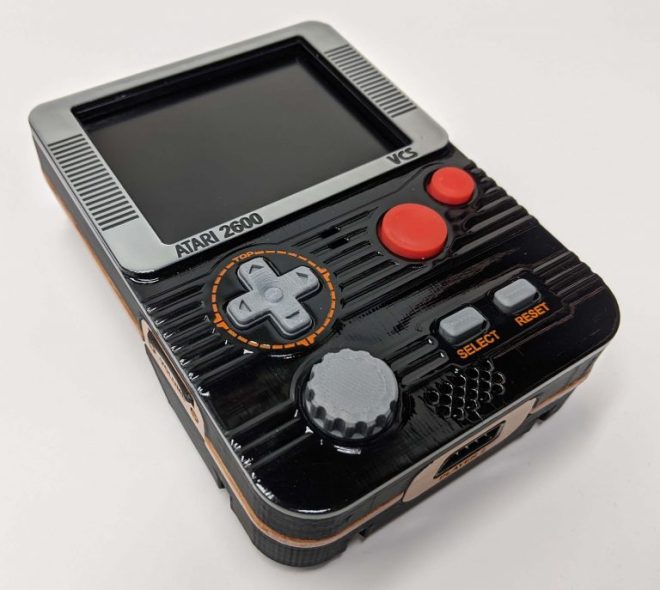
Ben Heck’s Atari 2600 Junior Single Chip Portable

Here’s a portable retro gaming project by Ben Heck:

3_unit_front_3quarter-768x687

Project started in 2000 finally finished – Atari 2600 Junior Single Chip Portable!

When I first starting buying Atari 2600 consoles for modding purposes back in 2000 (right after my website became famous) I was lucky enough that my first Atari 2600 Junior had the ultra-rare “single chip” variant inside.

Of course this was “portablization catnip” for me so I desoldered it and tried to make a custom PCB.  My skills at the time weren’t up to task and I feared the chip dead. Had I know then how rare it was (I’ve never found another since) I probably wouldn’t have tried but can’t change that now.

Flash forward to fall of 2018 and I come across the project in a junk box while moving out of the Ben Heck Show shop. Decided to give it another go and I have help this time – my friend Parker Dillmann has an intact single-chip 2600 Junior so we can cross reference to it.

I documented this near-year-long process in the video below. You can also click here for the full photo gallery with notes.

Ben Heck’s Atari 2600 Junior Single Chip Portable

Hackaday: DIY Scalar Network Analyzer

[Steven Merrifield] built his own Scalar Network Analyzer and it’s a beauty! [Steve]’s SNA has a digital pinout matching a Raspberry Pi, but any GPIO could be used to operate the device and retrieve the data from the ADC. The design is based around a few tried and true chips from Analog Devices. He’s taken some care to design it to be nice and accurate which is why he’s limited it to 1kHz to 30Mhz. We think it’s quite a fetching board once the shielding is in place.

via DIY Scalar Network Analyzer — Hackaday

Quote

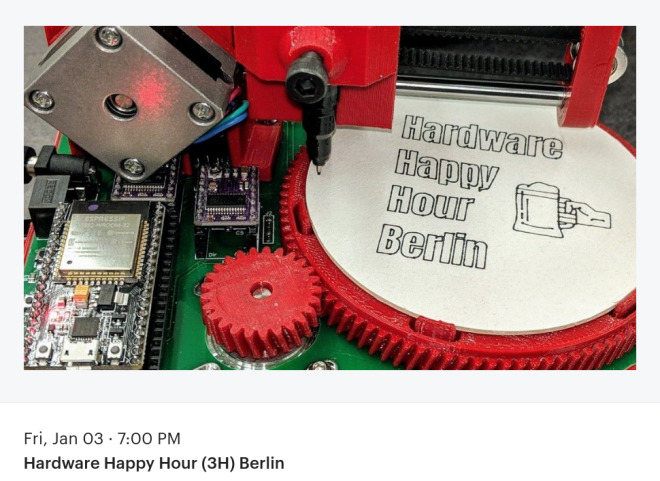
Hardware Happy Hour Berlin this Friday, Jan. 3rd

Screenshot from 2020-01-01 21-40-58.png
Hardware Happy Hour Berlin will be this Friday, January 3rd, at xHain hackspace
Please bring your latest project with you! Anything you’re working on, electrical, mechanical or software works! We want to see the stuff that you’re interested in!
Please bring your latest project with you! Anything you’re working on, electrical, mechanical or software works! We want to see the stuff that you’re interested in
This is special post-Congress edition of 3H at Berlin hackerspace xHain
Apologies for the short notice. I wanted to schedule something this week for people that are visiting Berlin after Chaos Communication Congress (36c3) in Leipzig last weeken
Hardware Happy Hour Berlin this Friday, Jan. 3rd

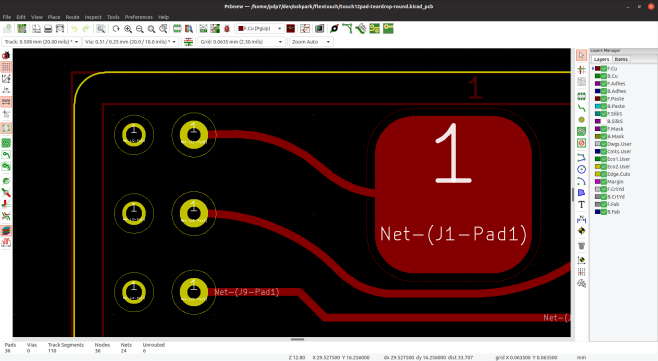
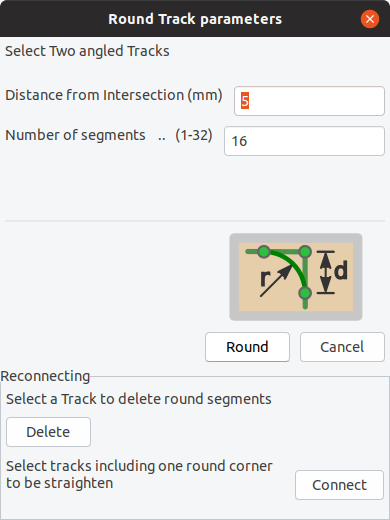
KiCad round tracks

Want to make curved traces in KiCad?

1

The track rounder plugin from KiCad RF tools can help:

RF-tools-KiCAD

2

I learned about the plugin thanks to this post on Hackaday:

RF TOOLS FOR KICAD

Recently, [Maurice] has released RF Tools for KiCad which include a collection of plugin’s that address a long felt need for RF design. The suite includes footprint wizards for designing mitred bends, tapered track connectors, and arc tracks (radius bends) for RF layout. These tools work by creating footprints, so it isn’t perfect, but it’s a big step in the right direction.

Also included is a set of action plugins for arc track corners, track length measurement, and a mask expansion tool. The expansion tool lets you adjust mask clearances for tracks and is handy for RF layout and for high current applications where you want to layer up extra solder on top of exposed copper tracks. It may also appeal to the artistic folks who want more control over track layout and visual design. Rounded tracks will also be pretty handy when designing flex PCBs. It’s worth pointing out that the arc action plugin will create segmented arcs while the arc footprint wizard will produce a smooth arc, so both have their pros and cons. If you get stuck, there’s an active thread on the forum for help and assistance. Check out the demo video embedded below.

https://github.com/easyw/RF-tools-KiCAD

KiCad round tracks

Low Power ESP32 Handheld

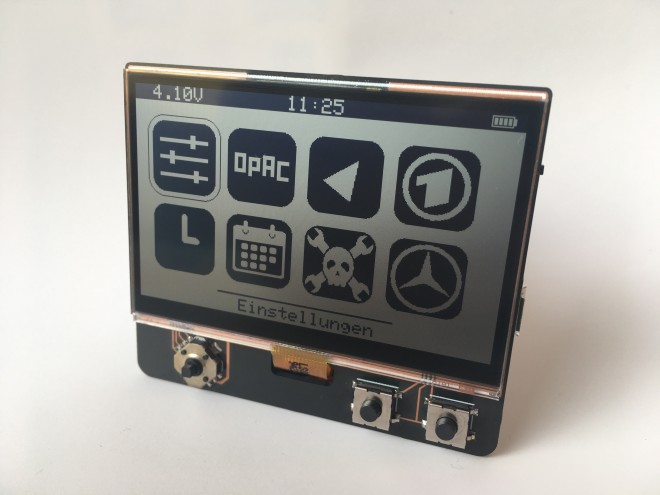
Max.K on Hackaday.io has created a pocket sized ESP32 display board with 300µW Always On Display:

7327171577179362033.jpeg

Low Power ESP32 Handheld

This handheld board is powered by an ESP32 and features a transflective Sharp memory LCD.  Similar to my previous Chronio smartwatch the focus of this project is on low power consumption.  Using the ESP32’s ULP core, the board can go into deep sleep with an active display.   The software includes a menu interface with a simple RSS reader.

Some of the key features are:
– 400x240px 2.7″ SHARP memory display
– 350 mAh LiPo battery with USB charging
– Always On Display with 300 µW power consumption
– 4-way joystick and buttons
– Date and time using built in RTC with NTP sync
– RSS Feed / Website parser

Layout files and Code on GitHub: https://github.com/CoretechR/ESP32-Handheld


Low Power ESP32 Handheld

The rise of the FPGA

Issue 26 of HackSpace Magazine is out! 

I wrote a column about how about open source FPGA tools developed by Claire Wolf, David Shah, and more have made FPGAs more accessible than ever before to makers and hackers:

The Rise of the FPGA

FPGAs have been the talk of the town at many of this year’s hacker conferences. At CrowdSupply’s Teardown there were workshops on two different FPGA boards, the IceBreaker and the Fomu, and Hackaday’s SuperCon based their conference badge on an FPGA. But what exactly is an FPGA, and why are they so hot right now?

Download the free PDF of the issue from the HackSpace website and subscribe if you enjoy the content.  It is one of my favorite magazines!

I only had 400 words for the column so here’s some additional notes:

The rise of the FPGA