Today the 2017 Hackaday Prize begins! This is Hackaday’s global engineering initiative that encourages people to direct their skill and energy to make the world a better place. We call it the Hackaday Prize, but it’s far more than that. Join a community of talented people who enrich their own lives by seeking out new challenges and new…
Month: March 2017
Working with Surface Mount Components and BGAs
Surface mount PCBs (Part 1) If you look at a circuit board today, you’ll see a beautiful array of surface mount chips and components, including very fine 0.5mm or even 0.4mm leaded devices and BGAs. Some of these ‘exotic’ devices can contain really advanced technology such as high speed ARM microprocessors, flash and high capacity […]
via Working with Surface Mount Components and BGAs — Intelligent Toasters
Hall Sensor Preamp
Piotr Zapart designed this board to overcome range issues when using traditional 300 degree potentiometers or Hall sensors as rotational angle to voltage converters:
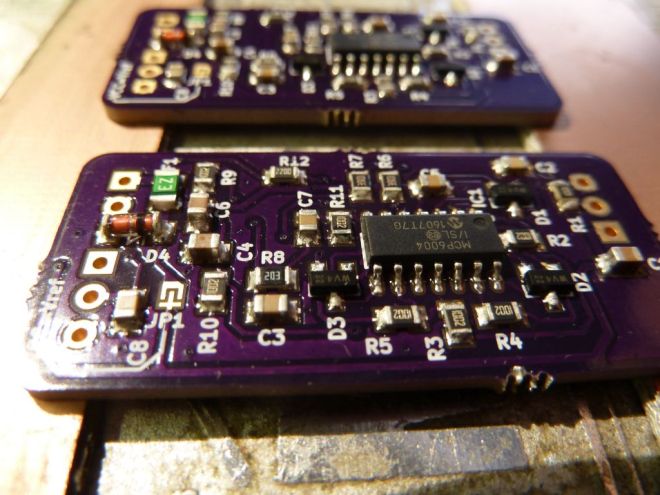
HALL Preamp/Analog axis calibrator
The idea was to create a device that will perform an axis calibration, usually done in digital domain, but before sampling the signal in the ADC, still in analog domain, using it’s advantageous infinite resolution
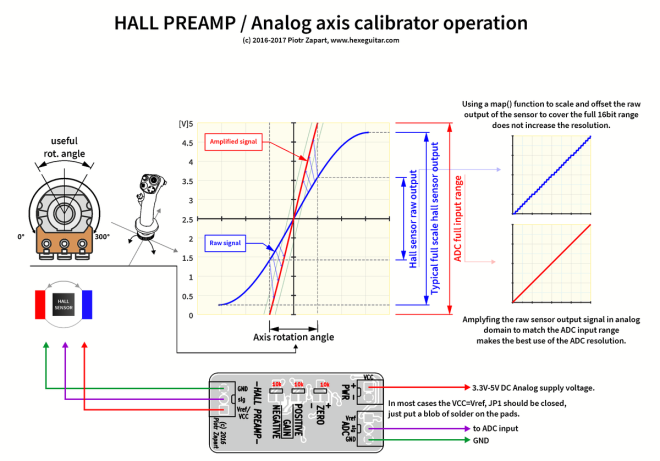
the main function of this device is to:
- Buffer the analog output signal coming from a potentiometer or another rotary angle to voltage converter like ie. Hall sensors.
- Filter out the high band noise and limit the bandwidth to an usable range only, protect the input against voltage spikes.
- Match the output voltage range of the source (pot/hall sensor) with the input range of the ADC, thus making the most of the available ADC resolution.
- Linearize the hall sensor output signal response by amplyfing it’s most linear region to the full scale ADC input range.
The board is shared on OSH Park:
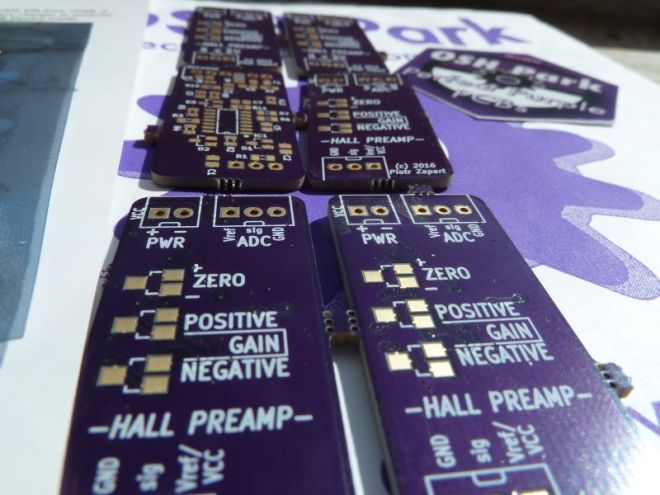
HALL Preamp
USB Interruptor
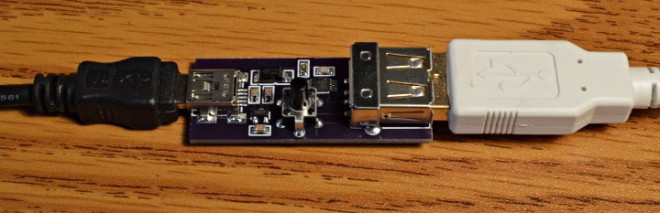
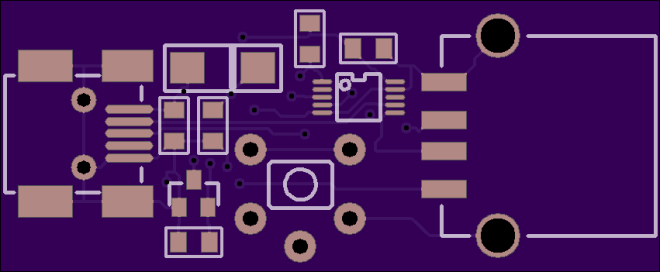
Teensy creator Paul Stoffregen designed this board to momentarily disconnect a USB device:
USB Interruptor
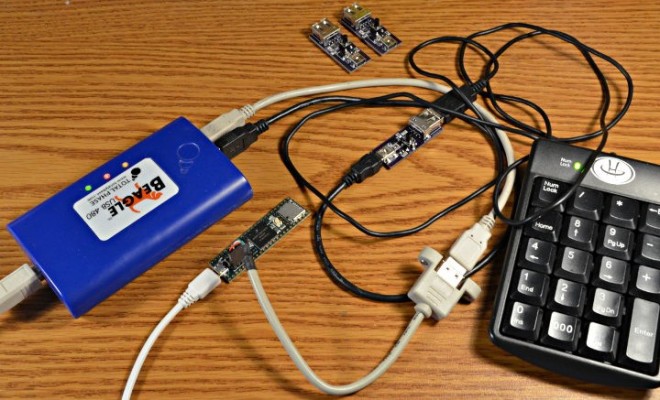
This simple board plugs inline with a USB cable. It always passes the 5V power and normally passes the USB data signals. But when you press the button, the USB data signals are momentarily disconnected.
For the last few months I’ve been developing a USB Host Library for powerful but complex EHCI USB port in Teensy 3.6 [..] Reaching over to physically unplug the USB cable gets old quickly! Really, really old, both hands off my keyboard… right when trying to focus [..] I made this handy little board with a proper USB 2.0 high speed mux chip. The control signal is just 3.3V logic, so I might even wire it up to something to automate the process.
USB Interruptor
Low Pass Filters explained
There comes a time in every electronic designer’s life when, whether they know it or not, they need an analog filter in their design. If you’re coming from a digital background, where everything is nice and numeric, the harsh reality of continuous voltages can be a bit of a shock. But if you’re taking input…
Star Trek Communicator Badge
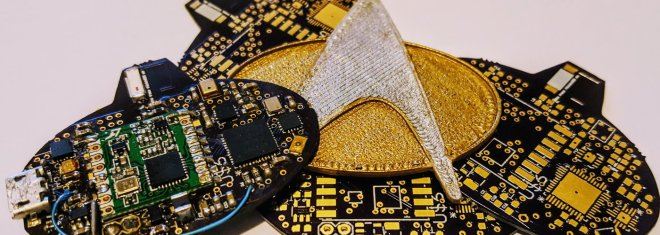
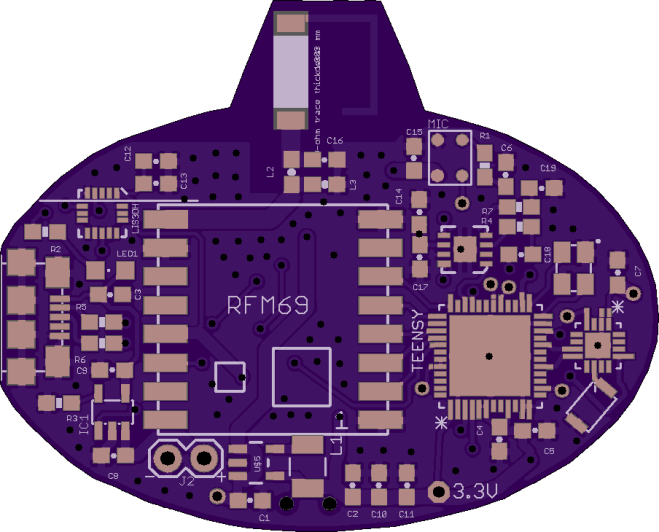
Joe Crop is a creating a real life version of this famous sci-fi device:
Star Trek Communicator Badge
In the true spirit of Star Trek, this communicator badge is completely autonomous, while fitting in the form factor of an original badge
Star Trek was known for dreaming up technology that was deemed nearly impossible given the limitations of the technology for the day. Having a small badge that could send audio across vast distances seemed out of the realm of possibility during the late 1980’s. This project’s aim is to use modern technology to provide nearly all the features of visionary tech, namely:
– Tap to connect and communicate instantly
– Long range (from orbit to planet surface)
– Small form factor (of an original TNG badge)
– Fully autonomous (no cell phone or base station needed)
– No external power source (i.e. battery powered)
joecrop has shared the board on OSH Park:
Star Trek Communicator v2p1
Smaller version of GameBoy Zero
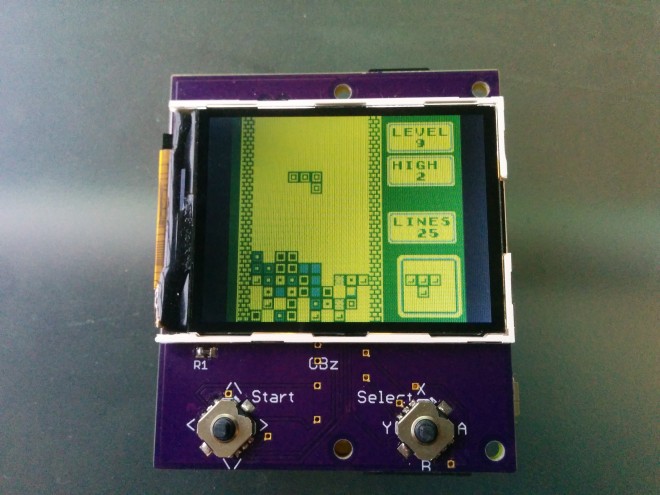
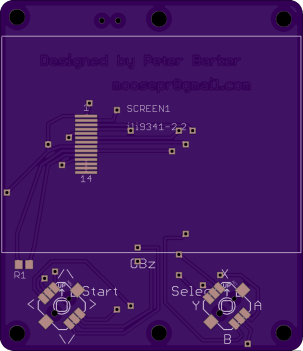
moosepr designed this small and simple GameBoy-style device using the Raspberry Pi Zero:
GameBoy Zero, but smaller!
I’m not overly fond of ‘rats nest’ wires, and I have a bit of an obsession with making things as small as possible, so this is what I came up with.
Tis just an ILI9341 screen, a Pi Zero, 2 navi switches (5 way), and a battery (with charge/protect circuit)
GBz
Here the board is in action:
How does solder work anyways?
I’ve been soldering for a long time, and I take pride in my abilities. I won’t say that I’m the best solder-slinger around, but I’m pretty good at this essential shop skill — at least for through-hole and “traditional” soldering; I haven’t had much practice at SMD stuff yet. I’m confident that I could make a…
Raspberry Pi Zero W desk clock
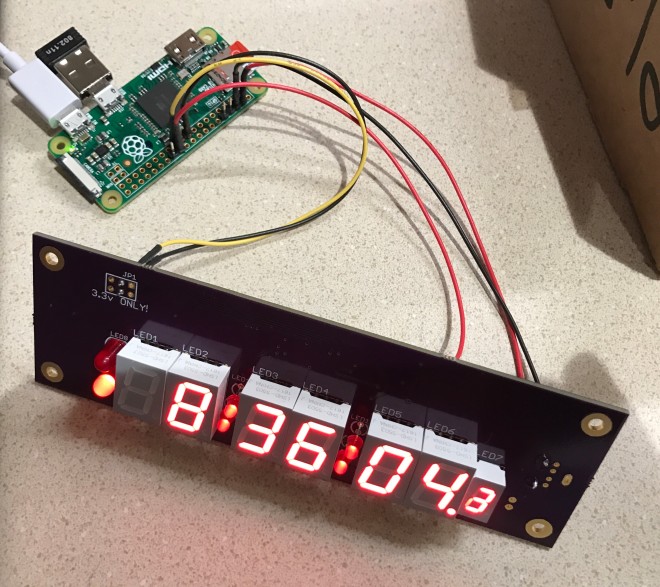
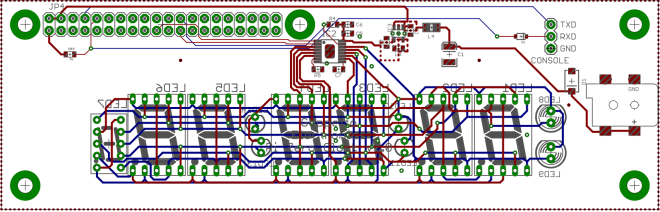
Nick Sayer created a LED desk clock driven by NTP on a Raspberry Pi Zero W:
Raspberry Pi Zero W desk clock
When I was in college, I bought and built a Heathkit GC-1000 WWV clock. Since then, I’ve been somewhat interested in accurate time measurement. I recently designed a GPS driven clock, but sometimes your local WiFi reception is better than GPS (say, indoors). For those circumstances, a clock that gets time from NTP over WiFi would be preferable. The newly released Raspberry Pi Zero W makes this quite a bit simpler to achieve
Midwest RepRap Fest in 2 weeks
Every year, sometime in March, the world’s preeminent 3D printing enthusiasts gather in the middle of nowhere This is MRRF, the Midwest RepRap Festival. It’s only two weeks away. You need to come. Get your (free) tickets here. I’ll be there, and Hackaday is proud to once again sponsor the festival. I need to backtrack a…
via Two Weeks Until The Greatest 3D Printer Meetup On The Planet — Hackaday