
The SF Hardware Startup Meetup is this Wednesday evening in San Francisco:
Look for our Drew Fustini in purple!
Look for our Drew Fustini in purple!

Hackaday and Tindie are on the road in the UK and we want you to grab one of your projects and come hang out! We have three meetups scheduled over the coming week
From Bradley Ramsey on the Tindie blog:
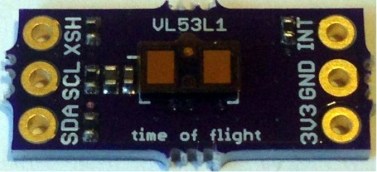
Watching your robotic creation take flight is an incredible feeling, but watching it collide with something or crash can make your stomach turn. One common sensor you may reach for in a case like this is the VL53L0. But it only provides ranging to a distance of 2 meters. For many of us, this is just shy of a range we would be comfortable with.
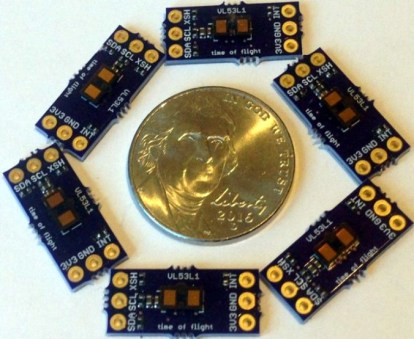
Thankfully, a new sensor has appeared which doubles the range. The VL53L1 extends the accurate distance detection to 4 meters. It also uses a patented ranging technology that harnesses time-of-flight from a 940 nm laser.
This results in estimation independent of surface reflectivity and high accuracy in a variety of weather and environmental conditions. This breakout board sold by Pesky Products is designed to bring out all the best capabilities of the VL53L1 from ST Microelectronics.
AndiceLabs writes about a fixed-wing autopilot project:
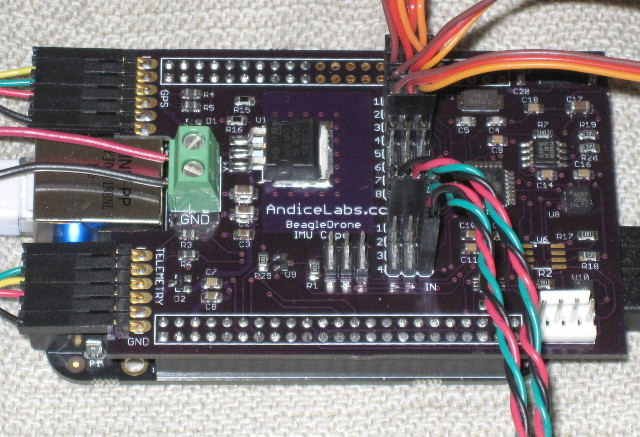
The BeagleDrone is fixed-wing autopilot project based on the BeagleBone and the IMU cape. The IMU cape provides a 3-axis magnetometer, accelerometer, gyro and a barometer on the BeagleBone’s I2C bus. There is also an AVR micro on the I2C bus that handles output pulse timing of the 8 servo channels and input pulse timing on the 4 radio signal channels. Two of the BeagleBone’s UARTs are exposed via FTDI-compatible connectors to allow connection of external modules like GPS and telemetry. It also has a regulator that provides 5VDC for the BeagleBone, AVR, and servos from the RC battery.
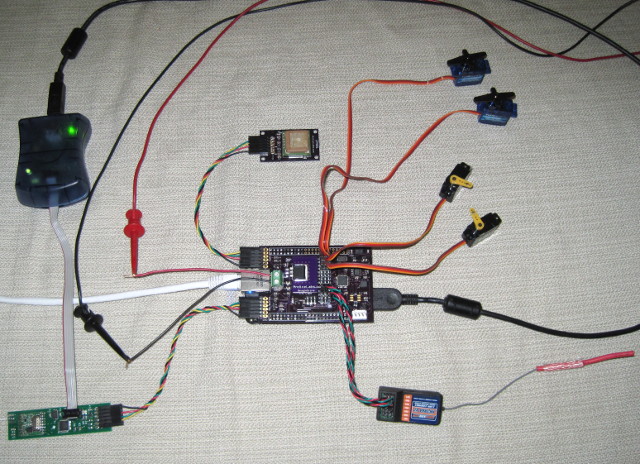
The BeagleBone provides the power of Linux in a footprint that is acceptable for RC and the Black has now made the platform even more affordable. With Linux’s extensive libraries and utilities almost any feature should be quickly realizable and development enjoyable. And unlike an autopilot powered by an 8 or 16 bit micro-controller, there is no need to worry about code and data size or overloading the processor with whatever crazy navigation features you can dream up.
I enjoy flying electric RC planes whenever I get the chance and building a fixed-wing autopilot for the BeagleBone has been on my list for a while now. Of course, there’s no reason that the BeagleBone couldn’t also control a multi-rotor aircraft. A flying Linux box is going to have very few limitations!
#bringahack Bay Area is next month on Maker Faire weekend! Please join us for this wonderful tradition that Jeri Ellsworth started:
Check out last year for some inspiration:
Dan Maloney on the Hackaday blog:
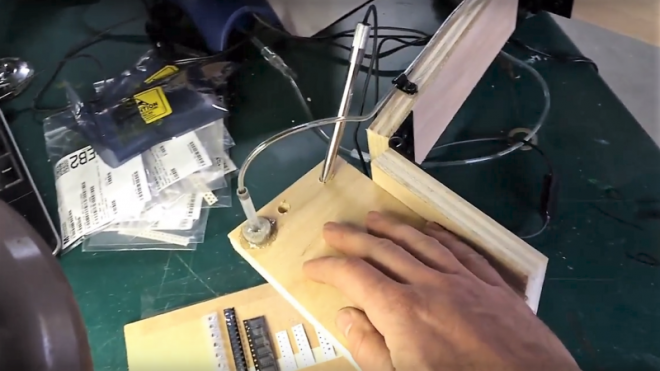
Simple Mechanism Gives Support for SMT Assembly
To fight the shakes, you can do one of two things: remove the human, or improve the human. Unable to justify a pick and place robot for the former, [Tom] opted to build a quick hand support for surface-mount work, and the results are impressive considering it’s built entirely of scrap.
It’s just a three-piece arm with standard butt hinges for joints; mounted so the hinge pins are perpendicular to the work surface and fitted with a horizontal hand rest, it constrains movement to a plane above the PCB. A hole in the hand rest for a small vacuum tip allows [Tom] to pick up a part and place it on the board — he reports that the tackiness of the solder paste is enough to remove the SMD from the tip.
Interested in learning how to design boards in KiCad? Check out this upcoming 1-day class in Reno, Nevada (USA) or watch it online:

We’ve asked Michael Welling of Qwerty Embedded Design to come to Reno to drop some knowledge on KiCad, an open source and multi-platform schematic capture and PCB layout tool. Michael uses KiCad for some of his famous designs such as LoFive, PocketBone, and BaconBits. Space is limited and you should have some basic electronics and CAD skills under your belt already to make the most of this unique opportunity.
This event will be recorded and live-streamed to the GroupGets YouTube channel.

Mary Etta West at SparkFun has remixed Anouk Wipprecht’s Kitty Ear project to make it react to audio:
At the beginning of this year I began prototyping an audio reactive headband to wear in my everyday life, like while dancing with my dog in my lab listening to Legend of Zelda dubstep.
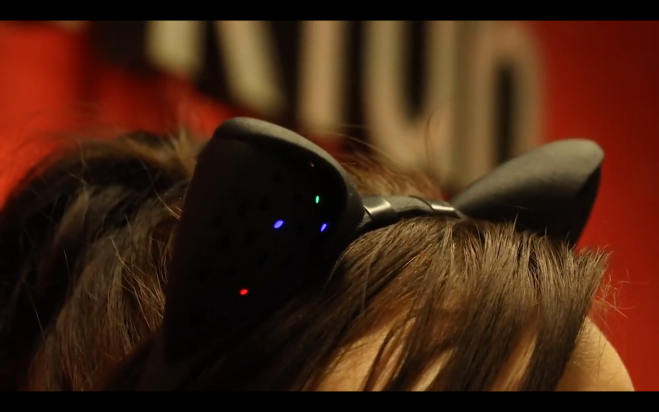
A few weeks ago I saw this post by my favorite Engineer/Maker/FashionTech Designer/Roboticist Anouk Wipprecht – a kitty ears soldering project with 3D-printed headband. I immediately ordered the Electronic Kitty Ears Headband from Shapeways, and after more digging around I found the Instructables tutorial for the kitty ears soldering project. The tutorial includes the BOM, the .stl files for the headband and a link to the OSHPARK shared project.
I downloaded the gerbers and exported the dimension layer as a gerber by itself. Then I imported it to the dimension layer in EagleCAD so I knew I had the same dimensions and my circuit would fit in the Kitty Ears headband. You can see the prototypes in the first picture. In a day I captured the schematic from the original prototype circuit and laid out the PCB design in the Kitty Ears form factor.
The design files and source code are available on GitHub:
From Mike Szczys on the Hackaday blog:
When on the road, we love to stop by a local hackerspace and connect with the hacker community. On Friday, TOG Hackerspace in Dublin, Ireland opened their doors to host a Bring-a-Hack with Hackaday and Tindie.


TOG is a Gaelic word which loosely translates as “to make”. Declan met us for the beer drop and gave us a tour when we returned for the evening event. The building is divided into several different spaces, starting with an entry area that serves as a meeting space, gaming room, and showcase of projects.


From Christopher Wang on the Hackaday blog:

The Open Source Hardware Association is now accepting applications for the Ada Lovelace fellowship which provides free admission to the Open Hardware Summit and a $500 travel stipend. One of OSHWA’s goals is to foster a more diverse community within open source. As part of this, Ada Lovelace Fellowships are open to women, LGBTA+, and people of color. There are a total of 10 fellowships available and applications are due by April 30th. The Open Hardware Summit will be held on September 27th at MIT.

The fellowship program, founded by Addie Wagenknecht and Alicia Gibb in 2013, builds on the ideal that Open Hardware is one way to reduce the barriers associated in access to technology. Removing some of the financial barriers associated with attending the Summit will help to ensure more people of diverse backgrounds are involved in shaping the Open Hardware world. In addition to the talks shared at the gathering, over the last several year OSWHA has been evolving the Open Hardware definition and an Open Hardware certification.


 OSH Park