4CHord MIDI

From Sven Gregori on Hackaday.io:
5817401500854057027.jpg

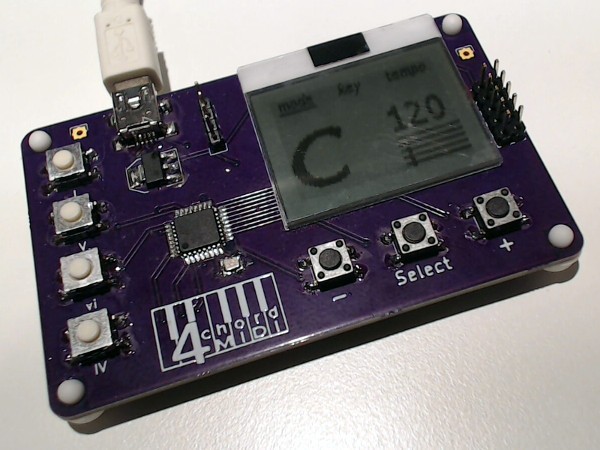
the USB MIDI keyboard dedicated to play all the four chord songs, from Adele via Green Day and Red Hot Chilli Peppers to U2 and Weezer. Thanks to MIDI, you can be any instrument – and all of them at once. Yay!
 Built around an AVR ATmega328 and Objective Development’s V-USB library, 4chord MIDI acts as a regular USB MIDI instrument. It supports playback in every key and five different playback modes:
  • simple triad chord (root, third, fifth)
  • triad chord + third + fifth + third as quarter notes
  • triad chord + third + fifth + octave as quarter notes
  • root note + third + fifth + third as quarter notes
  • root note + third + fifth + octave as quarter notes

The playback tempo can be set between 60 and 240 bpm.

Here is the board in action:

The design files and source code are available on GitHub:
sgreg/4chord-midi

4CHord MIDI

Hackaday Prize Entry: USB Packet Snooping

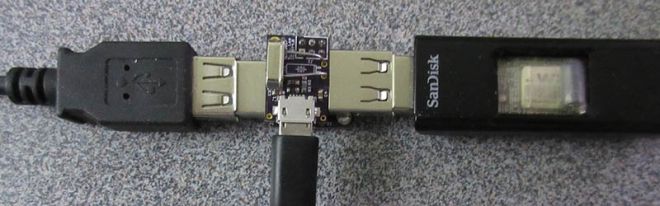
Sometimes you run into a few problems when developing your own hardware, and to solve these problems you have to build your own tools. This is exactly how [KC Lee]’s USB Packet Snooper was created. It’s a small device that allows for capturing and analyzing Full Speed USB traffic to debug one of [KC]’s other Hackaday…

via Hackaday Prize Entry: USB Packet Snooping — Hackaday

Hackaday Prize Entry: USB Packet Snooping

SSD1306 1.3″ OLED SPI breakout board

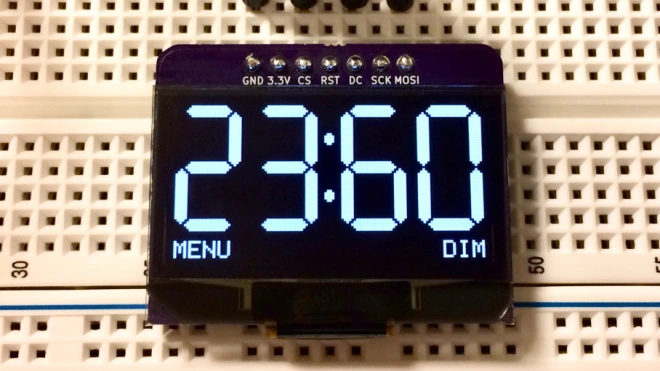
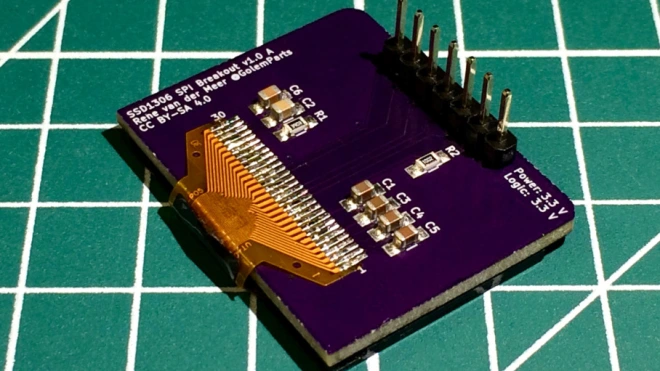
Rene van der Meer designed this breakout board for a bare OLED display:

ssd1306-10a-disp.jpg

SSD1306 1.3″ OLED SPI breakout board

I’ve been playing with cheap OLED display breakouts for years, incorporating complete boards into my projects – an easy, but bulky solution. Now that I’ve had some practice designing circuits and PCBs, it’s time for my next challenge: soldering the display FPCs directly to my own boards.

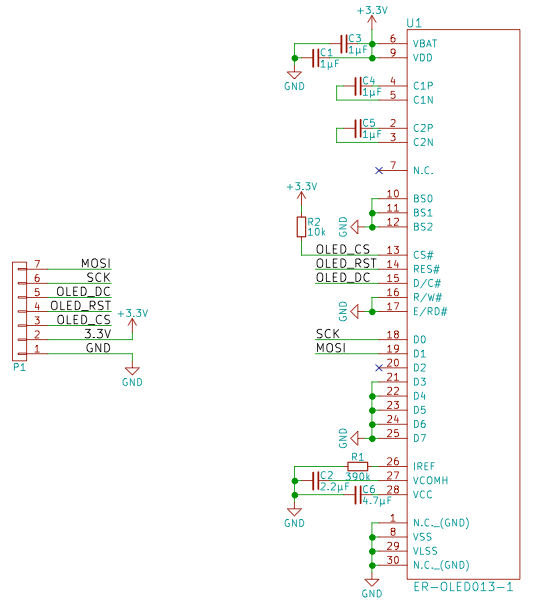
ssd1306spi-10a-sch

I designed this board to try out a minimal circuit before integrating it into any larger projects, and to figure out the best way to solder flexible circuits to my boards. Since all of my new microcontroller-powered board designs only require 3.3 V, I haven’t added any 5 V tolerant level shifting. What’s left is a bare minimum circuit to drive a Solomon Systech SSD1306 using SPI at 3.3 V.

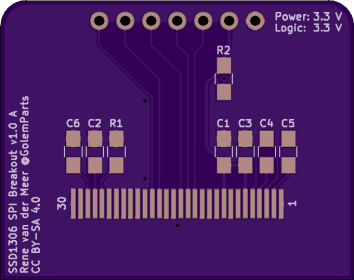
ssd1306-10a-back

golemparts has shared the board on OSH Park:

SSD1306 SPI Breakout v1.0 A

15d3c74ba0338db3d3a4469e58673f9b
Order from OSH Park

SSD1306 1.3″ OLED SPI breakout board

Raspberry Pi Soft Power Controller

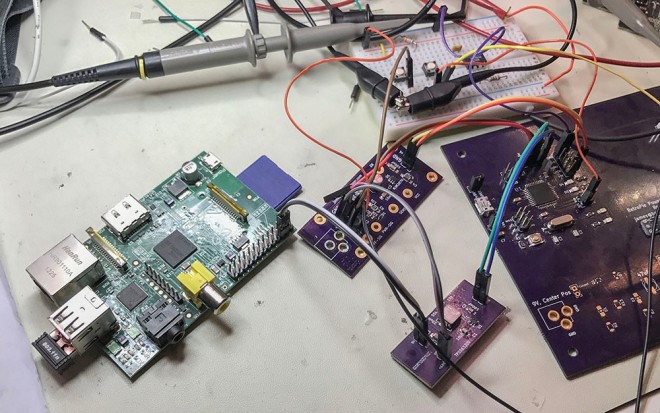
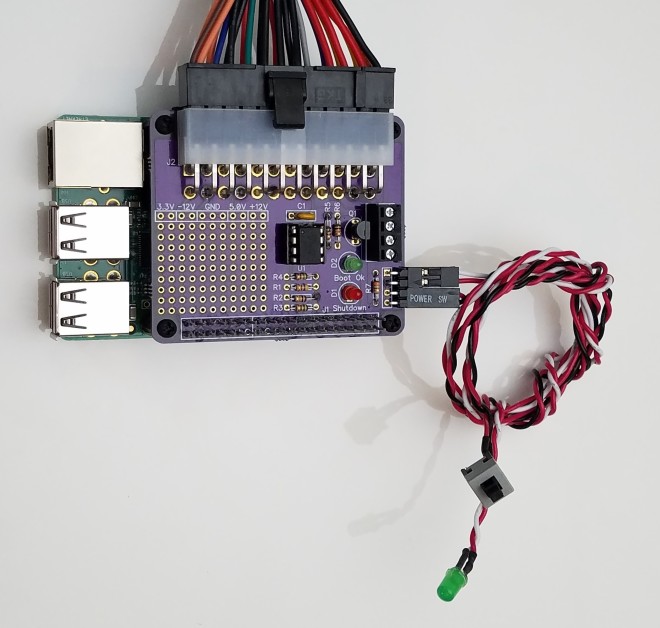
James Lewis designed this AVR based power controller for the Raspberry Pi that can safely shutdown the Pi:

6549371493595134727

Raspberry Pi Soft Power Controller

The total circuit includes an AVR microcontroller, a near-zero current LDO, and a switching (buck) supply. My current design draws about 350nA when Vin is 9V. The AVR controls power to the Raspberry Pi. Two GPIO pins are used. One for the AVR to initiate a shutdown and one for Raspberry Pi to tell AVR after filesystem has been unmounted.
The design files and source are shared on GitHub:

baldengineer/Raspberry-Pi-Soft-Power-Controller

Raspberry Pi Soft Power Controller

Automated Pool Controller

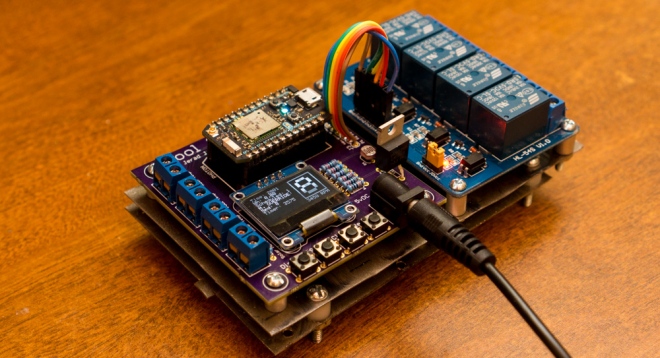
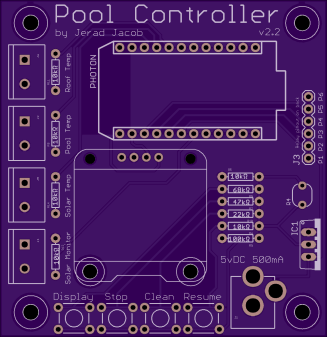
Jerad Jacob designed this board to monitor and control a swimming pool:

pool_controller.jpg

Here-Be-Dragons/Pool-Controller

Cloud-based pump speed, solar collector controls, and temperature monitoring for your pool with SmartThings and Alexa integration

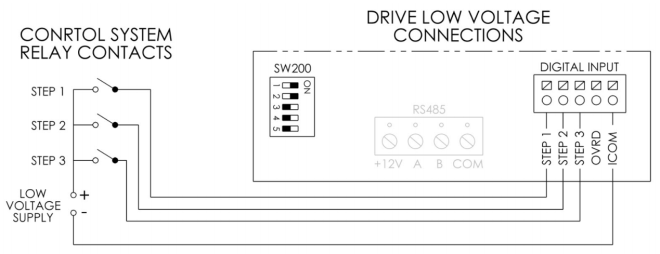
Timer Control of a Hayward Tristar VS Pump and Hayward GL-235 Solar Pool Controller

Tristar_VS_Relay_Wiring

osmosis has shared the project on OSH Park:

Pool Controller v2.2

7bab38e474b55dd8cd763149769d444f.png
Order from OSH Park

Automated Pool Controller

Game Gear HDMI with SNES Controller

From on the Hackaday log:
BhOyW7P

Game Gear HDMI with SNES Controller

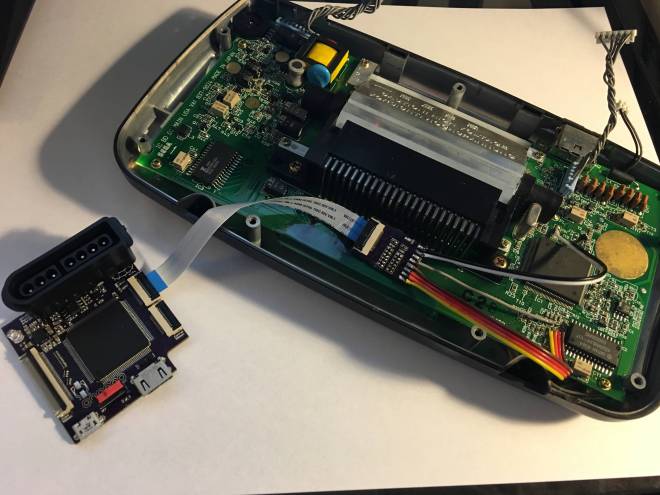
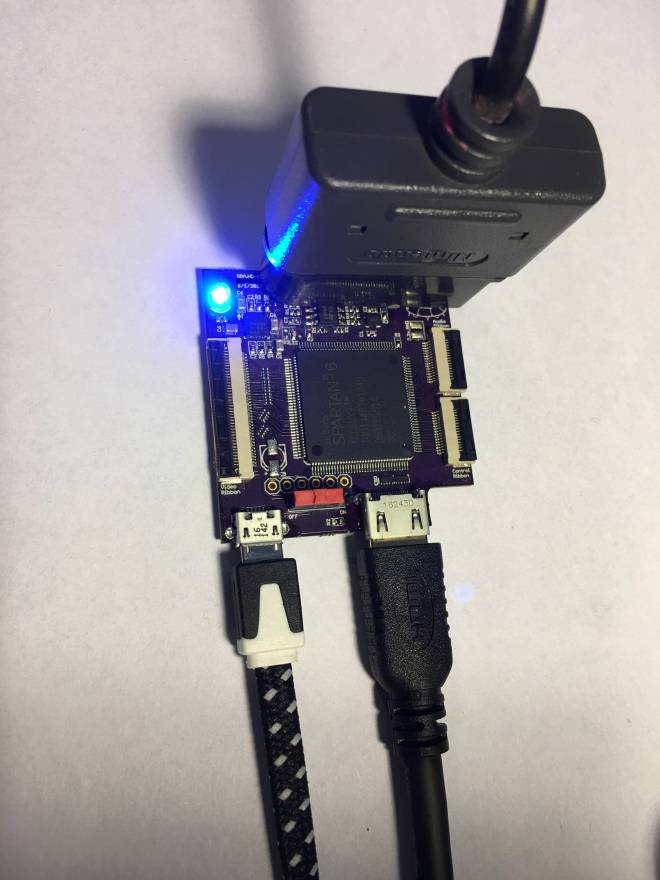
With its backlit color screen and Master System compatibility, the Game Gear was years ahead of its main competition. The major downside was that it tore through alkaline batteries quickly, and for that reason the cheaper but less equipped Game Boy was still able to compete.  Since we live in the future, however, the Game Gear has received new life with many modifications that address its shortcomings, including this latest one that adds an HDMI output.

tf6Skxn
Here is a video of it in action:

Very early prototype using my GBA HDMI board to get a 1280x720p output from the Game Gear.

The custom PCB uses a Spartan6 FPGA to convert the Game Gear’s 160×144 12-bit RGB video into a 1280x720p HDMI output using a 4x integer scale. HDMI video is generated directly from the FPGA, audio is taken from the Game Gear’s headphone jack.

It has some pixel glitches, but it could be due to the wiring as it’s very sensitive to positioning. The Game Gear was bought as a “broken” unit and is in need of a cap replacement, that could also be causing issues.

Game Gear HDMI with SNES Controller

Hackaday Prize Entry: BeagleLogic

A few years ago, [Kumar] created the BeagleLogic, a 14-channel, 100 MSPS logic analyzer for the BeagleBone as an entry for the Hackaday Prize. This is a fantastic tool that takes advantage of the PRUs in the BeagleBone to give anyone with a BeagleBone a very capable logic analyzer for not much cash. This year,…

via Hackaday Prize Entry: BeagleLogic — Hackaday

Hackaday Prize Entry: BeagleLogic

Health-Monitoring Flexible Smartwatch

Hackaday Prize Entry: Health-Monitoring Flexible Smartwatch

[Nick Ames]’s Flexible Smartwatch project aims to create an Open Source smartwatch made out of a flexible, capacitive e-ink touchscreen that uses the whole surface of the band. This wraparound smartwatch displays information from the on-board pulse and blood oximetry sensor as well as the accelerometer and magnetometer, giving you a clear idea of how stressed…


Health-Monitoring Flexible Smartwatch