Flash Memory Adapter for Game Boy

J.Rodrigo created this adapter board make it easier to flash a Game Boy cartridge:
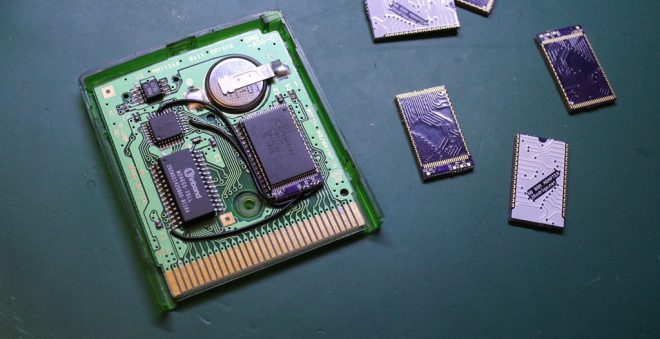
gb-rom-adapter-assem-1024x527.jpg

Flash Memory Adapter for some Game Boy Cartridges

You only need to solder 3 or 4 wires and the adapter board to an old cartridge, PCB adapter boards are manufactured on OSH park to ensure the best quality of castellations.

Compatible Cartridges:

  • DMG-A02-01: MBC5 + ROM (256/512/1024 KB) + RAM (32KB) + Battery
  • DMG-A06-01: MBC5 + ROM (256/512/1024 KB) + RAM (8KB) + Battery
  • DMG-A07-01: MBC5 + ROM (256/512/1024 KB)

JRodrigo has shared the board on OSH Park:

Flash Memory Adapter for Game Boy
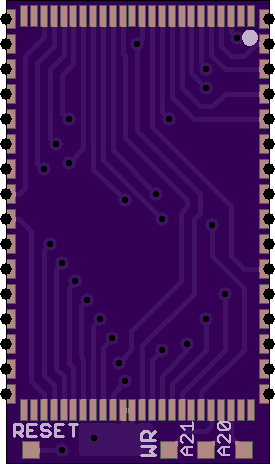
0613821c47efa791b2c0c99f02209886.png

Order from OSH Park

Flash Memory Adapter for Game Boy
E-Paper Breakout Board for Teensy

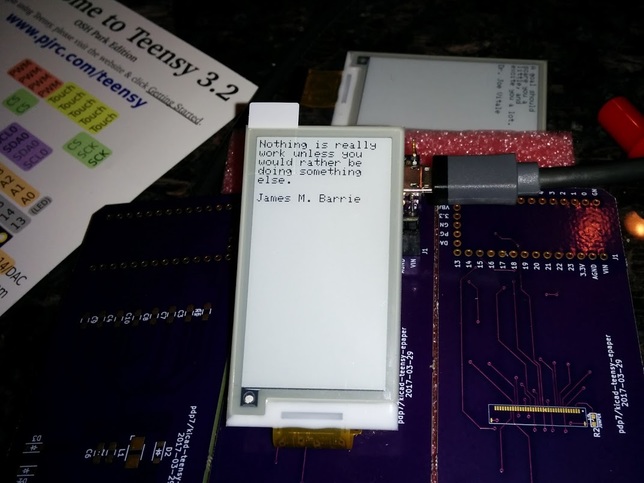
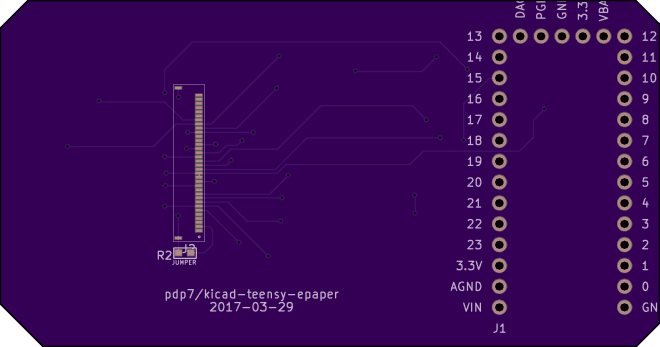
Breakout board designed in KiCad to connect Pervasive Displays 2.15″ E-Paper (E2215CS062) to Teensy 3.2 or Teensy LC. Based Teensy E-Paper Shield by Jarek Lupinski in EAGLE.

My goal is to create a name badge I can wear at conferences and Maker Faires. This was first step to verify the KiCad schematic and KiCad footprints work. I will post more information as the badge project progresses.

epaper-breakout-board-quotes

KiCad PCB design files:

The board is shared on OSH Park:

E-Paper Breakout Board for Teensy

e6ef9d2b1cc84fac4e40f451fcf6f188.png

Order from OSH Park

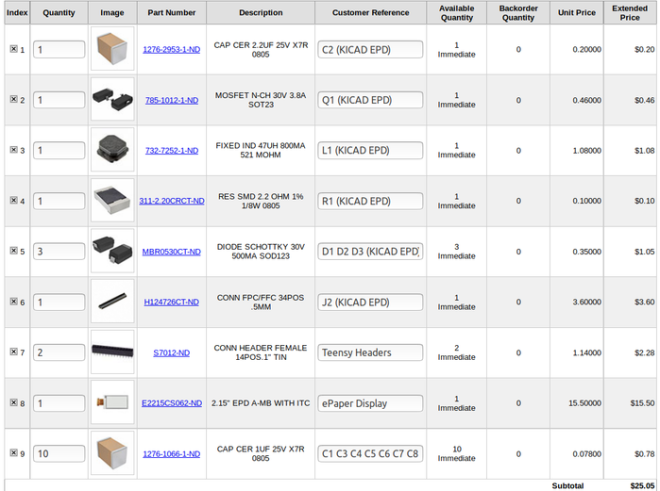
Bill of Materials (BoM)

kicad-epaper-digikey-bom.png

Source Code

  • uses EPD215 Arduino Library by Jarek Lupinski for his E-paper Teensy Shield
  • requires pinout modification:

Photos

Video

Related: Jarek’s ePaper Teensy shield

E-Paper Breakout Board for Teensy

Rotary Encoder Breakout with Pull-up Resistors

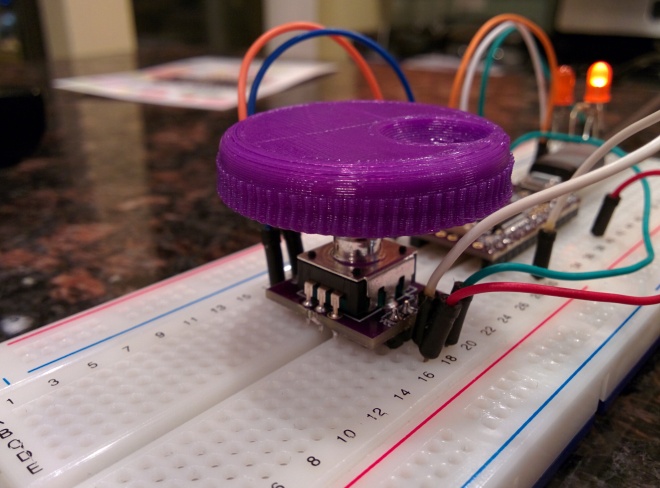
rotary1.jpg

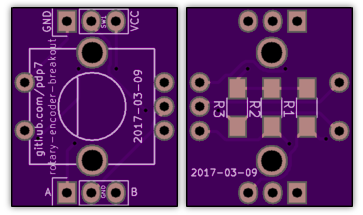
This breakout board designed in KiCad makes it easy to put a rotary encoder and pull-up resistors on a breadboard.  (Thanks to Enrico for the idea to add pull-up resistors).  The footprints on the back are meant for 1206 SMD resistors.  I choose 1K Ohm resistors, marked 102, when I assembled this board.

Additional photos are available in the GitHub repo’s images directory and in a Google Photos gallery.

Here is the OSH Park shared project for the board:

Rotary Encoder Breakout with Pull-ups

Screenshot from 2017-04-04 15-55-27

Order from OSH Park

The KiCad design files are available on GitHub:

github-smallpdp7/rotary-encoder-breakout

white

I used this KiCad symbol and footprint by Mike Cousins for a Sparkfun rotary encoder:

github-smallmcous/kicad-lib

white

I’ve verified that these rotary encoders fit:

I wrote this Arduino sketch to run on the Teensy 3.2.  The brightness of one LED is controlled by the rotary encoder knob.  The other LED is turns on when the rotary encoder knob is pressed down:

arduino-smallrotary-encoder-test.ino

white

Here’s a video of the breakout board being used with a Bourns PEC12R-4220F-S0024 and Teensy 3.2:

Rotary Encoder Breakout with Pull-up Resistors

Trixel Interactive LED Kit

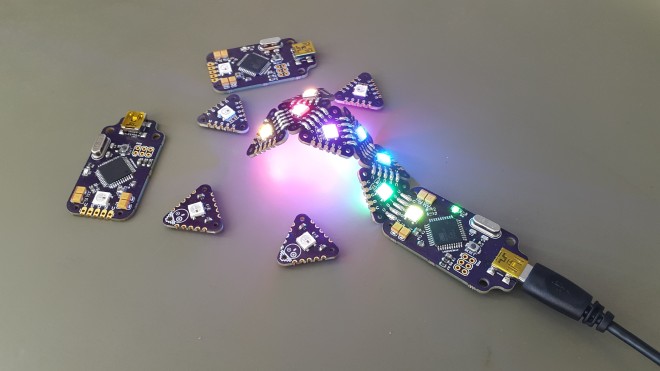
Arkadi designed this interactive LED kit:

3263321490102022951

Trixel LED

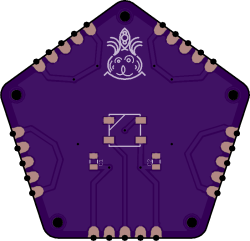
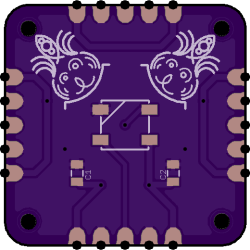
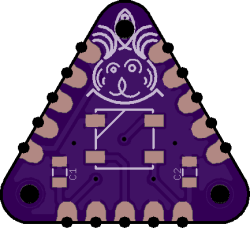
Create your own interactive Light elements by soldering basic shapes, such as triangle, square, pentagon and hexagon to create an interactive LED sculpture.

Here’s a video of the Trixel LED boards in action:

The design files are available on GitHub:

arkadiraf/Trixel-LED


Arkadi_Raf has shared the boards on OSH Park:

Pentagon LED

641630815d5e6e1b0f7b567d8651fd64
Order from OSH Park

Square LED

82acd583478babc1a95286aae403e16f
Order from OSH Park

Triangle LED

8eebfc9b5c3a92cc622943396c308e88
Order from OSH Park

Trixel Interactive LED Kit

SoundBeacon

Patrick Van Oosterwijck created an audio BLE beacon that can be activated by the vision impaired to find exact locations of doorways, bus stops, crosswalks, and more:

6274831490293880487.jpg

SoundBeacon

The idea is that a blind person uses a navigation app, and can query to see “what is around”. In the list of beacons that are around, they can tap the one they want to know the location of and it will start to produce an audible signal for a short time.

The BLE module is configured as an iBeacon and allows connections. It has a battery service and an “Immediate Alert” (AKA “Find me”) service.

Patrick used the following to build the prototype:

  • A 550 mAh 3.2 V LiFePO4 cell
  • A #LiFePO4wered/Solar1 prototype to charge the battery
  • A 5.5V, 0.6W monocrystalline solar cell
  • A Silicon Labs (formerly BlueGiga) BLE113 module
  • A beeper that works very badly (better solution needed)
  • And a IP65 enclosure

xorbit has shared the booster for loud piezo beeper on OSH Park:

PiezoBoost

99dbad4f53194c84dfc1cb673fa18158

Order from OSH Park

SoundBeacon

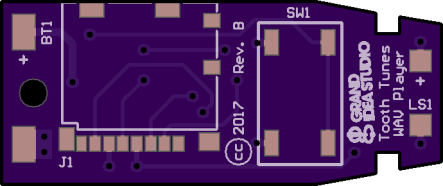
Musical Toothbrush by Joe Grand

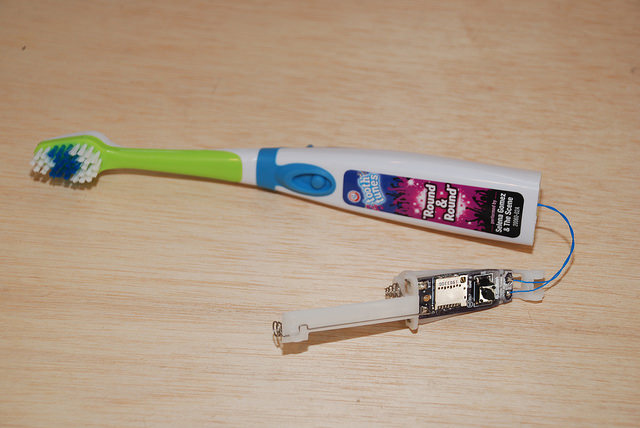
Hackaday wrote about a nifty hack by Joe Grand:

33584362176_d159e08108_z

[Joe Grand’s] Toothbrush Plays Music That Doesn’t Suck

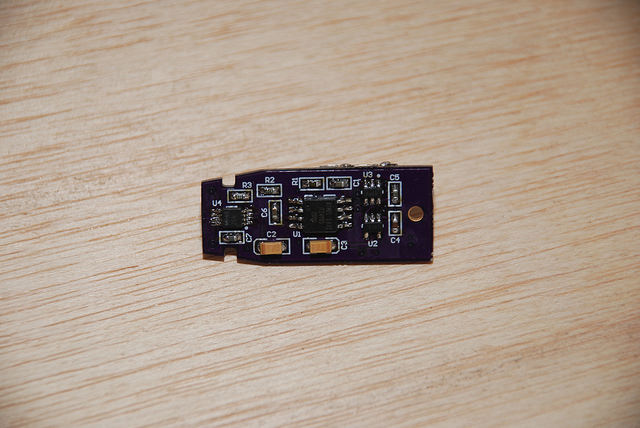
It’s not too exciting that [Joe Grand] has a toothbrush that plays music inside your head. That’s actually a trick that the manufacturer pulled off. It’s that [Joe] gave his toothbrush an SD card slot for music that doesn’t suck. The victim donor hardware for this project is a toothbrush meant for kids called Tooth Tunes.…

33584363126_442705bc93_z

Joe published full documentation for the project on his website:

The PCB is shared on OSH Park:

Tooth Tunes Hack

5fc6751cdeff95ffbd5f0f956553f2c7
Order from OSH Park

Joe describes the project in this video:

Hear the toothbrush in action:

Musical Toothbrush by Joe Grand

Creating the Benchoff Nickel

Screenshot from 2017-03-23 13-54-53.png

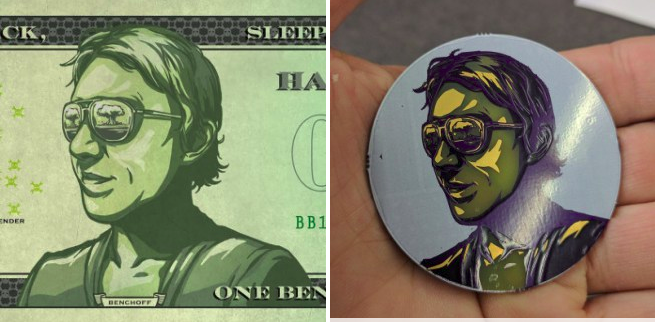
Andrew Sowa writes about the PCB he designed in KiCad to surprise Brian Benchoff last weekend at the Hackaday Unconference in Chicago:

Creating the Benchoff Nickel

I thought of making the Benchoff nickel after I saw Brian’s Hackaday,io profile. He has a hi-res image of the center a Benchoff Buck which is well suited to being converted to a PCB. There is only a few colors and they have sharp edges. Bitmap2Component in Kicad, can easily detect these transitions and convert them into a footprint file. With the help of a text editor, I was able to manually layer everything into one complete image.


The KiCad design files are available on GitHub:

screenshot-at-2017-02-14-20-58-40Junes-PhD/Benchoff-Nickel


Junes-PhD has shared the project on OSH Park:

Benchoff Nickel

b990e15b3b0bff6615d77bda90d22716

Order from OSH Park

Creating the Benchoff Nickel

14-bit 80MSPS ADC for SDR experiments

Eric Brombaugh designed this ADC board for RF signals:

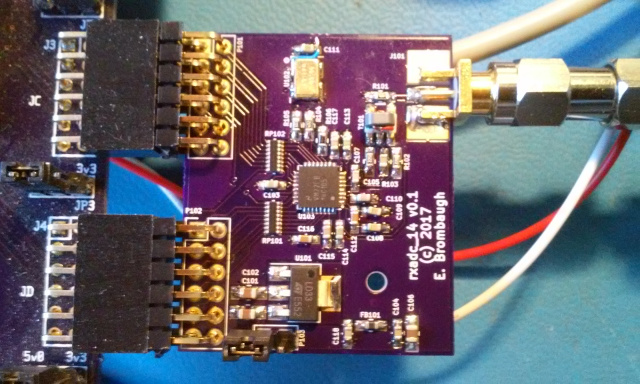
rxadc14.jpg

RXADC_14 Pmod

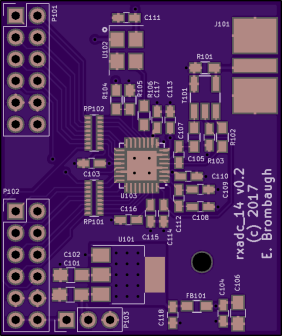
This is an ADC designed for use in digitizing RF signals with up to 40MHz bandwidth and 80dB SNR. The form-factor is compatible with a dual-connector Digilent Pmod so that it can be used with commonly available FPGA development boards to build a variety Software-Defined radio functions.

Features:

  • ADC14C105 14-bit 105MSPS RXADC.
  • Onboard 3.3V Regulator (5V input)
  • Filtered Analog 3.3V Supply
  • Onboard 80MHz clock oscillator
  • Digilent-compatible 2-connector Pmod interface
  • 50-ohm SMA input – 2.5Vpp ~= 0dBfs

emeb has shared the board on OSH Park:

14-bit 80MSPS ADC for SDR experiments

831aa0bd88f188310e6a04a187a105ae
Order from OSH Park

14-bit 80MSPS ADC for SDR experiments

Hall Sensor Preamp

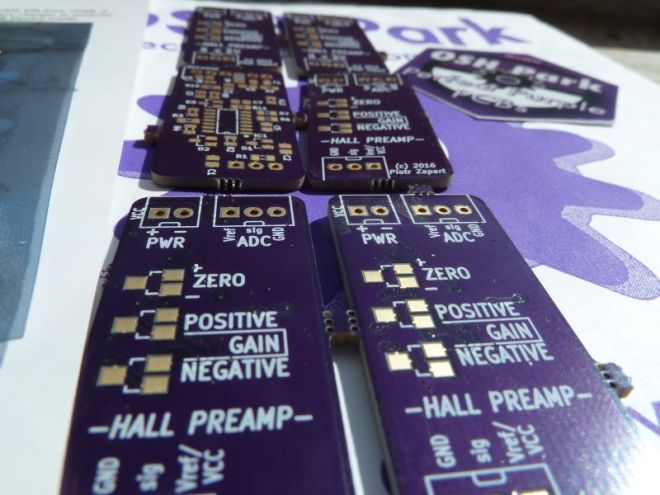
Piotr Zapart designed this board to overcome range issues when using traditional 300 degree potentiometers or Hall sensors as rotational angle to voltage converters:

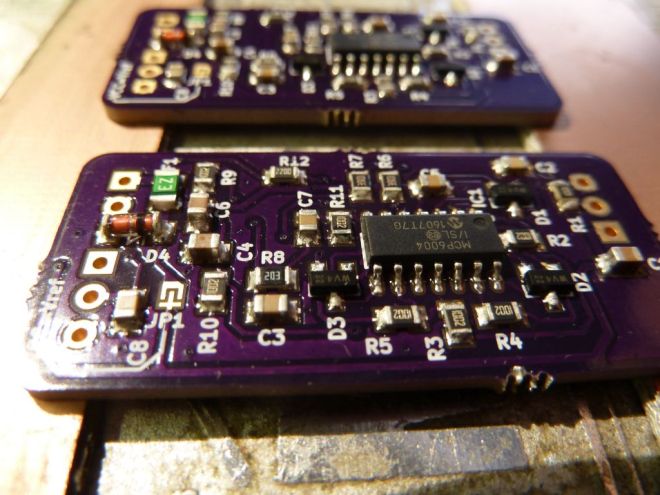
hpre4

HALL Preamp/Analog axis calibrator

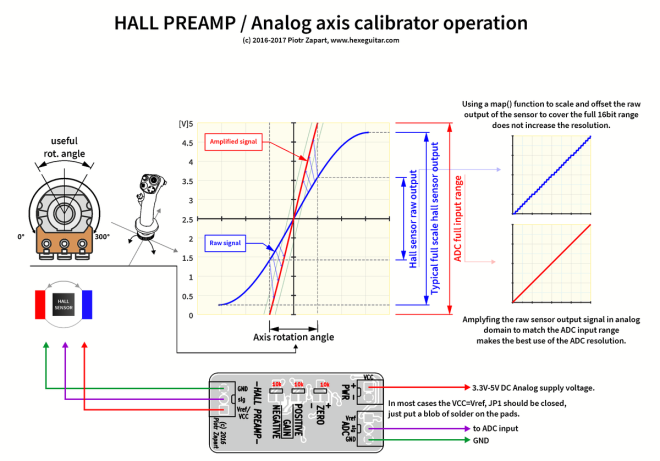
The idea was to create a device that will perform an axis calibration, usually done in digital domain, but before sampling the signal in the ADC, still in analog domain, using it’s advantageous infinite resolution

 HappPre_operation.png

the main function of this device is to:

  • Buffer the analog output signal coming from a potentiometer or another rotary angle to voltage converter like ie. Hall sensors.
  • Filter out the high band noise and limit the bandwidth to an usable range only, protect the input against voltage spikes.
  • Match the output voltage range of the source (pot/hall sensor) with the input range of the ADC, thus making the most of the available ADC resolution.
  • Linearize the hall sensor output signal response by amplyfing it’s most linear region to the full scale ADC input range.

The board is shared on OSH Park:

HALL Preamp

hpre2.jpgOrder from OSH Park

Hall Sensor Preamp