Competitive Soldering is Now a Thing

At Hackaday, we’re constantly impressed by the skill and technique that goes into soldering up some homebrew creations. We’re not just talking about hand-soldering 80-pin QFNs without a stencil, either: there are people building charlieplexed LED arrays out of bare copper wire, and using Kynar wire for mechanical stability. There are some very, very talented people out there, and they all work in the medium of wire, heat, and flux.

At this year’s DEF CON, we opened the floodgates to competitive soldering. Along with [Bunny] from Hardware Hacking Village and the many volunteers from the HHV and Soldering Skills Village, dozens competed to solder up a tiny kit full of LEDs and microscopic resistors.

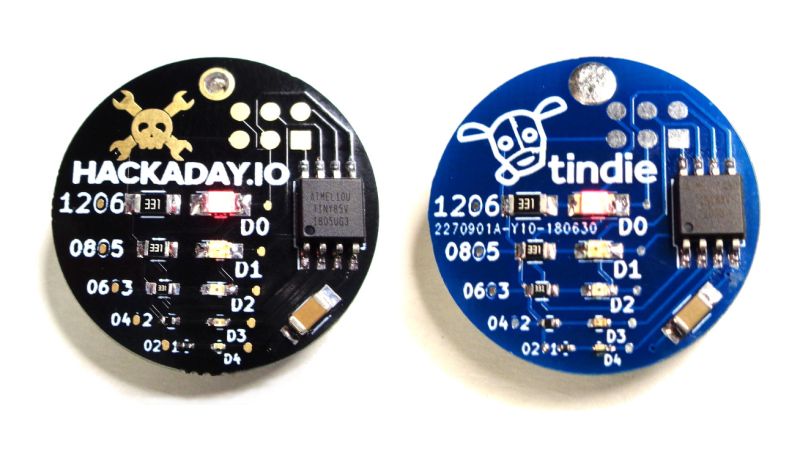
The kit in question was an SMD Challenge Kit put together my MakersBox, and consisted of a small PCB, an SOIC-8 ATtiny, and a LED and resistor for 1206, 0805, 0603, 0402, and 0201 sizes. The contest is done in rounds. Six challengers compete at a time, and everyone is given 35 minutes to complete the kit.

via Competitive Soldering is Now a Thing — Hackaday

Quote

PewPew: Python-based micro game console

From Radomir Dopieralski (ꝺeshipu) on Hackaday.io:

538041535059272195 (1)

PewPew Standalone

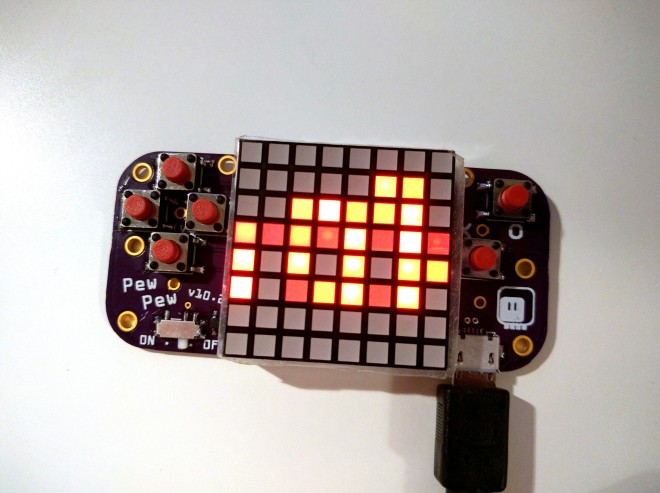
A Python-based micro game console, optimized for game development workshops.

I really like the #PewPew FeatherWing as a platform for teaching game development, but the cost of Feather boards needed to use it makes it difficult to organize workshops for larger groups of people. I have previously tried to work around that problem by merging the FeatherWing with the schematic stolen from a Trinket M0 (with an additional flash memory), but the resulting design was complex, difficult to make and still a bit expensive. Now after having designed a few more CircuitPython boards I think I can really cut the costs and make a standalone device with all the functionality of the original shield, but optimized for workshops.

PewPew: Python-based micro game console

E-Paper Badge is a Hint at Great Things to Come

From All the Badges of DEF CON 26 (vol 3) on Hackaday:

36-epaper-hackaday-shoutout

E-Paper Badge is a Hint at Great Things to Come

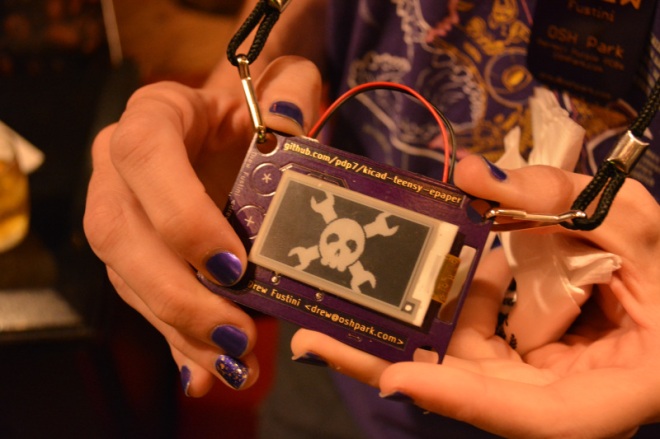
Friend of Hackaday, Drew Fustini, came to our Breakfast at DEF CON meetup sporting a name badge of his own design. The E-Paper Badge uses a Teensy LC to drive a 2.15″ E-Paper display. The row of capacitive touch buttons to the left allow the image to be changed, and he just happened to have the Jolly Wrencher in the gallery of choices for this picture.

This badge gets me really excited for this year’s Open Hardware Summit which is at MIT on September 27th. This year’s badge is a collaborative effort between a group on Hackaday.io! It’s basically Drew’s badge on steroids, and he told me the experience of working with a team has been really positive. It seems each time the group hits a hard problem or a pile of work that needs to be done, someone on the team grabs it and runs with it. It’s a great example of both certified open hardware and team development.

Quote

New Charmware PCBs by Alex Glow

Screenshot from 2018-08-29 13-45-30.png
Alex Glow from Hackster posted an update on the Charmware modular tech jewelry system:

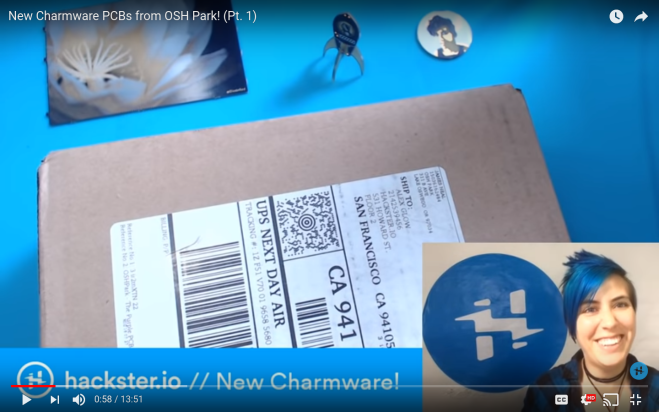
New Charmware PCBs from OSH Park! (Pt. 1)

Sweet, a package from OSH Park! Time for an unboxing! Plus, see how to upload and order your own boards.

New Charmware PCBs from OSH Park! (Pt. 2)

Visit Hackster.io for more information on the project:

Charmware // Modular Tech Jewelry System

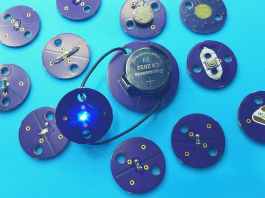
These mini PCB beads (PCBeads?) help you build wearable electronic circuits!

copy_of_workshop_O5TD9874Qs
New Charmware PCBs by Alex Glow

Retro CPC Dongle: advise on tented vias

Advice from the Intelligent Toasters blog on how to do tented vias in DesignSpark PCB software:

Retro CPC Dongle – Part 37

Tented Vias – who’d have thought they play such an essential role? If you have no idea what tented vias are, then you’re not alone and I’m here to enlighten you.


Quote

‘Teach Kids Coding’ with a 3D Printed ‘Code Kitty’

Jason from CodeKitty wrote the Adafruit blog to tell them what the organization is up to:


‘Teach Kids Coding’ with a #3DPrinted ‘Code Kitty’ & OSH Park PCB

Hello! We are a Twin Cities, Minnesota (USA) based technology
education 501(c)(3) tax-exempt non-profit. Our mission is to make coding
and engineering skills accessible to everyone (especially targeting girls
and underrepresented groups) by providing donation-funded (or free) coding
workshops using our extremely low cost 3D printed robot. Our workshop is a
$50 suggested donation per attendee and includes the robot, so that Every
Kid Gets a Robot. So far we have given away around 100 robots in this
fashion, and provided our workshop for both students as young as second
grade, and for teachers as Professional Development (in a meta-workshop
train-the-trainer model).

We are constantly working to simplify our robot, and the currently released
model is based around your excellent Trinket m0 board, a custom designed
(oshpark fabricated) breakout board, and 360 degree microservos). The
challenge we have as a very small non-profit is that I design and
manufacture all of the robot kits by hand myself, including reflow and hand
soldering all of the breakout boards. Although the Trinket m0 is very low
cost, the time and materials cost of self-manufacturing our trinket breakout
board raises our costs substantially, and our total cost of this model of
our robot is $27.54, not factoring in any cost or value at all for the
considerable amount of time i spend making them.

There’s a v1.0 of their ‘bot and a recently updated v2 with OSH Park purple PCBs provided here and instructions online:

The Code Kitty robot is a 3D printed robot designed to help teach kids coding. It was developed by the Code Kitty non-profit because we wanted there to be a robot cheap enough for every kid to have one and learn the joy of engineering, coding, and robotics! We offer the robot to participants of our workshop, or sell complete robot kits under a “buy one/give one” program for $50.

Although the 3D printed parts of the robot are the same, there are two “builds” of the electronics of the robot: The “Workshop Build” and the “DIY Build”. In either case you will need to print one base, one face, one tail, two wheels and two hubcaps. We recommend combining all of the parts you want to be the same color into one print job, and the parts are small enough that the entire robot can be printed in two print jobs on most 3D printers.

They’re doing great things and you can always check out what they’re up to here.

‘Teach Kids Coding’ with a 3D Printed ‘Code Kitty’

This Is Your Last Chance To Design The Greatest Human Computer Interface

This is your last chance to get your project together for the Human Computer Interface Challenge in this year’s Hackaday Prize. We’re looking for innovative interfaces for humans to talk to machines or machines to talk to humans. These are projects that make technology more intuitive, more fun, and a more natural activity. This is your time to shine, and we’re accepting entries in the Human Computer Interface Challenge in this year’s Hackaday Prize until August 27th. This is your last weekend to work on your project, folks.

via This Is Your Last Chance To Design The Greatest Human Computer Interface

Quote

DC26: overview of the DC503 party badge

From Nisha Kumar:
DjT3Kg5VsAAS8bW
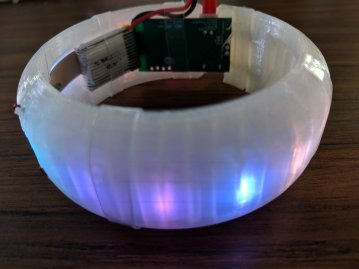
An overview of the DC503 party badge as seen at DefCon 2018

Hi! My name is Nisha, and I made a party bangle for my friend, Miki, to take with her to DefCon25. It was my first fully-formed electronics project and it posed some interesting challenges due to its unusual form factor. You can read about my experiences with that project here.

Soon after DefCon25, I was approached by r00tkillah to make over a 100 of something similar for the DC503 party at DefCon26. The plan was to combine the power of the BMD-300 SoC by Rigado used in the Wagon Badge from the previous year with my Neopixel bangle form factor. We would call it “The Banglet” and it was going to be awesome.

banglet_shell_500

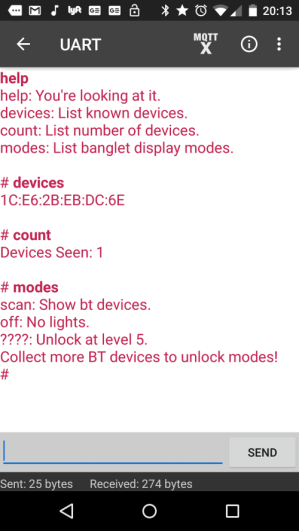
In passive mode, the banglet’s LEDs light up when detecting nearby Bluetooth devices. The number of LEDs that are lit correspond to the number of BT devices detected and their colors are based on each device’s mac address.

DC26: overview of the DC503 party badge