2018 Hackaday Prize: Build Hope. Design the Future

Every year we are inspired by the projects entered into the Hackaday Prize, and we are excited that the 2018 Hackaday Prize season has begun:

This is our global engineering initiative with huge prizes for those hackers, designers, and engineers who want to use their skill and energy to build something that matters. This year, we challenge you to Build Hope. Show the world the amazing ways technology enriches humanity, and that its benefits can be shared by all. There is over $200,000 in cash prizes headed to the most interesting hardware builds of the year. With plenty of room for great ideas, the top 100 entries will each receive a $1,000 cash prize and continue

Have you entered a project into 2018 Hackaday Prize?


2018 Hackaday Prize: Build Hope. Design the Future

The Amazing Hacks Of World Create Day

For this year’s Hackaday Prize, we started an amazing experiment. World Create Day organized hundreds of hackerspaces around the world to come together and Build Hope for the future. This was an experiment to bring community shops and workspaces together to prototype their entries for the Hackaday Prize, and boy was it a success. We had hackerspaces…

via The Amazing Hacks Of World Create Day — Hackaday

The Amazing Hacks Of World Create Day

Intro to KiCad with Shawn Hymel

Digi-Key presents An Intro to KiCad – Part 1: How PCBs Are Made with Shawn Hymel:

Digi-Key Electronics presents: An introduction to KiCad with engineering superhero Shawn Hymel. In the first part of this series Shawn discusses how PCBs are made and the benefits of utilizing KiCad as a design tool. KiCad is a free and open source platform which makes it great for learning how to make your own PCBs while still being powerful enough to do more complicated design work.

Resources:

Intro to KiCad with Shawn Hymel

Estimated Time of Arrival (ETA) Nixie Tube Clock

From Mark Smith on the Surf ‘n Circuits blog:

4f9e07f8-8527-4256-bd58-c69a521f223c-4140-0000071679b34fd1_file-e1522612873965

What is an ETA Nixie Tube Clock and How Do You Build One?

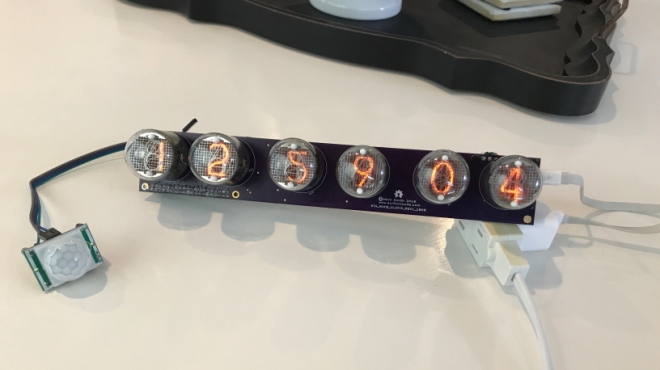
Adding IOT to the Nixie Tube Clock. A clock that provides the estimated time of arrival for up to ten destinations

The ETA Nixie clock is programmed to display the normal time and up to ten different ETA times that are easy to identify and visually stimulating. The current time is displayed for 5 seconds (i.e. 8:41:38 AM), then up to ten different ETA destinations are displayed for three seconds each before the cycle is repeated. The current time displays all six digits including seconds. The ETA locations are numbered and display hours and minutes without seconds helping to distinguish between them.  In our house, the ETA to work is ETA number 1 (i.e. 9:07 AM) and the ETA to school is ETA number 2 (i.e. 8:58 AM). Lots of other options are possible with custom programming of the Raspberry Pi to meet your ETA requirements.

surfncircuits has shared the board on OSH Park:

An Estimated Time of Arrival (ETA) Nixie Tube Clock Rev 2.

ff5a9c545d1c50e39dc57941c7e174bf.png

Order from OSH Park

Estimated Time of Arrival (ETA) Nixie Tube Clock

Teardown: a new hardware conference by CrowdSupply

CrowdSupply is organizing a new hardware con named Teardown in Portland on the weekend of May 11th – 13th:

teardown-collage-02_png_project-tile

Teardown 2018

A party for hacking, discovering, and sharing hardware

Teardown is an event put on by Crowd Supply in association with Make+Think+Code @ PNCA. You can think of Teardown as live-action Crowd Supply, but with fewer cardboard boxes and packing peanuts. We’ll be bringing together hardware aficionados from around the world to celebrate, inspect, create, and, of course, tear down hardware.

There will be long-time Crowd Supply creators and backers, as well as people we’re meeting for the first time. There will be hardware, art, food, drink, puzzles, workshops, tutorials, talks, music, field trips, and friends. Most of all, there will be ideas and projects to explore and inspire. We hope you’ll be there too!

Latest update: Andrew “bunnie” Huang to keynote Teardown

Please considering submitting a proposal like a talk, workshop, demo or installation:

Teardown 2018: Call for proposals

Screenshot from 2018-04-03 12-09-36

Teardown: a new hardware conference by CrowdSupply

PDX Raspberry Pi and Arduino Meetup

There is a new PDX Raspberry Pi and Arduino meetup organized by hosted by Mitch Bayersdorfer coming to Portland on Saturday, April 7th:

https://www.meetup.com/PDX-Raspberry-Pi-and-Arduino-Meetup/events/248456808/

• What we’ll do:

Part social and part build time, this meet-up is for those

• What to bring

Computer. Raspberry Pi and/or Arduinos if you have them. Projects that you want to share. Items for the “parts luck” swap bin.

• Important to know

The shop where this is held only has space heaters – so please dress warmly on colder days. On very cold days, we will forego building and have a social in a heated space, if we can’t find an alternative spot.

PDX Raspberry Pi and Arduino Meetup

Neon Display for a Vacuum Tube Calculator

From  on Hackaday blog:

Neon Display for a Vacuum Tube Calculator

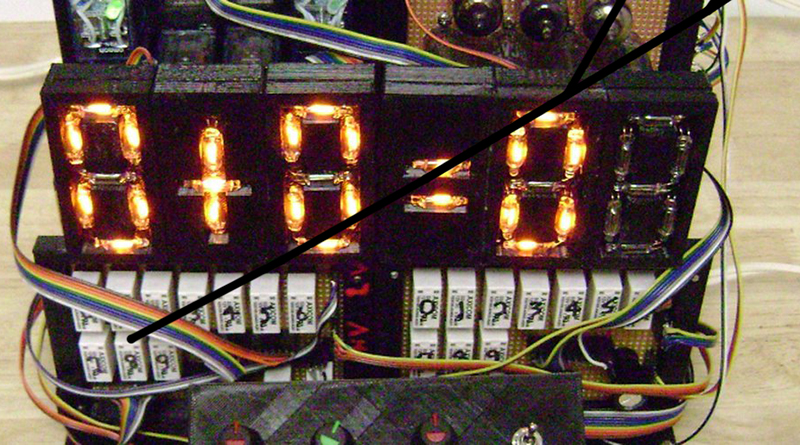
When it comes to vintage displays, everyone gravitates to Nixies. These tubes look great, but you’re dealing with a certain aesthetic with these vintage numeric tubes. There is another option. For his Hackaday Prize entry, [castvee8] is making seven-segment displays out of vintage neon lamps. It looks great, and it’s the basis of an all-vacuum tube calculator.

The core of this build are a few tiny NE-2 neon bulbs. These are the same type of bulbs you’ll find in old indicators, and require somewhere around 100 volts to fire. These bulbs are then installed in a 3D-printed frame, giving [castvee] a real seven-segment display, a plus or minus sign, and an equals sign. It’s the beginnings of a calculator, right there.

One of the recent updates to this project is controlling these displays with modern logic. That might be a bit of a misnomer, because [castvee] is using diode steering and a TTL chip to cycle through the numbers 1 to 4. The actual code to do this is running on a microcontroller, though, so that might get a pass. This is just a test, though, and the real project looks to be an all-vacuum calculator. The project is still in its early stages, but there are still months to go in the Hackaday Prize, and we can’t wait to see what comes out of this project.

Neon Display for a Vacuum Tube Calculator

MSI Chicago Mini Maker Faire on Saturday, March 31st

Tomorrow, Saturday March 31st, at the Museum of Science and Industry in Chicago:

28516108_10155197447202882_4625927599713819985_o

MSI Chicago Mini Maker Faire

On Saturday, March 31 we’re keeping our doors open from 9:30 a.m. to 9 p.m. as we host the MSI Chicago Mini Maker Faire! Join some of the most fascinating, curious people—from engineers and artists, to scientists and crafters—in a celebration of local maker culture. Learn how to become an innovator yourself by speaking one-on-one with makers, and leave inspired and ready to invent.

Look for our Drew Fustini in purple!

MSI Chicago Mini Maker Faire on Saturday, March 31st

Building a Giant USB Three Key Mechanical Keyboard

From Jeremy S. Cook on the Hackster blog:

1_Un7UKnIW5LinAhX8Pbg4DQ

Ginormous 3-Switch Keyboard Is Awesomely Impractical

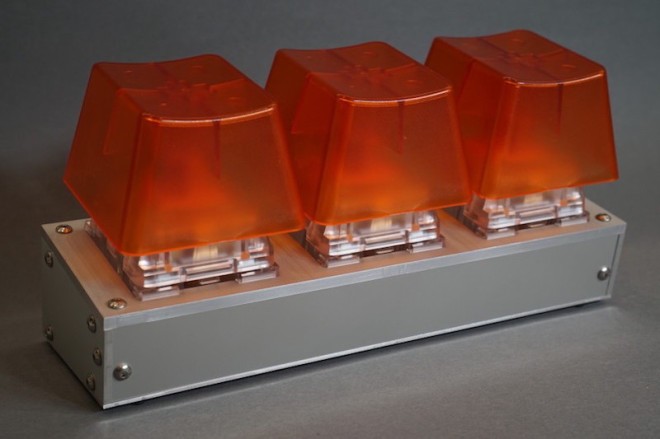
As hackers and creators, we sometimes get asked the question “why?” While many of the gadgets we make do have a specific purpose, many of them definitely don’t, and are made because we wonder if something can actually be done. This giant three-key mechanical keyboard would certainly fall into that second category, and though I can’t think of a practical use for it, I still find the device quite entertaining.

1_nDZswgG0dfI2lgmY9SzFFw

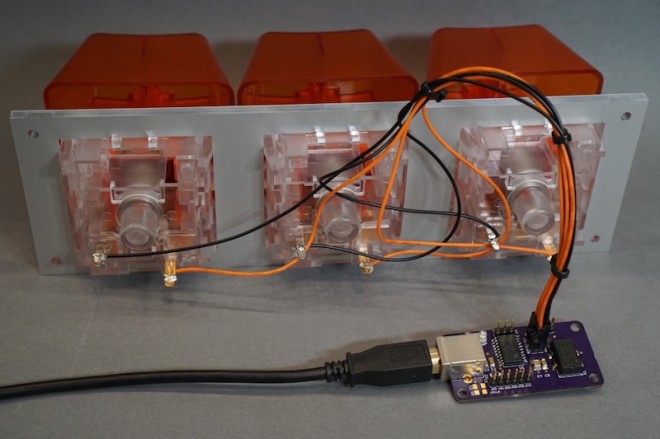
The heart of this device is a trio of “Big Switch” devices from Novel Keys, which are four times larger in length/width/height than what you’re used to typing on. While that might sound only sort of interesting, that translates to 64 times normal size in volume; plus they include similarly ginormous keycaps. Glen Akins, inspired by a similar project on Adafruit, decided to build his own 3-key array, with a PIC18F14K50 chip providing an interface between the keys ans USB input.

DSC00640-1024x683.jpg

The housing is made out of aluminum, and sits at an angle to the user for excellent ergonomics — if you happen to be a giant, and only use three keys at a time. While the electronics are fairly straightforward, these large keys are electrically quite noisy. Debounce code was added to combat this, reducing the letters per keypress from a range of one to three to only a single character.

Read more on Glen’s own Photons, Electrons, and Dirt blog:

Building a Giant USB Three Key Mechanical Keyboard

Building a Giant USB Three Key Mechanical Keyboard