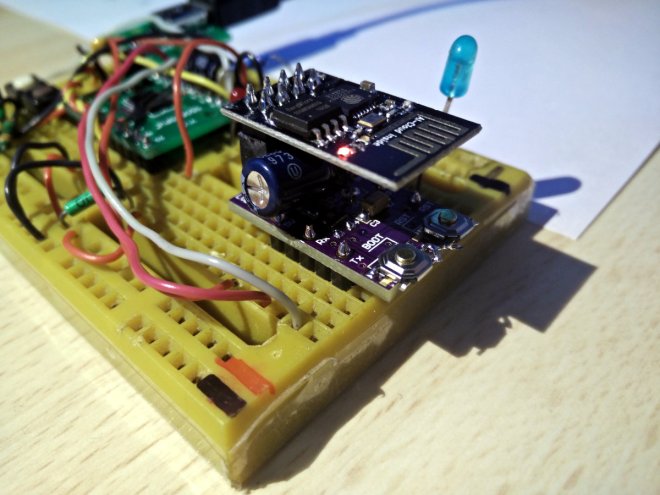
From debug messages to the fundamental ‘hello world’, serial communication does it all over three little wires. Now imagine being able to cut the cord to your next microcontroller project and use your phone as a VT100 terminal. This was the premise of [Ondřej Hruška]’s Wireless Terminal Project where he took an ESP8266 and added an in-browser terminal emulator which can be accessed…
Uncategorized
Hackaday Prize Entry: WiFi ePaper
[Frank Buss] designed an electronic version of a sticky note: a WiFi enabled, solar-powered ePaper, with magnets embedded in the casing. It’s based on the new ESP32, and the idea is that you can update it via your smart-phone or over the internet via a cloud app to show any message you want. Being an…
Dis-Integrated 6502 at Maker Faire
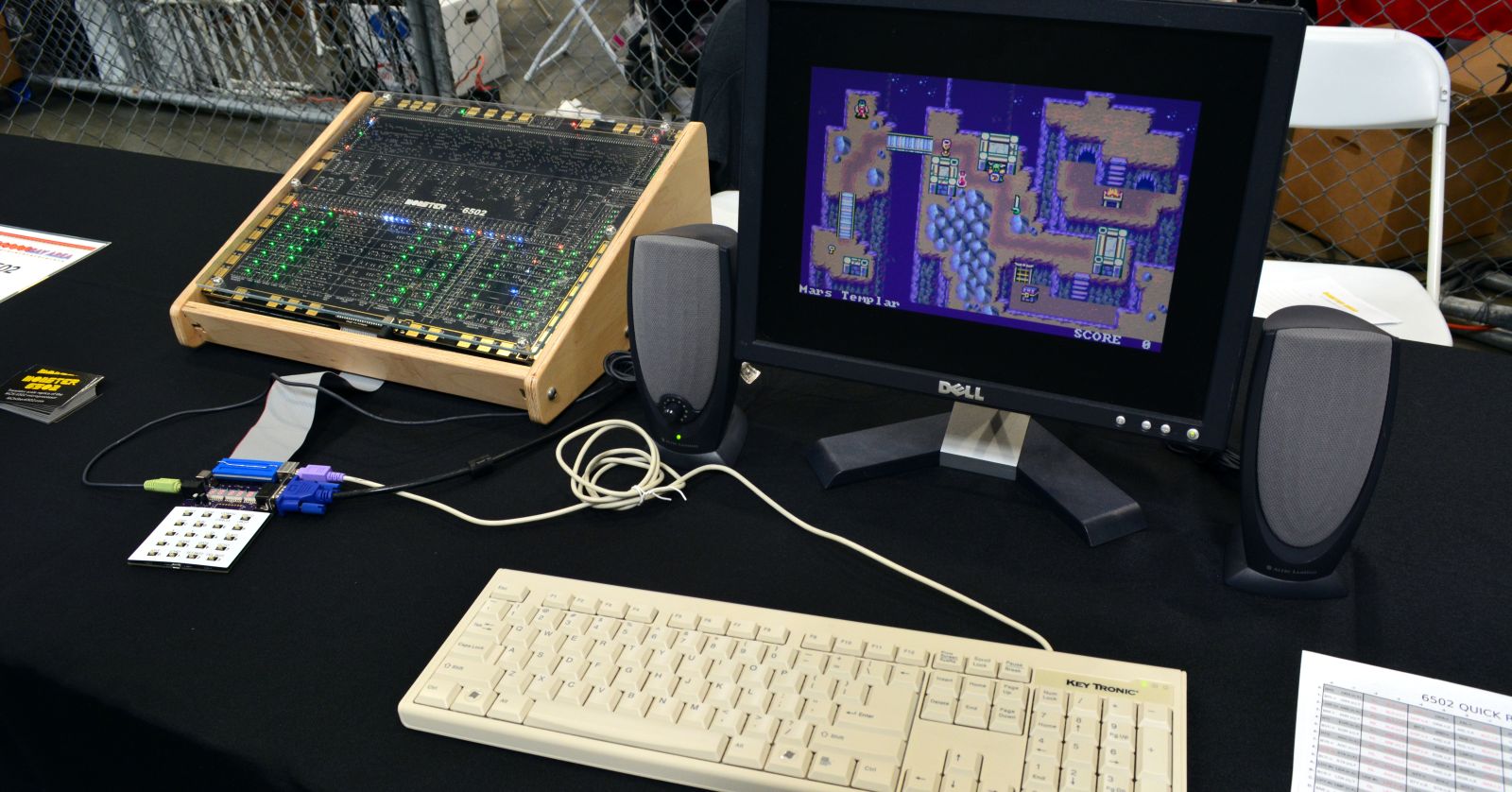
[Eric Schlaepfer] tends to turn up to Maker Faire with projects you simply don’t want to miss. This year is no different. Twelve months ago we delighted in seeing his 6502 processor built from an enormous reel of discrete MOSFETs. At the time it was freshly built and running random code to happily blink the…
via Dis-Integrated 6502 Running Programs; Acting Like Computer — Hackaday
Bring-a-Hack this Sunday!

Join us for #bringahack this Sunday at BJ’s after Maker Faire!
2206 Bridgepointe Pkwy, San Mateo, CA 94404
Sunday, May 21st, 6pm to closing

Hackaday: “A Few of Our Favorite Chips”
Raindrops on roses, and whiskers on kittens? They’re alright, I suppose. But when it comes down to it, I’d probably rather have a bunch of 4051, 4052, and 4053 analog multiplexers on the component shelf. Why? Because the ability to switch analog signals around, routing them at will, under control of a microcontroller is tremendously…
Hackaday: Cheap Helping Hands
We think of helping hands as those little alligator clips on a metal stand. They are cheap and fall over, so we tend to buy them and don’t use them. However, if you are willing to put $35 or $40 into it, you can get the newer kind that have–well–tentacles–on a heavy base. [Archie_slap] didn’t…
3D Printing A Synthesizer

From Brian Benchoff on Hackaday:
3D Printing A Synthesizer
Before there were samplers, romplers, Skrillex, FM synths, and all the other sounds that don’t fit into the trailer for the new Blade Runner movie, electronic music was simple. Voltage controlled oscillators, voltage controlled filters, and CV keyboards ruled the roost. We’ve gone over a lot of voltage controlled synths, but [Tommy] took it to the next level. He designed a small, minimum viable synth based around the VCO in an old 4046 PLL chip
The circuit for this synth is built in two halves. The biggest, and what probably took the most time designing, is the key bed. This is a one-octave keyboard that’s completely 3D printed. We’ve seen something like this before in one of the projects from the SupplyFrame Design Lab residents, though while that keyboard worked it was necessary for [Tim], the creator of that project, to find a company that could make custom key beds for him.
Read more on the F0 on Tommy’s blog:
Hello, F0
Hackaday Prize Entry: Secure Storage on SD Cards
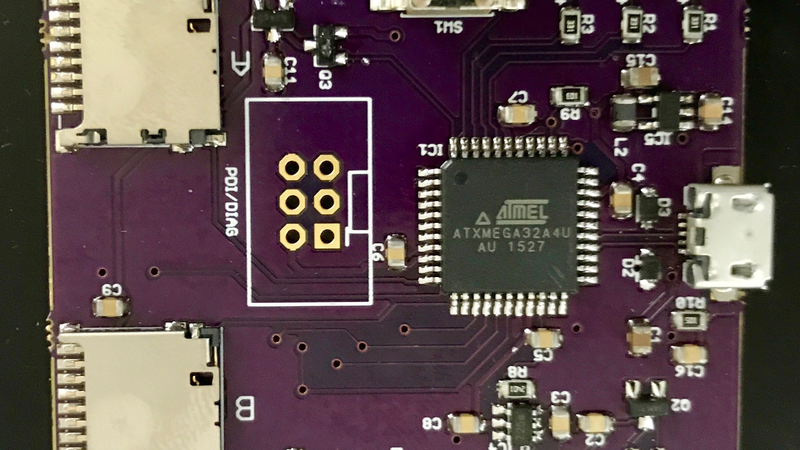
Here’s a puzzler for you: how do you securely send data from one airgapped computer to another? Sending it over a network is right out, because that’s the entire point of an airgap. A sneakernet is inherently insecure, and you shouldn’t overestimate the security of a station wagon filled with tapes. For his Hackaday Prize…
via Hackaday Prize Entry: Secure Storage on SD Cards — Hackaday
Retro CPC Dongle – Part 22
From the Intelligent Toasters blog:
Retro CPC Dongle – Part 22
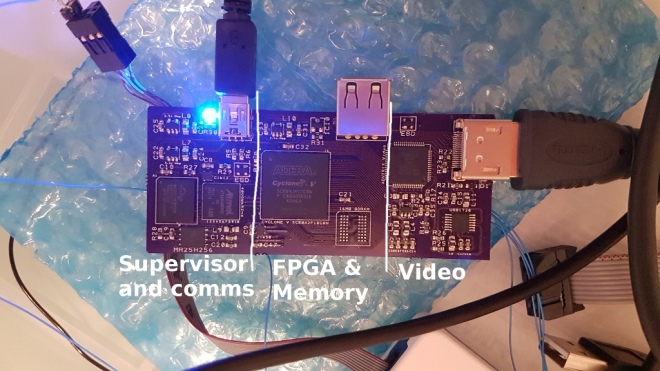
The screen shot below says it all. Yay! Video output from the CPC2.0! I promised myself that I wouldn’t post those shaky photos/videos that people seem to post of their game/emulator/screen. Unfortunately, at this time a photo of the screen is the best I can do. Longer term, I’ll get a HDMI capture card from eBay […]
Mesh networking for sensor grids
Mesh networking board by Daniel on Hackaday.io:
Low-power mesh networking for small sensor grids
Tiny MQTT-interoperable broadcast mesh networking with simple radios
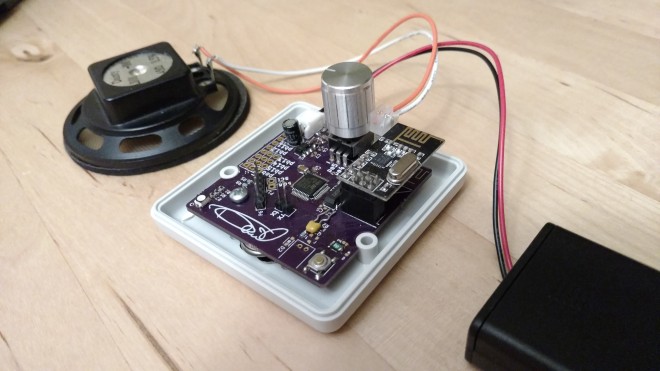
This project is a low-resource mesh networking stack and mote with battery-powered routers based on state synchronization. The target is for the stack to use less than 2kb SRAM. Nodes use low power listening and an adaptive gossip protocol to synchronize key/values pairs with each other without relying on explicit routing or per-node addressing.
For example, a light might transmit (/lamp, {“state”:”on”}) to the mesh. Write (/lamp, {“state”:”off”}) to the mesh, and the lamp application will notice. The powerful but simple state synchronization primitive allows you to update the state of the mesh to update the world, and update the state of the world to express the same on the mesh. Trivially bridged to a private MQTT server and managed with off-the-shelf MQTT applications.
The design files and source code are available on Bitbucket: