We think of helping hands as those little alligator clips on a metal stand. They are cheap and fall over, so we tend to buy them and don’t use them. However, if you are willing to put $35 or $40 into it, you can get the newer kind that have–well–tentacles–on a heavy base. [Archie_slap] didn’t…
Author: fustini
3D Printing A Synthesizer

From Brian Benchoff on Hackaday:
3D Printing A Synthesizer
Before there were samplers, romplers, Skrillex, FM synths, and all the other sounds that don’t fit into the trailer for the new Blade Runner movie, electronic music was simple. Voltage controlled oscillators, voltage controlled filters, and CV keyboards ruled the roost. We’ve gone over a lot of voltage controlled synths, but [Tommy] took it to the next level. He designed a small, minimum viable synth based around the VCO in an old 4046 PLL chip
The circuit for this synth is built in two halves. The biggest, and what probably took the most time designing, is the key bed. This is a one-octave keyboard that’s completely 3D printed. We’ve seen something like this before in one of the projects from the SupplyFrame Design Lab residents, though while that keyboard worked it was necessary for [Tim], the creator of that project, to find a company that could make custom key beds for him.
Read more on the F0 on Tommy’s blog:
Hello, F0
SupplyFrame Hardware Developers meetup before Maker Faire
We’re excited that there will be a SupplyFrame Hardware Developers meetup next Thursday before Maker Faire Bay Area weekend:
https://www.meetup.com/Hardware-Developers-Didactic-Galactic/events/239907140/
Hackaday+Tindie Maker Faire Meetup
We had a great time last year and recommend folks at Maker Faire Bay Area 2017 come to this Saturday night meetup hosted by Hackaday and Tindie:
It’s Maker Faire Bay Area time of year again and we’re holding our 4th annual Hackaday and Tindie MFBA Meetup!
After a ridiculously fun Saturday at Maker Faire, carry on the festivities with us at O’Neill’s in San Mateo on Saturday night from 7pm.
Bring your finest blinky, flashy, IoT, hacks, wearables, or other techy items for us to paw. Bonus points if you bring your #HackadayPrize project for us to get super excited about.
We can’t wait to see you there or at the faire.
Space is limited, so get your foot in the door early. 21 or over only. Please bring ID.
Hackaday Prize Entry: Secure Storage on SD Cards
Here’s a puzzler for you: how do you securely send data from one airgapped computer to another? Sending it over a network is right out, because that’s the entire point of an airgap. A sneakernet is inherently insecure, and you shouldn’t overestimate the security of a station wagon filled with tapes. For his Hackaday Prize…
via Hackaday Prize Entry: Secure Storage on SD Cards — Hackaday
Retro CPC Dongle – Part 22
From the Intelligent Toasters blog:
Retro CPC Dongle – Part 22
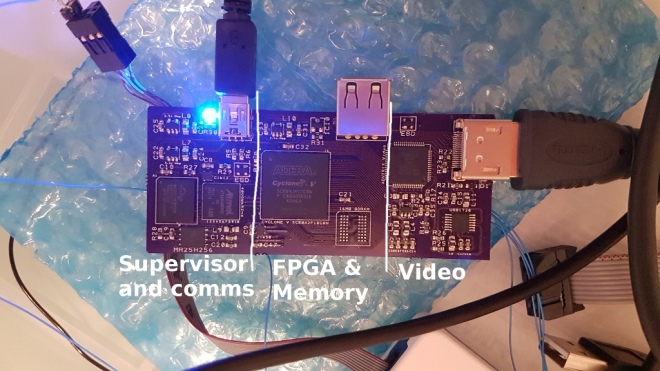
The screen shot below says it all. Yay! Video output from the CPC2.0! I promised myself that I wouldn’t post those shaky photos/videos that people seem to post of their game/emulator/screen. Unfortunately, at this time a photo of the screen is the best I can do. Longer term, I’ll get a HDMI capture card from eBay […]
Mesh networking for sensor grids
Mesh networking board by Daniel on Hackaday.io:
Low-power mesh networking for small sensor grids
Tiny MQTT-interoperable broadcast mesh networking with simple radios
This project is a low-resource mesh networking stack and mote with battery-powered routers based on state synchronization. The target is for the stack to use less than 2kb SRAM. Nodes use low power listening and an adaptive gossip protocol to synchronize key/values pairs with each other without relying on explicit routing or per-node addressing.
For example, a light might transmit (/lamp, {“state”:”on”}) to the mesh. Write (/lamp, {“state”:”off”}) to the mesh, and the lamp application will notice. The powerful but simple state synchronization primitive allows you to update the state of the mesh to update the world, and update the state of the world to express the same on the mesh. Trivially bridged to a private MQTT server and managed with off-the-shelf MQTT applications.
The design files and source code are available on Bitbucket:
dholth/mesh
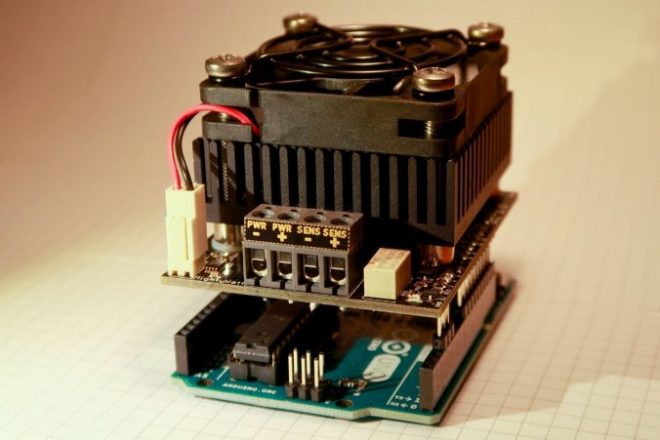
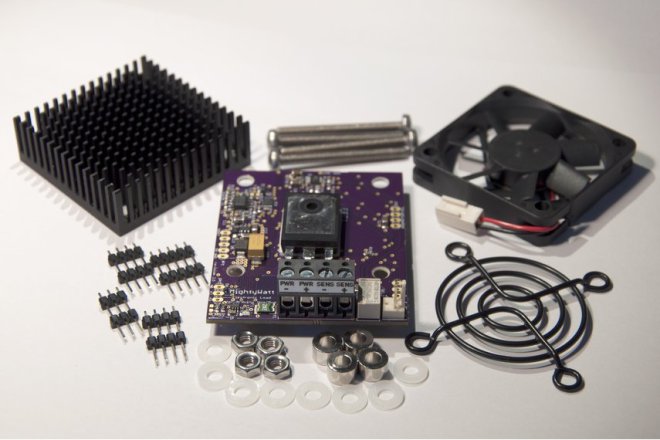
Tindie Seller Interview: Jakub Polonský and His “MightyWatt” Load
Jakub Polonský and His “MightyWatt” Load
There are people of diverse backgrounds selling on Tindie, but as far as I know, Jakub Polonský is the only one here with a PhD in electrochemistry. Though this gave him a good background in testing of electronic quantities for electrochemical systems, as far as designing electronics, he’s self taught. He graduated in 2012, but started with Arduino boards in 2010, allowing him to use this versatile tool for research purposes.
Check out our previous blog post for more information on the project:
The MightyWatt: a 70W Electronic Load Kit
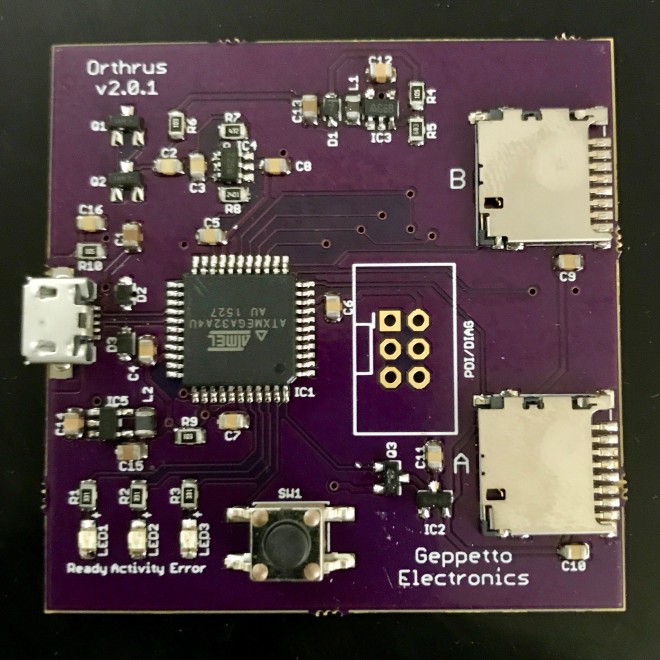
Orthrus: secure two-card storage
From Nick Sayer on Hackaday.io:
Orthrus: SD card secure RAID USB storage
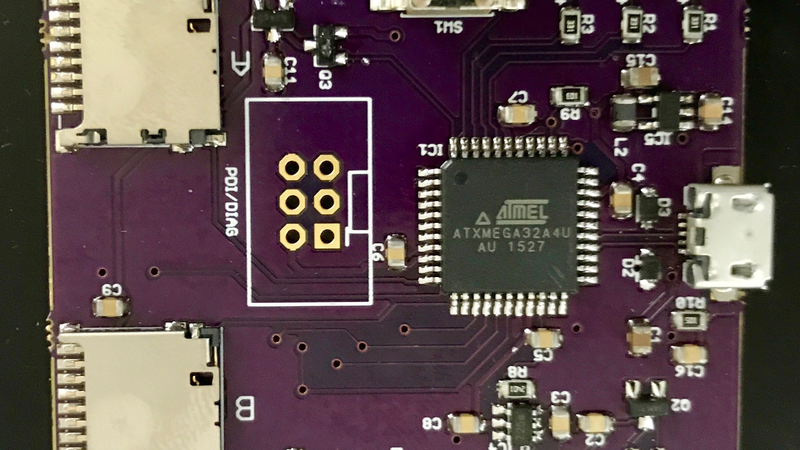
This allows you to securely transport a data set by writing it onto a pair of cards and separately transporting them to a destination for recombination.
The intent is that only the pairing of two cards becomes in any way special. A card pair could be inserted in any Orthrus device and the data would be made available. But with only one card, all you get is half of the data encrypted with a key which you only half-possess.
The firmware source code is available on GitHub:
nsayer/Orthrus

The assembled board is available on Tindie:
DIY LED Tweezers
Surface mount diodes are simple enough — all you need to do is make sure you have the anode and cathode in the right order when you place them on the pad when you solder them. These SMD diodes come in industry-standard packages, but do you think there’s an industry-standard way of marking the cathode?…